
Will Splinted Teeth Look Natural?
Stabilizing Shifting Teeth with Splinted Crowns: Achieving Natural Appearance and Function
Case study by Dr. Gerald Marlin at Elite Prosthetic Dentistry in Friendship Heights, DC
Many patients come to us because their teeth are shifting and becoming unstable due to tongue thrust habits, sleep apnea devices, severe grinding, or other forces that push against their dentition. These forces can cause their teeth to move out of alignment, creating functional problems and aesthetic concerns. When patients learn that their treatment will involve splinting their front teeth together with crowns, they frequently express a valid concern: will the teeth look natural, or will they appear obviously connected?
This is an excellent question that deserves a thorough answer. The short answer is: yes, splinted teeth can look completely natural. With careful prosthodontic planning and expert crown design, splinted crowns maintain individual character while providing the necessary stability to prevent further shifting. Let me explain through a clinical case.
Understanding Tooth Splinting
Tooth splinting is a well-established prosthodontic technique where two or more teeth are connected together with a rigid restoration, typically multiple crowns that are fused together at the base or along their contact surfaces. The splinting prevents individual tooth movement while maintaining normal functional forces.
Splinting is indicated when teeth are unstable due to:
- Tongue thrust, a habit where the tongue pushes forcefully against the teeth, particularly the front teeth. Strong tongue thrust can gradually push teeth forward, opening the bite and creating malocclusion.
- Sleep apnea devices like mandibular advancement devices that apply constant forward pressure on the lower front teeth.
- Severe grinding or clenching (bruxism) that destabilizes teeth, particularly when combined with periodontal disease.
- Traumatic injury that damages the periodontal support structure.
- Advanced periodontal disease where bone loss has compromised individual tooth stability.
In these situations, individual teeth cannot maintain their position against the forces acting upon them. Splinting stabilizes the entire group, distributing forces across multiple teeth and allowing the periodontal structures to heal and stabilize.
The Case: A Shifting Bite
Our patient presented with significant concern about her changing bite. She had noticed her upper front teeth progressively moving forward and her bite becoming increasingly open. She described the sensation that her bite was “shifting” with each passing month. Her dentist recognized the signs of tongue thrust and recommended orthodontic correction followed by splinting to prevent recurrence.
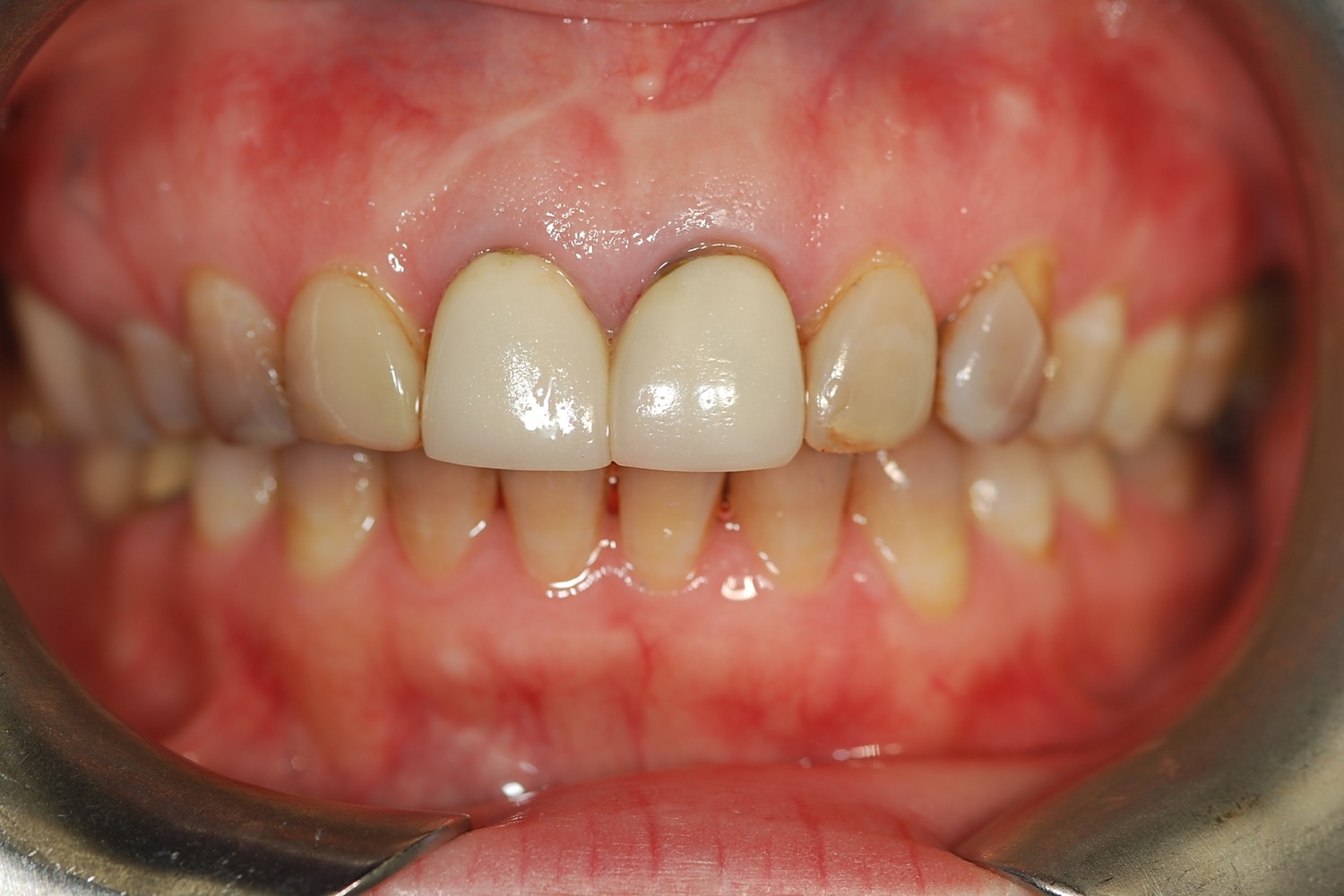
Initial Assessment (Figs. 1, 2)
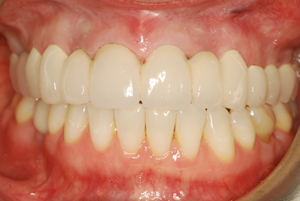
Fig. 1: Strong Tongue Thrust Causing Crowned Teeth to Flare
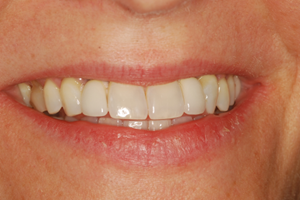
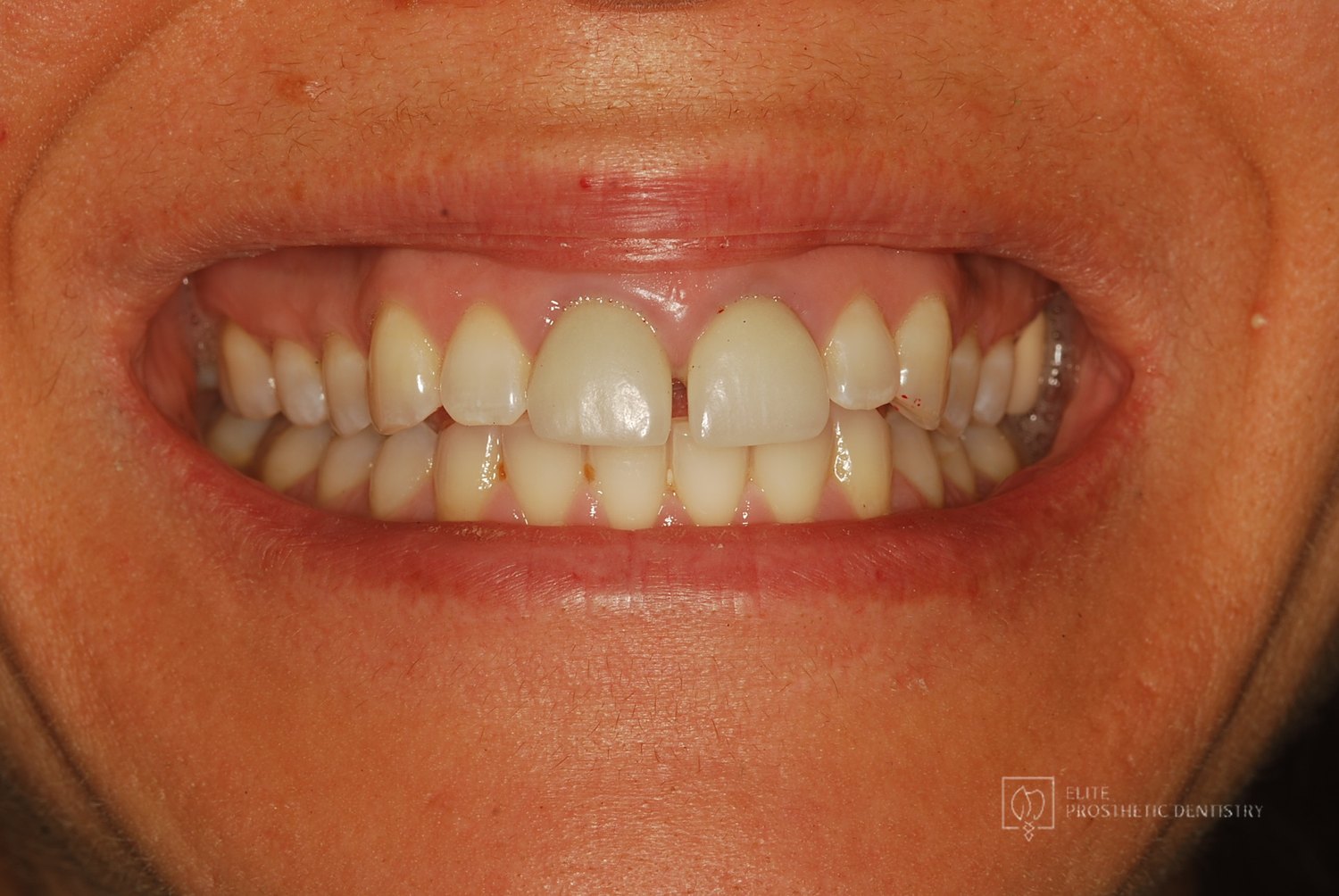
Fig. 2: Front Teeth Unstable and Shifting Out of Alignment
The initial photographs showed classic signs of tongue thrust causing anterior flaring. Her upper front teeth were tipped facially (toward the front), her bite was opening, and her occlusal plane was becoming canted. The force driving this was consistent anterior tongue thrust during function and sleep. Without intervention, this would have progressively worsened.
Orthodontic Correction
The first phase of treatment involved orthodontic correction to pull the teeth back into proper alignment and close the anterior bite opening. An orthodontist worked to position the teeth in optimal alignment, correcting the flaring and re-establishing a proper overbite and overjet. This phase typically takes several months and requires patient compliance with the orthodontic appliance.
Temporary Stabilization
Following orthodontic completion, temporary splinted crowns were placed to stabilize the teeth while the periodontal tissues underwent healing and remodeling. This temporary phase allowed Dr. Marlin to verify that the corrected position was stable and that the patient could tolerate the splinted restoration.
The Final Restoration: Natural-Looking Splinted Crowns
The permanent splinted crowns were then designed and fabricated. This is where the art and science of prosthodontics becomes critical. A skilled prosthodontist can create crowns that are connected at the base or internally, maintaining the appearance of individual teeth while providing the rigid connection needed for stability.
Design Principles for Natural Appearance
The key to maintaining natural appearance in splinted crowns involves several design considerations:
- Individual contours for each tooth. Even though the crowns are connected, each crown is contoured to replicate the natural anatomy of that specific tooth, with appropriate ridges, developmental grooves, and surface characteristics.
- Varied shade and translucency. Rather than creating crowns with identical appearance, the prosthodontist varies the shade, texture, and light transmission to create a natural-looking gradation across the splinted group.
- Appropriate morphology for each tooth. The central incisors should appear as central incisors, the lateral incisors as laterals, with appropriate size relationships and contours for each tooth.
- Proper contact areas and embrasures. The spaces between the teeth (embrasures) and the points of contact between adjacent teeth are carefully designed to mimic natural anatomy.
- Natural incisal surfaces. The biting edges are contoured with appropriate thickness, curvature, and slight irregularities that give the appearance of natural wear rather than artificial uniformity.
Advanced Materials and Techniques
Modern prosthodontic materials make natural-looking splinted crowns possible in ways that weren’t possible with older ceramic technologies. Zirconia crowns with ceramic veneering, pressed ceramics, and newer lithium disilicate materials allow for precise shade matching, proper translucency, and excellent aesthetic control.
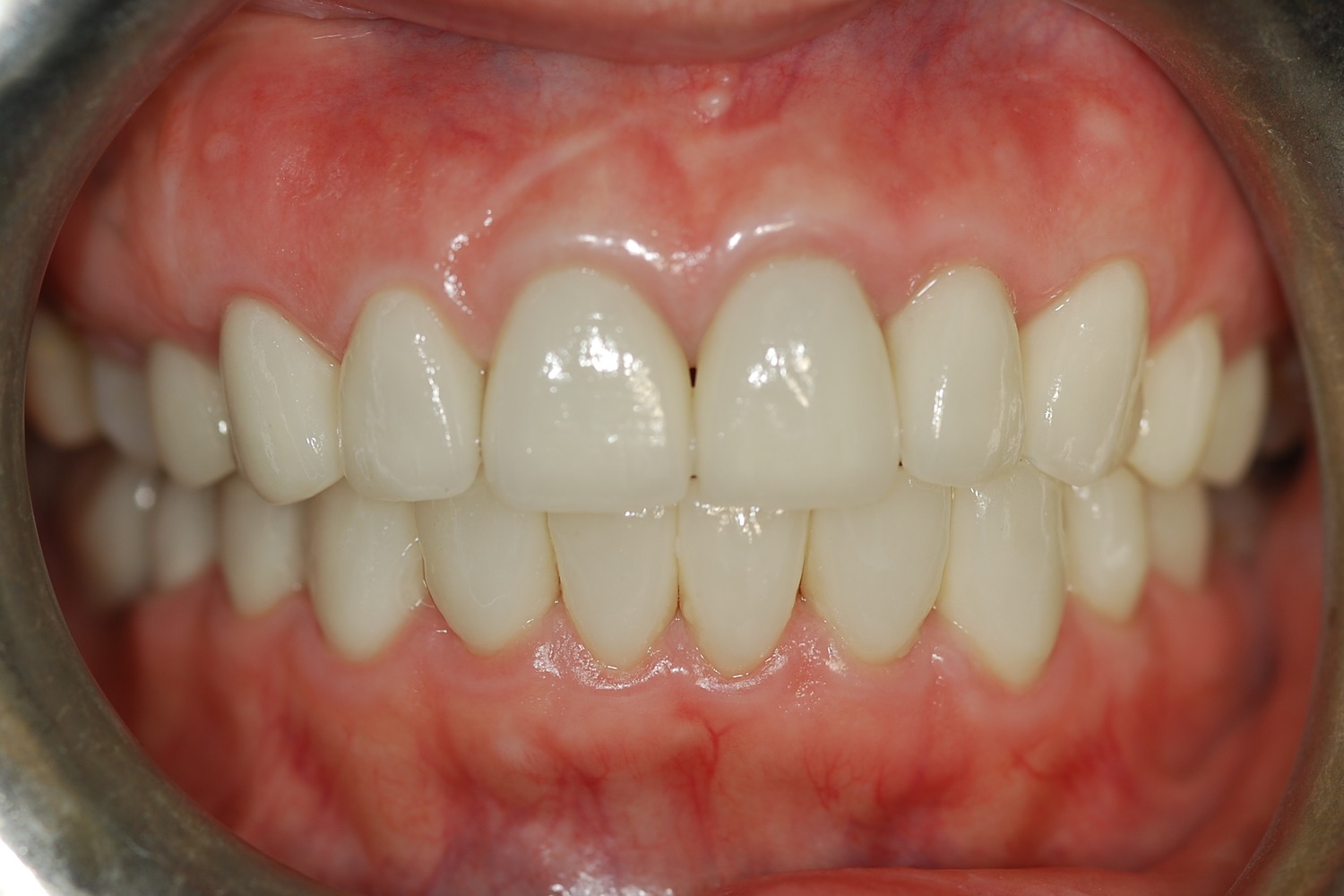
The Result (Figs. 3, 4)
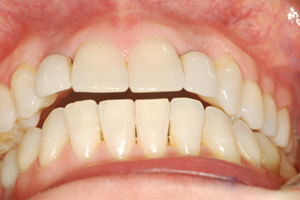
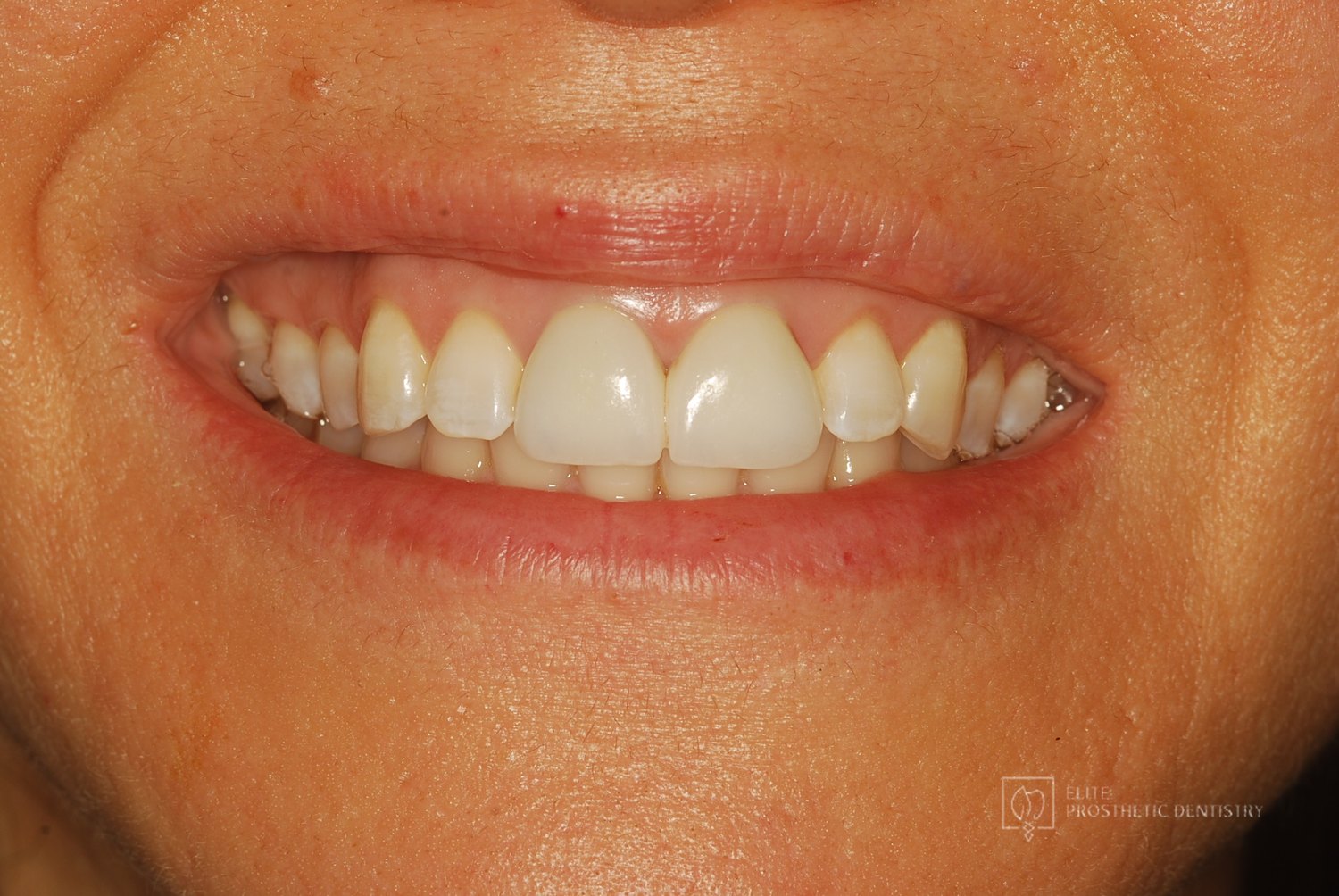
Fig. 3: New Splinted Crowns Holding Teeth in Place

Fig. 4: Radiant Smile with Permanent Splinted Crowns
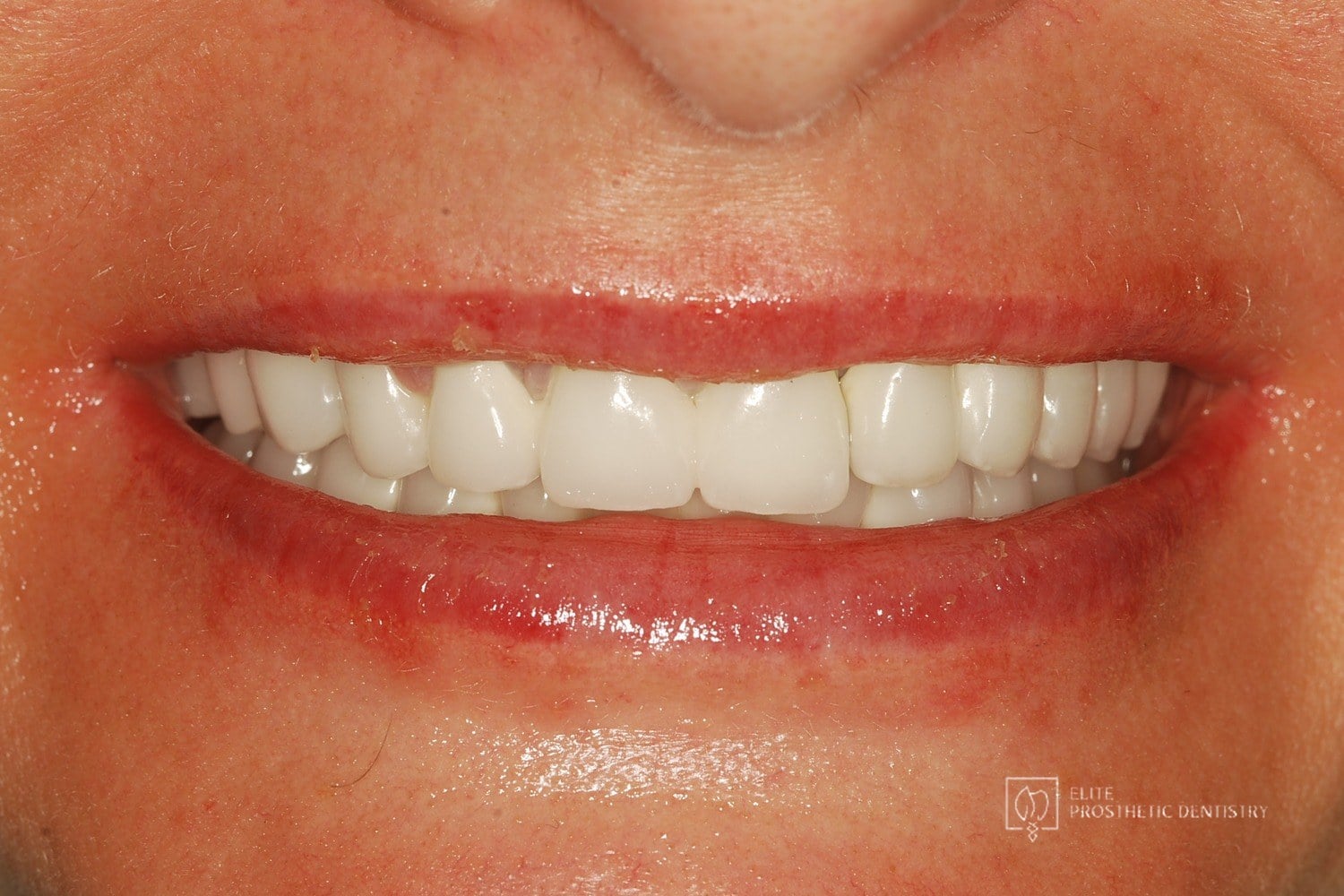
The photographs show the transformation from unstable, flaring teeth to a stable, aligned, and naturally appearing smile. The teeth are connected where they need to be for stability, but to the casual observer, they appear as individual teeth. The connection is not visible. The smile is radiant and natural.
Our patient was able to maintain her corrected bite position without worrying that tongue thrust would re-flare her teeth. The splinted crowns served their functional purpose while maintaining the natural aesthetic that was so important to her.
Why This Matters: Stability Plus Aesthetics
One of the common misconceptions patients have about splinting is that teeth have to look “connected” or artificial. This simply isn’t true. A skilled prosthodontist can create splinted crowns that are functionally rigidly connected while appearing completely natural to any observer, including dental professionals.
The functional benefit of splinting (stability, prevention of further movement, resistance to tongue thrust and bruxism forces) is combined with the aesthetic benefit of crowns that look like natural teeth. This is the hallmark of excellent prosthodontic treatment.
When Splinting Is the Right Choice
If you have teeth that are shifting, becoming loose, or unstable, don’t delay seeking evaluation. The longer you wait, the more damage occurs, and the more complex the treatment becomes. Early intervention with orthodontics followed by splinting can completely resolve the problem and prevent serious complications.
If your general dentist has recommended splinting but you’re concerned about aesthetics, request a consultation with a prosthodontist. We can show you examples of our work, discuss design options, and assure you that stable, natural-looking teeth are entirely achievable.
If you have teeth that are shifting or becoming unstable, schedule a consultation with Dr. Marlin to explore your options for achieving a stable, natural-looking smile.
See How We Resolve These Problems
Our patient success stories show real cases and real results. Browse outcomes from a specialist prosthodontist with decades of experience and 3,900+ implants placed.
Key Takeaways
- ✓ Splinted crowns connect two or more teeth into one rigid unit to stop shifting caused by tongue thrust, grinding, sleep apnea appliances, or weakened periodontal support.
- ✓ Properly designed splinted crowns look like individual teeth. The connection is engineered where it cannot be seen.
- ✓ Individual contours, varied shade and translucency, and natural embrasure design are what preserve the illusion of separate teeth.
- ✓ Splinting is often the stabilizing final phase after orthodontic correction, protecting the corrected position permanently.
Frequently Asked Questions
Do splinted crowns look connected?
Not when they are designed well. Each crown in the splint is contoured as an individual tooth, with its own anatomy, shade variation, and translucency, and the rigid connection is placed where observers cannot see it. To the casual eye, and usually even to dental professionals, the teeth read as separate.
Why would teeth need to be splinted?
Splinting is indicated when teeth cannot hold their position on their own: strong tongue thrust habits, forces from sleep apnea appliances, severe grinding or clenching, trauma, or bone loss from periodontal disease. Connecting the teeth distributes those forces across the group.
Can I floss splinted crowns?
Yes, with adapted technique. Because the connected teeth have no open contacts between them, you clean beneath the connectors using floss threaders, interdental brushes, or a water flosser. We demonstrate the routine when the splint is placed.
Is splinting permanent?
The splinted crowns are a long-term fixed restoration, built with the same materials and standards as our individual crowns. As long as the underlying cause, such as tongue thrust, persists, the splint is what maintains the corrected tooth position.
Related Patient Success Stories
Explore similar patient success stories demonstrating our expertise in advanced prosthetic dentistry.
 Before
  After
After How Aging, Failing Dentistry Was Replaced with a Coordinated Full-Mouth Implant and Crown Reconstruction
The patient presented with throbbing upper-molar pain, long-standing infections, multiple root canals and unfinished prior treatment, generalized sensitivity, and several hopeless teeth.
 Before
  After
After How Aging, Opaque Restorations Were Replaced with Customized Ceramic Restorations Designed for Long-Term Natural Esthetics
The existing restorations appeared opaque, worn, and unnatural over time, affecting both confidence and overall smile harmony.
 Before
  After
After Two Front Teeth Saved From Extraction: A Second Opinion, Custom Gold Posts, and Crowns Made to Last
Two upper central incisors with failed root canal treatment and recurrent decay had been recommended for extraction and implant replacement. A CBCT evaluation showed that removing the roots from their thin facial bone housing could create a visible esthetic defect in the gum and bone contour, made worse by the patient's high lip line.
Related Articles
Deepen your knowledge with additional insights on this topic.
 Dental Crowns
 Why Are Some Temporary Crowns More Natural Than Others?
Temporary crowns do not have to look temporary. A DC prosthodontist explains how lab-made provisionals protect your smile and preview your final crowns.
 Dental Crowns
 What Makes a Natural-Looking Crown?
Emergence profile, translucency, internal color, and healthy gum response: a DC prosthodontist explains the anatomy of a crown no one can detect.
 Dental Crowns
 How Is an Immediate Smile Makeover Performed?
An immediate smile makeover transforms your smile in one visit using hand-crafted temporary crowns as a living preview. A DC prosthodontist explains how.