
What Makes a Natural-Looking Crown?
A crown looks natural when it does four things at once: it keeps the surrounding gum tissue pink and healthy, it emerges from the gumline with the correct profile, it matches the patient’s smile line and facial pattern, and it carries proper translucency with internal coloration. Miss any one of the four and the eye notices, even if the observer cannot say why.
In our office, every crown in the front “esthetic zone” is hand-crafted in our in-house laboratory precisely because all four elements have to be controlled together. Here is what each one contributes.
Healthy Gum Response: The Frame Around the Crown
Gum tissue is the frame of every visible restoration, and it reacts honestly to what it touches. A biocompatible crown with a properly sealed margin and correct contours lets the tissue drape naturally and remain pink. An over-bulked, rough-margined, or poorly seated crown produces swollen, red, receding tissue that no amount of ceramic artistry can hide.
This is the “emergence profile” at work: the contour with which the crown rises out of the gum. Get it right and the crown appears to grow from the gumline like a natural tooth. Get it wrong and the tissue itself gives the restoration away.
A Case in Point: Thin Tissue, High Stakes
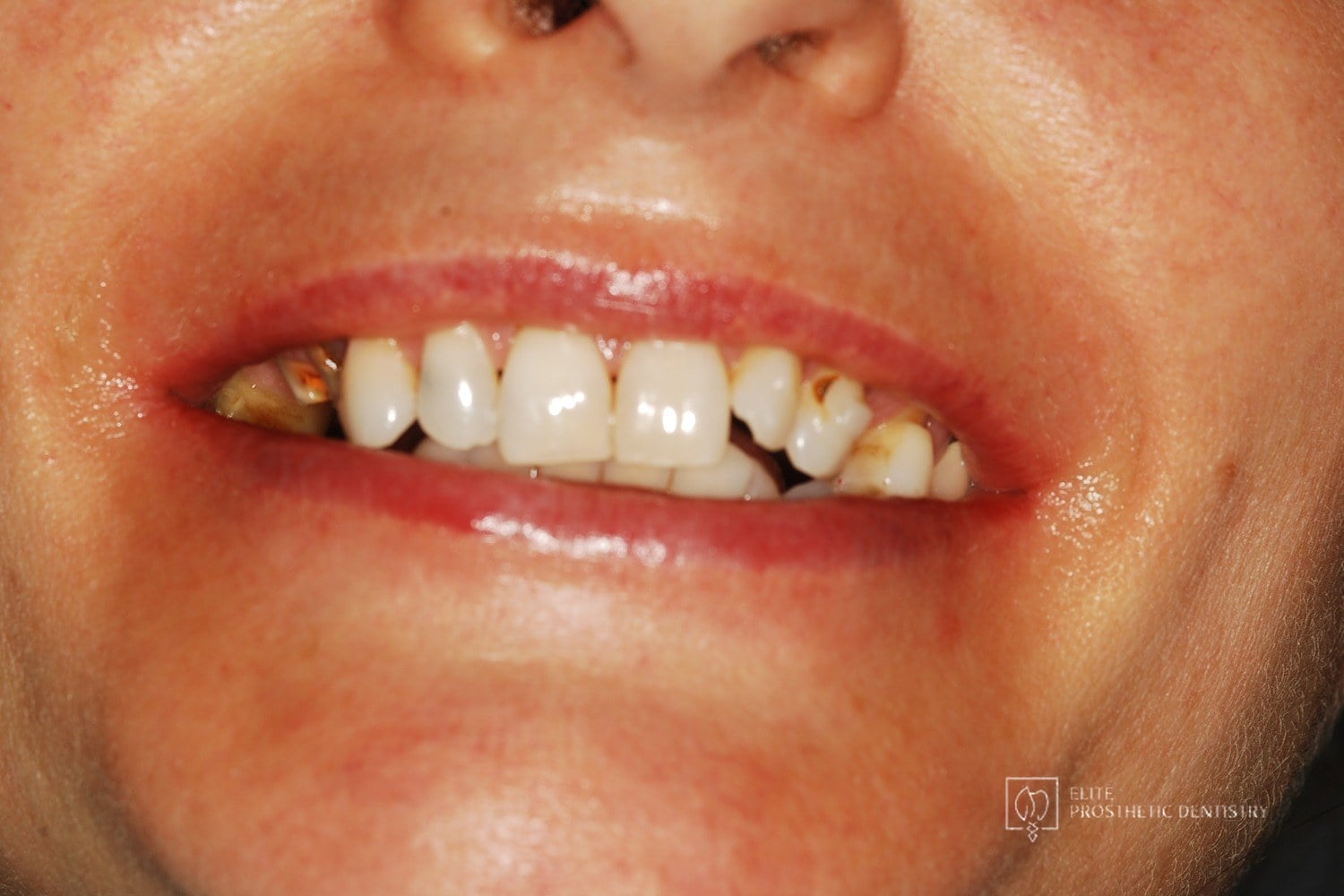
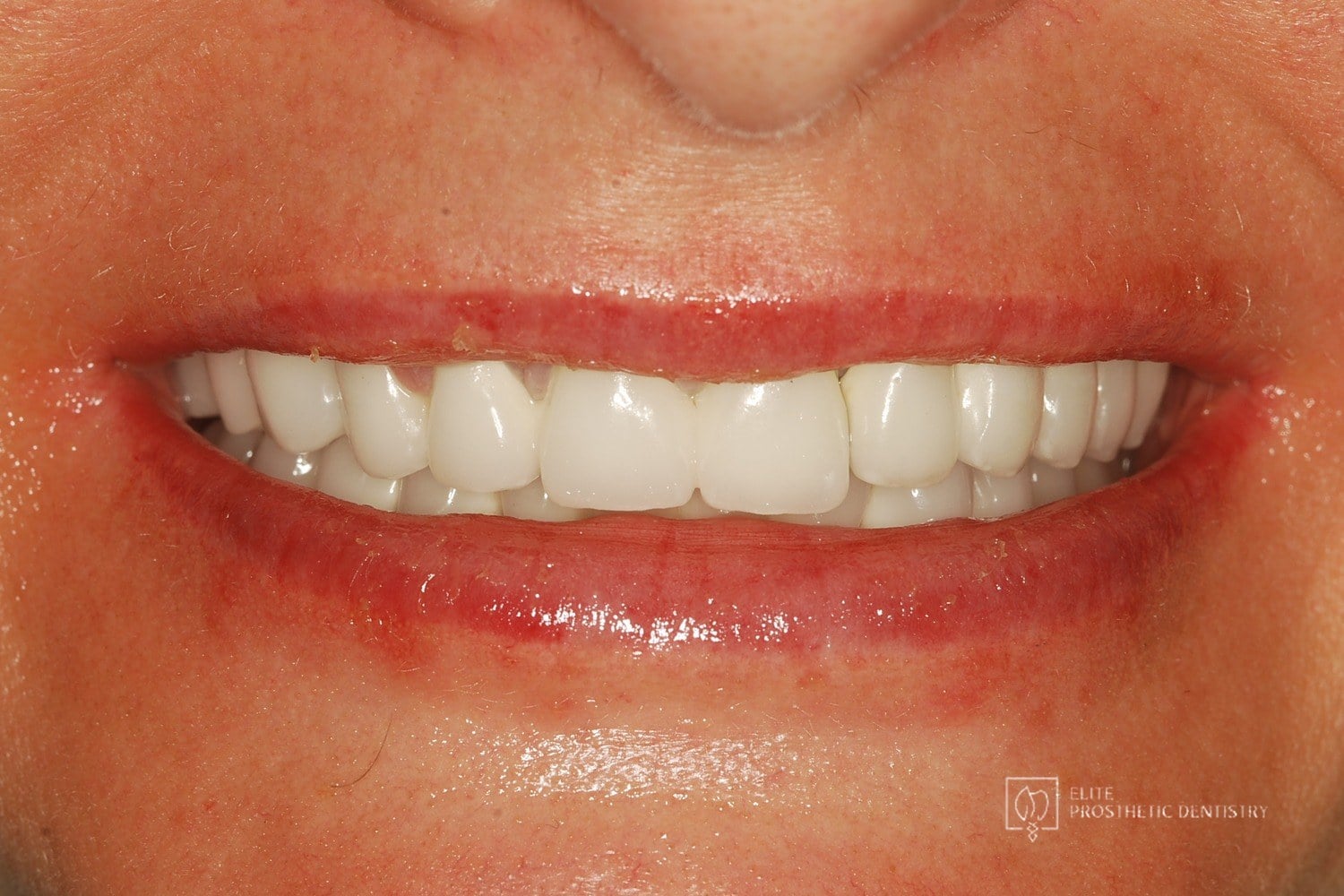
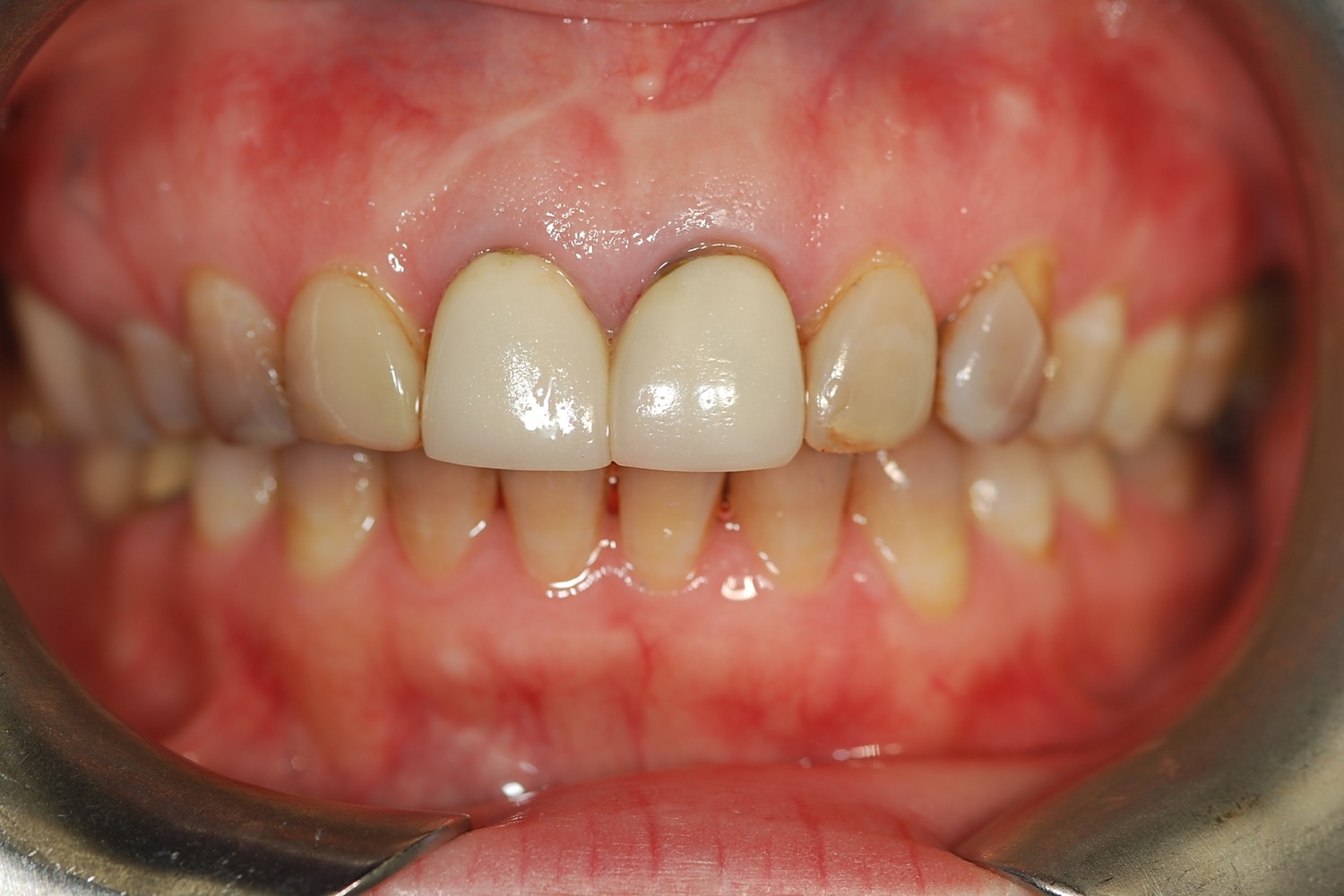
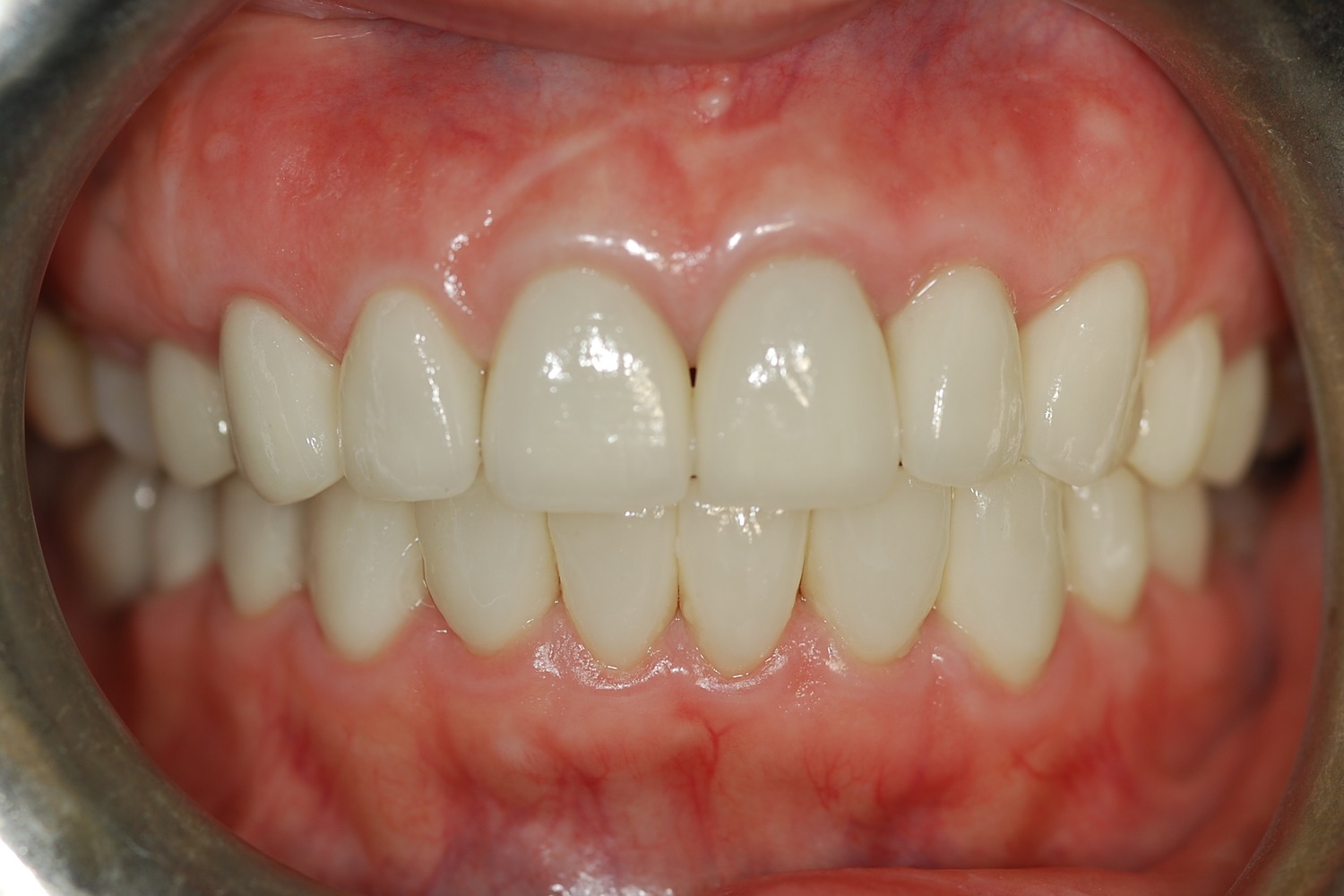
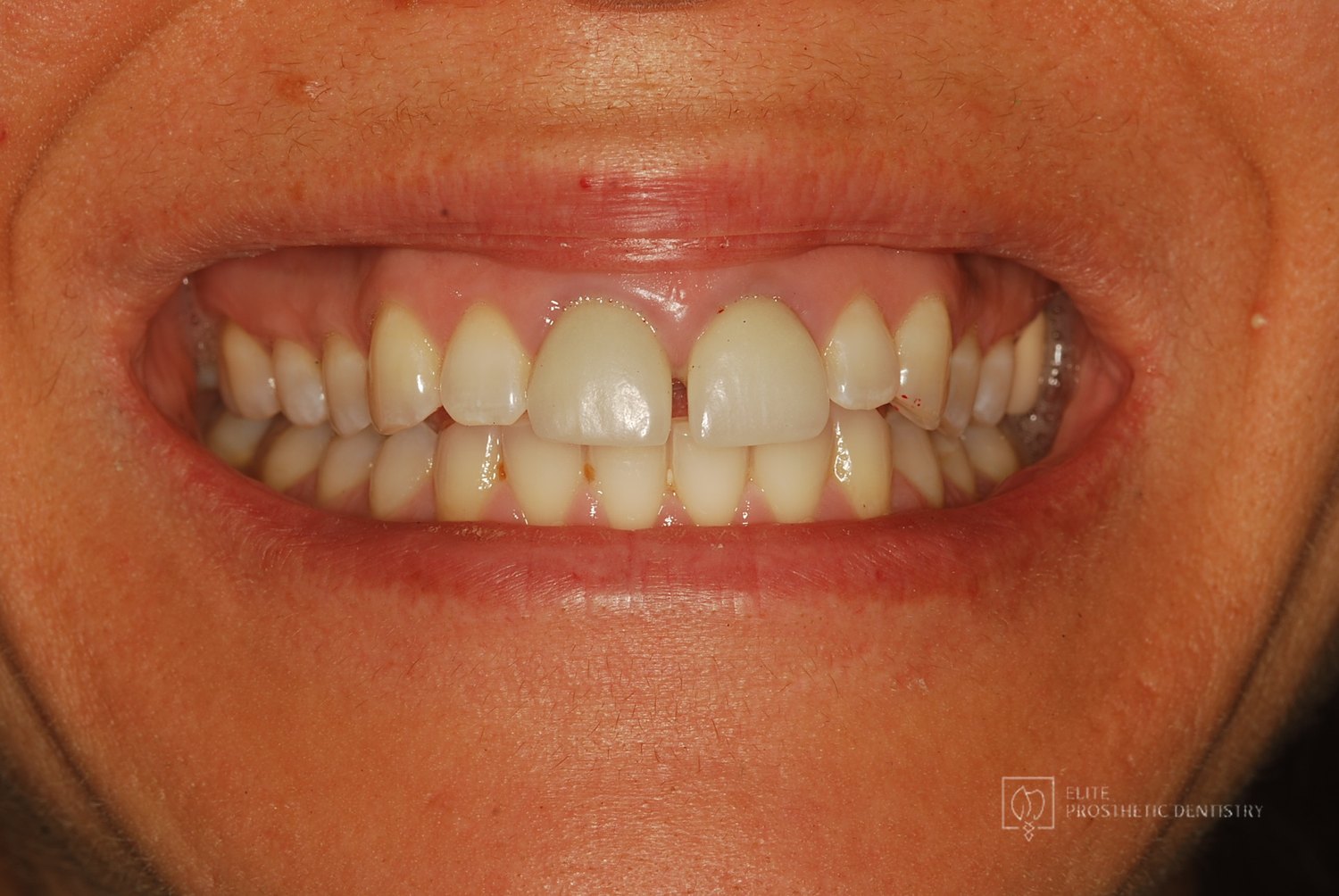
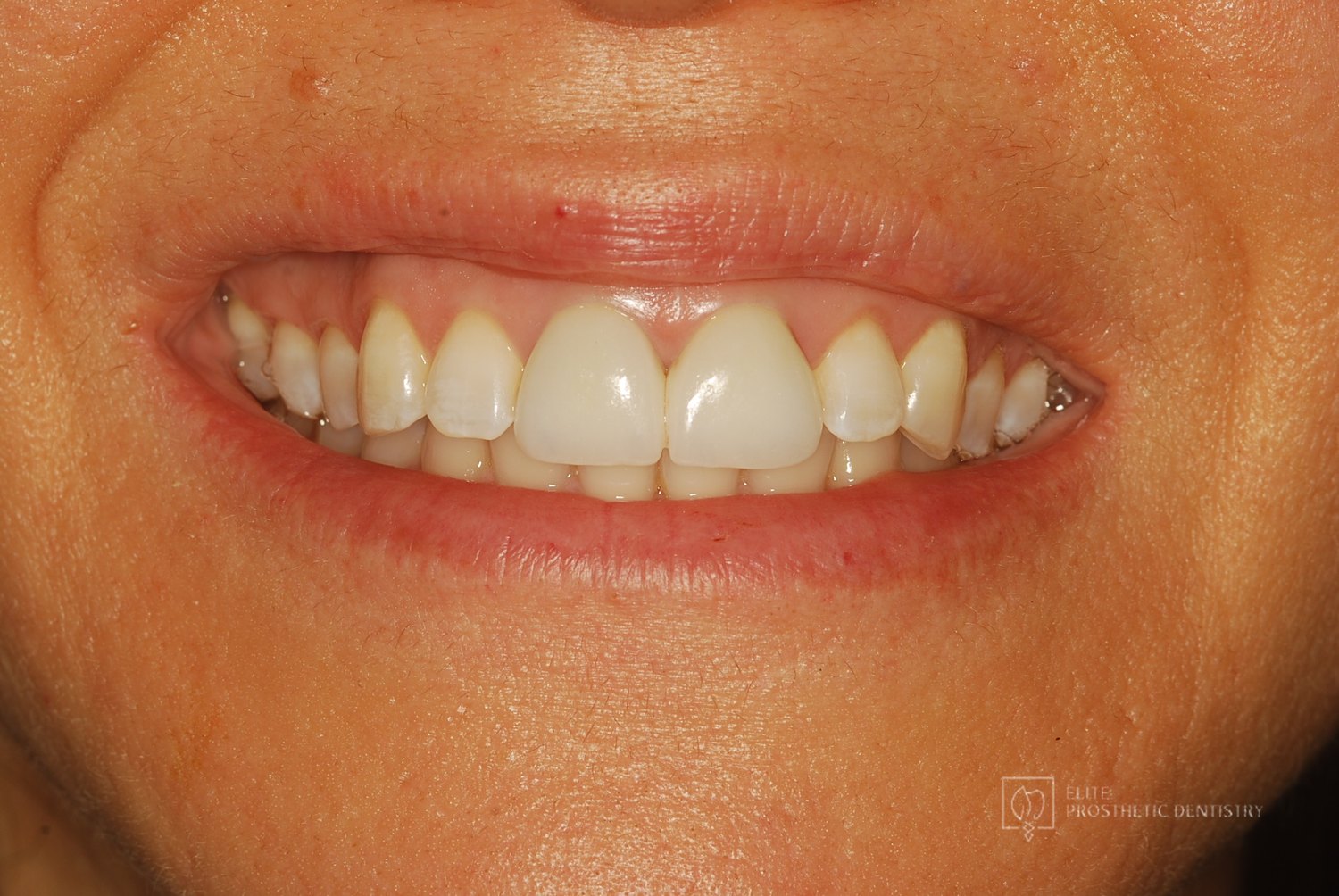
One of our patients came to us unhappy with her smile line. Severely discolored teeth pulled attention away from her eyes and cheekbones (Fig. 1), and her very thin gum tissue raised the difficulty considerably: without a delicate, precisely matched crown design (Fig. 2), thin tissue reads inflamed and the margins show through. Her new crowns were hand-crafted to respect that tissue, and the result blends seamlessly with her natural smile (Figs. 3 through 5).
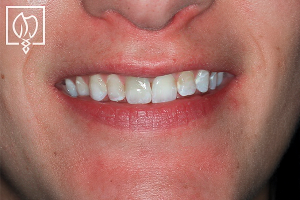
Fig. 1: Severely Mottled Smile Line
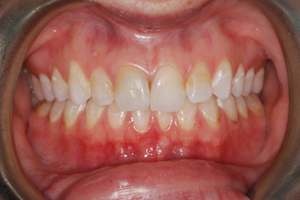
Fig. 2: Very Thin Tissue Requiring Delicate Custom Crowns
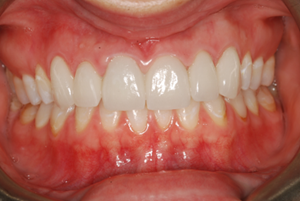
Fig. 3: Crowns Blend with the Thin Gum Tissue
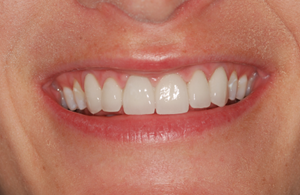
Fig. 4: New Smile Line

Fig. 5: Teeth Blend with Facial Pattern Rather Than Dominating It
Anatomy That Belongs to Your Face
A natural crown is not simply a white tooth. Its length, its line angles, and its position are designed against your lip line, your smile line, and your facial pattern, so the tooth participates in your face rather than competing with it. This is why we evaluate crowns on the patient, chairside, before anything is final. A restoration that flatters a model on a laboratory bench can still sit wrong in a living smile.
Color From the Inside Out
Natural enamel is translucent, and the color of a real tooth comes from layers beneath the surface. Our technician reproduces that structure by building internal coloration through the ceramic at multiple depths, then characterizing the crown chairside against your adjacent teeth. Surface stain on an opaque base cannot imitate this, which is one of the fundamental limits of milled restorations we cover in Part II of Are All Crowns the Same.
The hardest version of this assignment, matching a single upper front tooth so precisely that no one can find it, is the standard by which we judge our laboratory. You can see it done in our single anterior crown case study.
Natural Results, Whether One Crown or a New Smile Line
Some patients need one crown to vanish among natural teeth. Others are replacing older visible crowns that always looked slightly wrong, or rebuilding a smile line that discoloration and wear have aged. Treatment ranges from a single restoration to comprehensive reconstruction depending on your needs, and the aesthetic principles stay identical at every scale.
If you want a crown, or a smile, that reads as unmistakably yours, Dr. Gerald Marlin and our in-house laboratory team have been producing that standard in Washington, DC since 1985. Call 202-244-2101 or book your consultation at our Friendship Heights office.
See How We Resolve These Problems
Our patient success stories show real cases and real results. Browse outcomes from a specialist prosthodontist with decades of experience and 3,900+ implants placed.
Key Takeaways
- ✓ A crown looks natural when four elements align: healthy pink gum response, correct emergence profile, anatomy matched to your smile line, and color built inside the ceramic rather than painted on.
- ✓ The emergence profile, how the crown rises out of the gumline, determines whether tissue stays healthy and pink or turns swollen and red.
- ✓ Translucency and internal coloration let light pass through the crown the way it passes through natural enamel.
- ✓ Thin or delicate gum tissue demands an especially precise, gentle crown design, which is where hand fabrication shows its value.
- ✓ We hand-craft every crown in the front aesthetic zone in our in-house laboratory, refined chairside against the patient's actual smile.
Frequently Asked Questions
What is an emergence profile?
The emergence profile is the contour with which a crown emerges from the gumline, the transition from root surface to visible tooth. When it is correct, gum tissue drapes naturally and stays pink and healthy. When it is over-contoured or under-contoured, tissue becomes inflamed, red, or recedes, and the restoration announces itself.
Why do some crowns look fake even when the shade matches?
Because shade is only one variable. Natural teeth are translucent and carry color in internal layers, so they interact with light dimensionally. A crown with a technically correct surface shade but no internal color structure reads flat and opaque. Anatomy matters too: a generic shape among individual teeth stands out regardless of color.
How long do natural-looking crowns last?
Aesthetics and longevity come from the same discipline: precise fabrication and fit. Crowns hand-crafted and verified in our in-house laboratory have lasted 35 years and longer with proper care. Mainstream patient guidance puts typical crown life at 5 to 15 years.
Will my gums stay healthy around a new crown?
They should. Healthy, pink tissue around a crown is the visible proof of a biocompatible material, a sealed margin, and a correct emergence profile. Persistent redness or swelling around an existing crown is a sign it deserves professional evaluation.
Can a crown be matched to very thin gum tissue?
Yes, but it demands a delicate, precisely contoured design, because thin tissue shows every error underneath it. These are cases where direct collaboration between the prosthodontist and an in-house technician makes the difference.
Related Patient Success Stories
Explore similar patient success stories demonstrating our expertise in advanced prosthetic dentistry.
 Before
  After
After How Aging, Failing Dentistry Was Replaced with a Coordinated Full-Mouth Implant and Crown Reconstruction
The patient presented with throbbing upper-molar pain, long-standing infections, multiple root canals and unfinished prior treatment, generalized sensitivity, and several hopeless teeth.
 Before
  After
After How Aging, Opaque Restorations Were Replaced with Customized Ceramic Restorations Designed for Long-Term Natural Esthetics
The existing restorations appeared opaque, worn, and unnatural over time, affecting both confidence and overall smile harmony.
 Before
  After
After Two Front Teeth Saved From Extraction: A Second Opinion, Custom Gold Posts, and Crowns Made to Last
Two upper central incisors with failed root canal treatment and recurrent decay had been recommended for extraction and implant replacement. A CBCT evaluation showed that removing the roots from their thin facial bone housing could create a visible esthetic defect in the gum and bone contour, made worse by the patient's high lip line.
Related Articles
Deepen your knowledge with additional insights on this topic.
 Dental Crowns
 Why Are Some Temporary Crowns More Natural Than Others?
Temporary crowns do not have to look temporary. A DC prosthodontist explains how lab-made provisionals protect your smile and preview your final crowns.
Dental Crowns What Makes a Natural-Looking Crown?
Emergence profile, translucency, internal color, and healthy gum response: a DC prosthodontist explains the anatomy of a crown no one can detect.
 Dental Crowns
 How Is an Immediate Smile Makeover Performed?
An immediate smile makeover transforms your smile in one visit using hand-crafted temporary crowns as a living preview. A DC prosthodontist explains how.