
All-on-6® Dental Implants in Washington, DC
All-on-6® is the full-arch dental implant protocol that uses six implants per arch to support a fixed, non-removable prosthesis. The additional implants distribute occlusal forces more evenly and provide biomechanical redundancy for long-term stability.
3,900+
Implants Placed
97%+
Success at 20+ Yrs
1985
In-House Lab Since
9
U.S. Patents

Gerald M. Marlin, DMD, MSD
Specialty-Trained Prosthodontist (DMD, MSD)
Washingtonian "Top Dentist" 2026 and Hall of Fame
Why Choose a Specialist for All-on-6
- Planning, surgery, and restoration coordinated under one specialist-led plan. No hand-offs between offices.
- In-house dental laboratory since 1985 fabricates the final prosthesis on-site
- CBCT planning for every implant case to optimize the six-implant distribution
- Customized prosthesis design built around the patient's anatomy and bite forces
- 9 U.S. patents in dental implant restoration methodology
Or call now: (202) 244-2101
How All-on-6® Works
Six implants placed across the arch support a fixed prosthesis. The six-implant design serves three biomechanical purposes that the four-implant equivalent cannot match in every situation.
Broader Load Distribution
Occlusal forces from chewing distributed across six implants instead of four. Per-implant load reduces by 30-40%. Particularly relevant for patients with strong bite forces.
Biomechanical Redundancy
If any single implant develops a long-term issue, the prosthesis can typically continue functioning on the remaining five. More margin than four-implant equivalent.
Prosthesis Design Flexibility
Additional implants allow for a more natural tooth position, less cantilevering, and prosthesis design closer to the original dentition.
The All-on-6 Treatment Process
The treatment timeline mirrors All-on-4. The difference is in the implant count and prosthesis design — not in how long the process takes.
Consultation and CBCT
Clinical exam, CBCT 3D scan, review of medical history. Bone availability across the full arch is assessed to confirm the patient can support six implants.
Digital Treatment Planning
Every implant case at Elite Prosthetic Dentistry, from a single implant through full-mouth reconstruction, is planned on a CBCT (cone beam CT) scan. Implant positions, angulations, and prosthesis design developed digitally. Six implants positioned to maximize stability and minimize cantilevering.
Surgical Placement
Six implants placed in a single visit under local anesthesia with sedation options. A fixed temporary prosthesis is provided during the healing phase.
Final Restoration
After 3 to 6 months of osseointegration, the final prosthesis is designed and fabricated in the in-house lab. Material options reviewed during planning.
Why Specialist Training Matters for All-on-6
All-on-6 is unforgiving of planning errors. Implant position, angulation, and the relationship between implants and the final prosthesis design must be planned together, not sequentially.
-
Integrated Planning, Not Sequential
Specialist prosthodontic training is structured around planning surgical placement and prosthetic design together. Most cases are designed for the prosthesis, not the prosthesis fitted to placed implants.
-
One Plan, All Phases
Every All-on-6 case is planned from the final restoration backward, with placement and restoration coordinated inside the practice. No hand-offs between offices at any phase.
-
In-House Master Ceramist
The final prosthesis is fabricated on-site, with the master ceramist working directly with the clinician throughout. No commercial-lab lag.
-
9 U.S. Patents in Implant Restoration
Depth of research that informs how high-investment full-arch cases are engineered for long-term stability.

Who Is a Candidate for All-on-6?
All-on-6 is typically the right protocol when bone density allows and biomechanical redundancy is the priority. Specific situations where it tends to be the better choice over All-on-4:
Adequate Bone Across the Full Arch
Six implants require sufficient bone in the anterior and posterior regions. Patients with this profile are excellent candidates.
High Bite Forces or Bruxism
Patients with strong bite forces or clenching habits benefit from the broader load distribution that six implants provide.
Larger Arches
Wider dental arches benefit from the additional implant support, reducing cantilever effects on the final prosthesis.
Long-Term Stability Priority
Patients prioritizing maximum long-term predictability over the minimum-implant approach often choose All-on-6 when bone allows.
All-on-6 Material Choices for the Final Prosthesis
The All-on-6 design supports a wider range of final prosthesis materials than All-on-4 because the additional implants reduce the load on any single point. The most common options are:
- Monolithic zirconia. Highest strength, longest expected longevity, most resistant to wear. Higher cost. Reviewed in detail on the zirconia vs. acrylic page.
- Acrylic-hybrid. Titanium framework with acrylic teeth and gums. More forgiving, easier to repair, lighter weight. Lower cost. Best for patients prioritizing repairability and short-term comfort.
- Porcelain-fused-to-metal hybrid. Used in selected cases. Generally not first choice for full-arch hybrid prosthesis.
Material selection is made during the planning phase based on bite forces, aesthetic preferences, longevity expectations, and budget.
All-on-6 in the DMV Market
For patients comparing All-on-6 treatment options across the Washington DC metro area, the meaningful distinctions are not the procedure name. The differences are the planning model, how surgical and restorative care are integrated, the lab relationship, and the case complexity the practice routinely handles. A more detailed comparison of specialist, corporate, and general-dentist implant models is available on the main dental implants page.
Ready to Discuss Your Treatment Options With a Specialist?
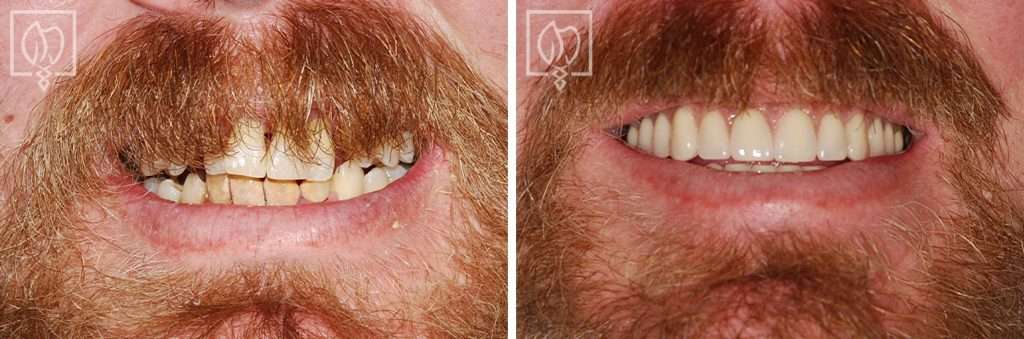
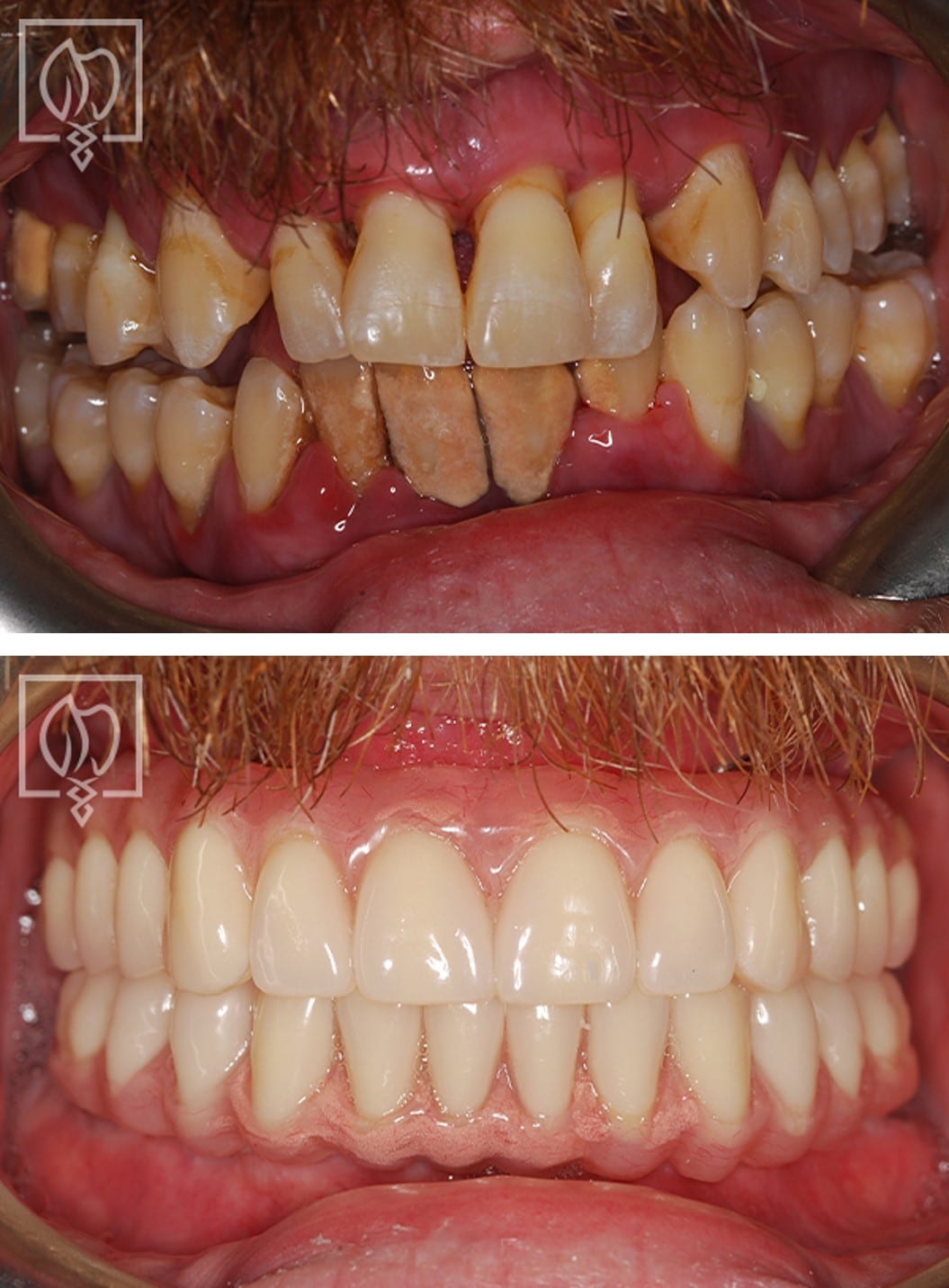
Real All-on-6 Patient Results
Two unique All-on-6 cases planned, placed, and restored by Dr. Marlin at the Washington, DC practice.
Frequently Asked Questions
What is All-on-6®?
All-on-6® is a full-arch dental implant protocol that uses six implants per arch to support a fixed, non-removable prosthesis. The additional implants distribute occlusal forces more evenly, provide redundancy in the long-term load-bearing design, and often allow for a more natural tooth position and angulation in the final restoration.
How is All-on-6 different from All-on-4?
Both protocols support a fixed full-arch prosthesis. All-on-4 uses four implants per arch with the posterior implants tilted. All-on-6 uses six implants per arch, typically with less aggressive tilting and broader load distribution. All-on-6 is often preferred when bone density is adequate and the patient has higher bite forces. A direct comparison is available on the All-on-4 vs. All-on-6 page.
Is All-on-6 better than All-on-4?
Neither protocol is universally better. The right answer depends on bone quality, bite forces, arch anatomy, and the design of the final restoration. All-on-6 offers more biomechanical redundancy and broader force distribution. All-on-4 is appropriate when bone is adequate anteriorly and the posterior bone is compromised. The decision is made during planning based on the patient's individual anatomy.
Does All-on-6 require bone grafting?
It can, depending on bone volume in the posterior regions where the additional implants are placed. Patients with significant posterior bone loss may benefit from All-on-4 (which avoids the posterior implant zones) or from bone grafting and sinus augmentation before All-on-6 placement. CBCT 3D imaging during planning identifies which approach the patient's anatomy supports.
How long does All-on-6 treatment take?
Surgical placement of six implants per arch is typically completed in a single visit. A fixed temporary prosthesis is provided during the healing phase. The final restoration is delivered after three to six months of osseointegration. Total treatment time mirrors All-on-4.
Related All-on-X Resources
All-on-X Overview
The full-arch implant category and how the protocols compare.
All-on-4® Dental Implants
The four-implant alternative with tilted posterior implants.
All-on-4 vs. All-on-6
Direct comparison of the two protocols.
Am I a Candidate?
Full-arch implant candidacy criteria in detail.
Zirconia vs. Acrylic Prosthesis
Material selection for the final prosthesis.
Full Mouth Dental Implants
Complete upper and lower arch rehabilitation.
Conveniently Located in Friendship Heights
Serving Washington DC, Bethesda, Chevy Chase, McLean, Great Falls, Potomac, and surrounding communities. One block from the Friendship Heights Metro on the Red Line.
Request Your Specialist Consultation
Personally reviewed by Dr. Marlin or his team.
Hours
- Monday — Thursday8:00 AM — 5:00 PM
- Friday8:00 AM — 2:00 PM
- Saturday — SundayClosed
All-on-4® and All-on-6® are registered trademarks of their respective owners and are referenced here for descriptive purposes only. Elite Prosthetic Dentistry is not affiliated with, endorsed by, or sponsored by the trademark holders.