
When Jaw Surgery Fails: How Prosthodontic Care Helped a Patient Rebuild Her Smile
Jaw surgery usually goes well. This is the story of a case in which it did not, and of what became possible when the treatment direction changed from more surgery to preservation and reconstruction. It is worth reading if you or someone you love is living with the aftermath of an operation that did not deliver what it promised.
A Complex Case That Needed More Than Another Operation
Our patient came to Elite Prosthetic Dentistry after a Le Fort I osteotomy, an operation that repositions the upper jaw, developed serious complications: significant vertical bone loss, incomplete healing of the bone (nonunion), and a bite that was progressively collapsing. Several revision surgeries and multiple bone grafts had been attempted, and despite everyone’s best efforts the situation had grown less stable with each round. Two teeth had already been lost along the way, and the proposed next step involved removing additional, still-healthy teeth.
She feared that another operation would leave her worse off again. Her instinct deserved to be taken seriously.
“Every time someone told me I needed another surgery, I felt my situation getting worse. When I finally found a team focused on preservation instead of more surgery, everything changed.”
Before and After: Structural Restoration and Smile Rejuvenation
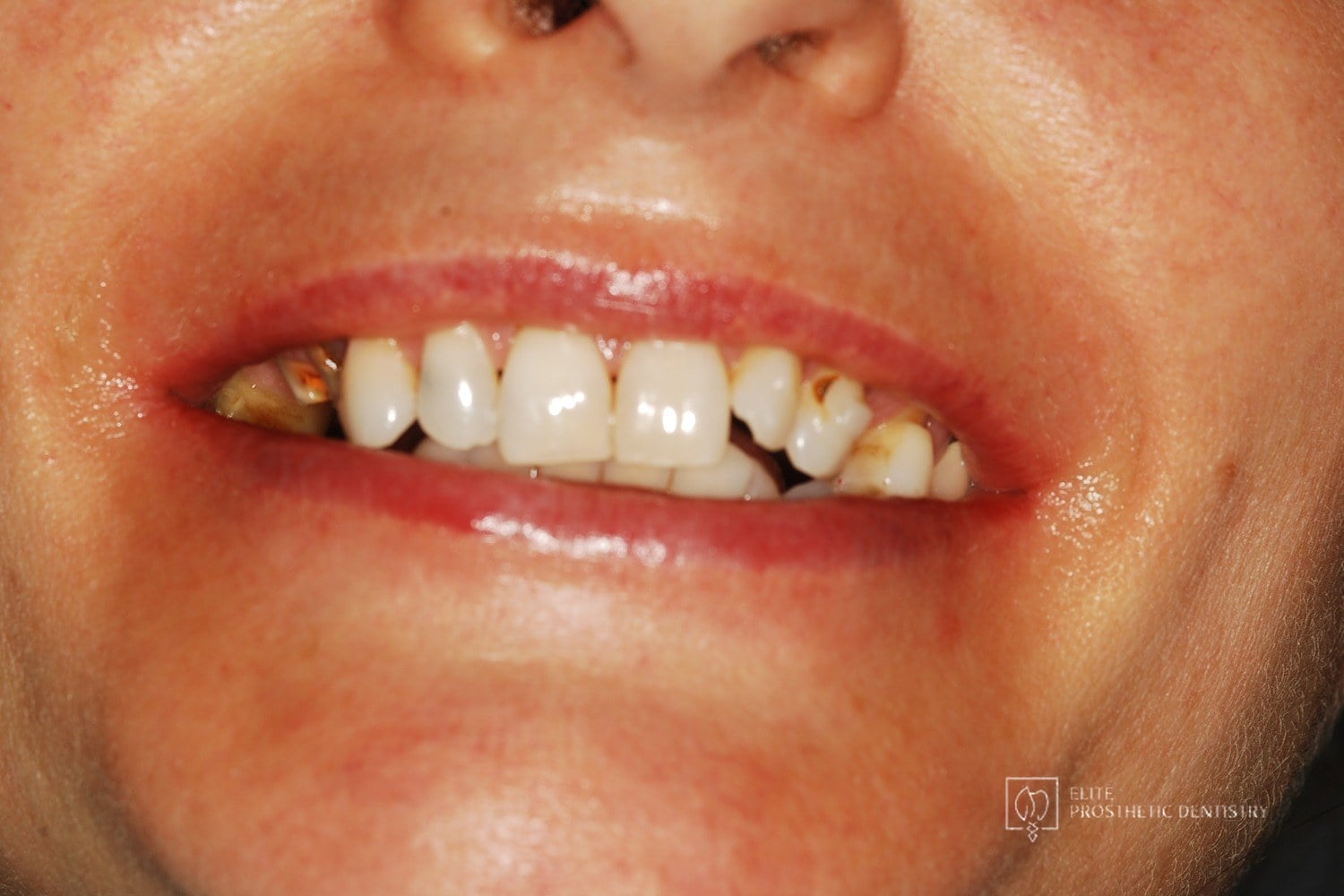
Before: Collapsed Bite and Structural Damage After Failed Jaw Surgery

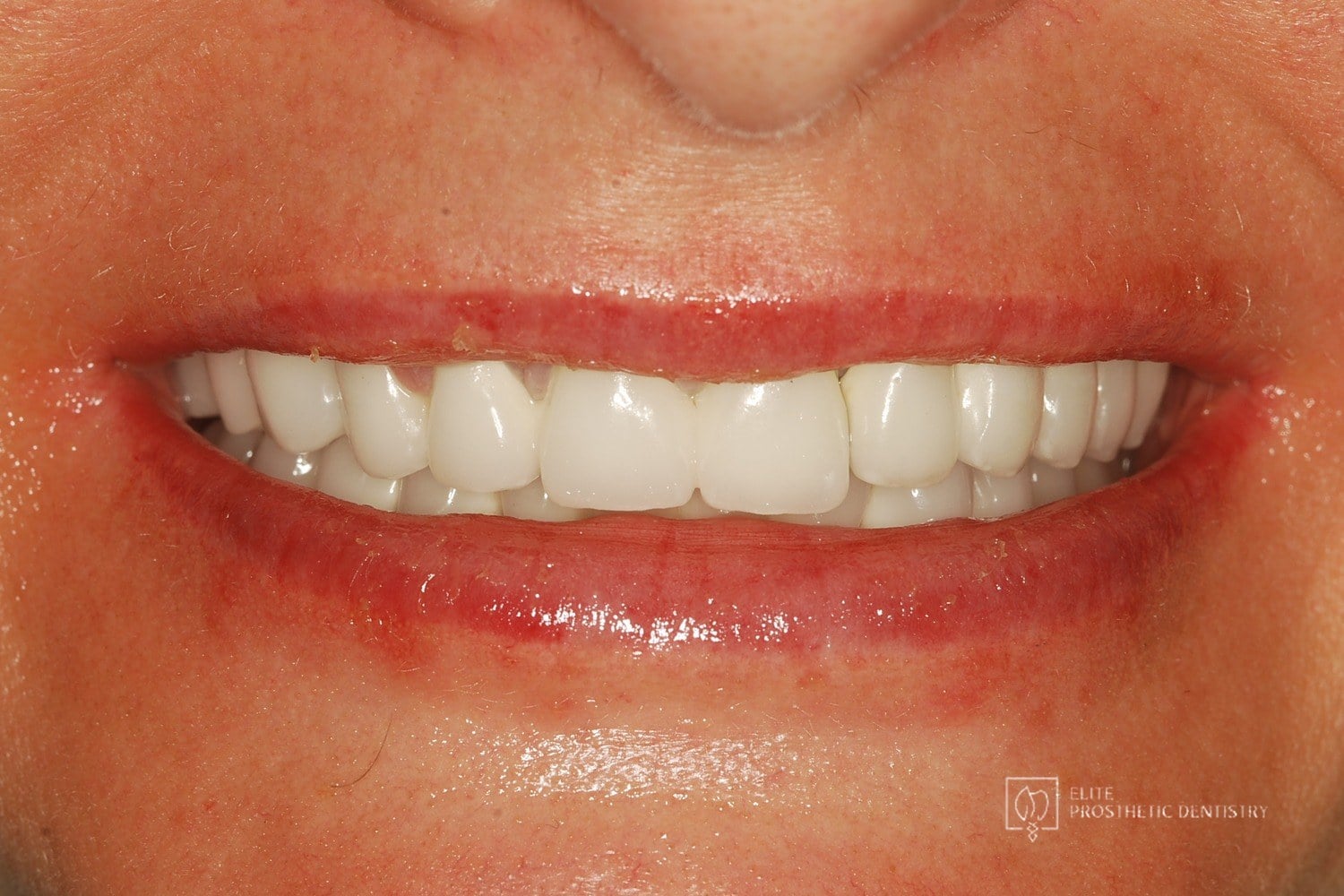
After: Restored Smile Following Comprehensive Prosthodontic Reconstruction
A Preservation-Based Plan Instead of More Surgery
Dr. Marlin reframed the direction of the case. Instead of extracting healthy teeth or repeating high-risk grafting, the plan focused on stabilizing what remained and building on it, with prosthodontic planning coordinating every discipline involved:
- Stabilizing the arch without removing additional teeth
- Orthodontic retreatment to reestablish symmetry
- Limited periodontal grafting to repair soft tissue defects
- Precision prosthodontic reconstruction built on the stabilized foundation
- Restoration of function, architecture, and aesthetic balance
This is the same philosophy that guides our approach to full-mouth reconstruction generally: preserve what is sound, correct what is correctable, and let the final restorations be built on stability rather than hope. The staged sequencing such cases require is described in how long a full mouth reconstruction takes.
The Outcome: A Functional, Stable, Natural Smile
Once the foundation was stable, the final restorations rebuilt her bite, symmetry, and natural aesthetics. She regained the ability to chew comfortably and smile without self-consciousness. The transformation was structural, functional, and, in her words, emotional. You can see a comparable coordinated rebuild in our case study of a smile makeover with dentition reconstruction.
If Your Jaw Surgery Failed, You Still Have Options
This case does not mean surgery is wrong or that revision is never needed; orthognathic surgery helps many patients, and recovery usually goes as planned, as we outline in 5 tips for jaw surgery recovery. What the case demonstrates is narrower and more hopeful: when operations have not held, more surgery is not the only path forward. A careful second opinion evaluation can reveal safer, more predictable reconstructive solutions that protect your long-term health.
Dr. Gerald Marlin is a specialty-trained prosthodontist with 40+ years of experience in complex reconstructive cases. Call 202-244-2101 or request an appointment at Elite Prosthetic Dentistry in Friendship Heights, Washington, DC.
See How We Resolve These Problems
Our patient success stories show real cases and real results. Browse outcomes from a specialist prosthodontist with decades of experience and 3,900+ implants placed.
Key Takeaways
- ✓ When jaw surgery does not achieve its goals, more surgery is not automatically the next step. Preservation-based prosthodontic reconstruction can be the safer path.
- ✓ Complications such as bone loss, nonunion, and a collapsing bite compound with each intervention, so the treatment direction matters as much as the treatment.
- ✓ A preservation plan stabilizes the arch without sacrificing healthy teeth, then rebuilds function on that stable foundation.
- ✓ Interdisciplinary coordination, orthodontic, periodontal, and prosthodontic, is what makes complex salvage cases succeed.
- ✓ If you have been told repeatedly that you need another operation, a prosthodontic second opinion costs one visit and may change everything.
Frequently Asked Questions
What happens if jaw surgery fails?
Complications can include bone loss, incomplete healing of the repositioned bone (nonunion), soft tissue damage, tooth loss, and a bite that progressively collapses. The essential next step is a careful evaluation of what is structurally sound, because the right plan may be reconstruction on the existing foundation rather than another operation.
Can a failed jaw surgery be fixed without more surgery?
In select cases, yes. When enough healthy teeth and bone remain, a preservation-based plan can stabilize the arches, correct alignment orthodontically, repair soft tissue with limited periodontal grafting, and rebuild the bite prosthodontically. Whether that path fits your case requires individual evaluation, but it exists, and patients are not always told so.
Why see a prosthodontist after failed jaw surgery?
Because the end goal is a functioning bite, and the prosthodontist is the specialist in engineering bites. Where a surgical lens looks for what to reposition, a restorative lens asks what can be preserved and built upon. In complex salvage situations, that reframing frequently reveals options that repeated surgery cannot offer.
Should I get a second opinion before another revision surgery?
For any major, irreversible procedure after a previous one has disappointed, yes. Honest clinicians differ about difficult cases, and a specialty-trained prosthodontist can evaluate whether reconstruction could achieve your goals with less risk. One additional consultation is a small price for confidence in an irreversible decision.
Related Patient Success Stories
Explore similar patient success stories demonstrating our expertise in advanced prosthetic dentistry.
 Before
  After
After How Aging, Failing Dentistry Was Replaced with a Coordinated Full-Mouth Implant and Crown Reconstruction
The patient presented with throbbing upper-molar pain, long-standing infections, multiple root canals and unfinished prior treatment, generalized sensitivity, and several hopeless teeth.
 Before
 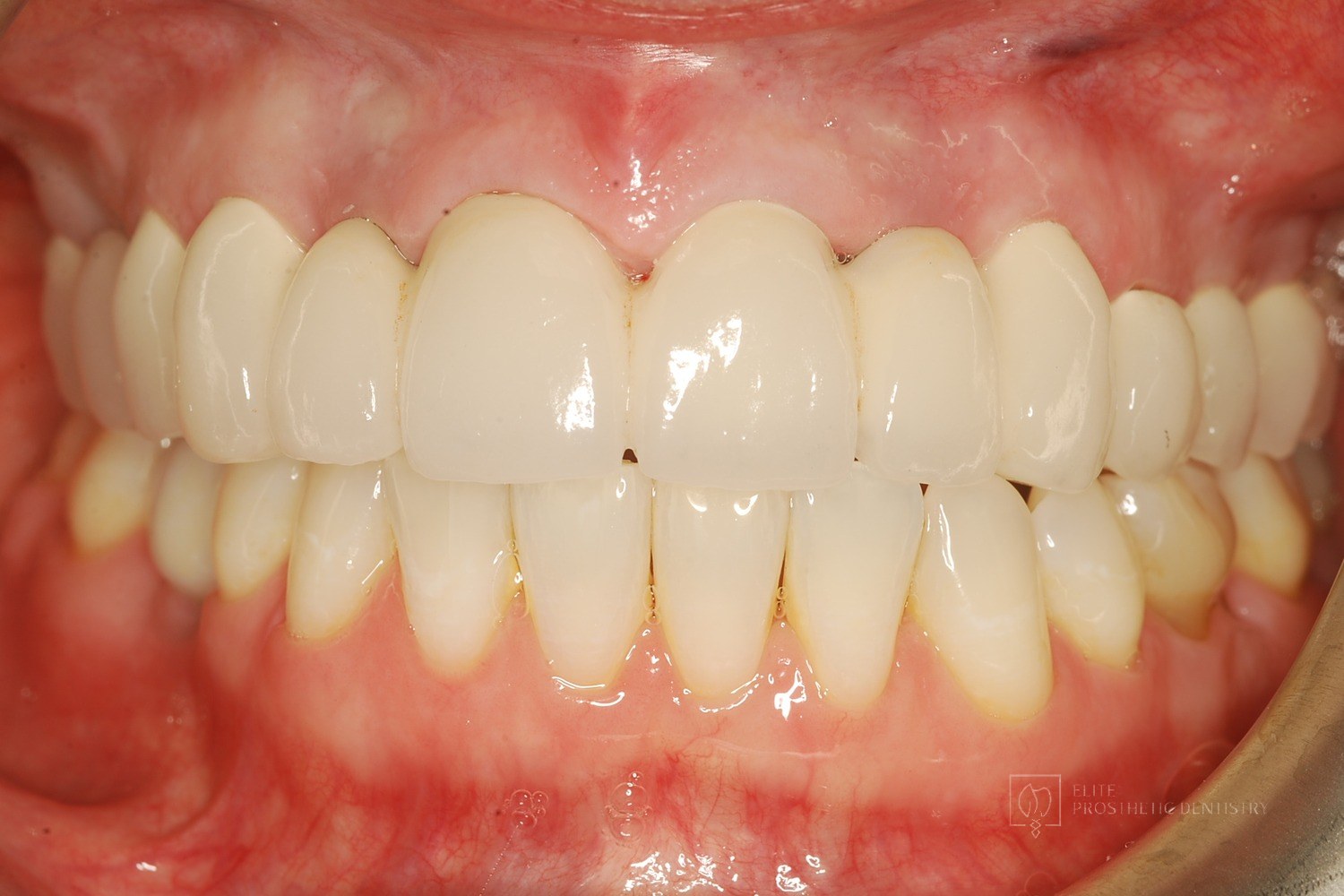 After
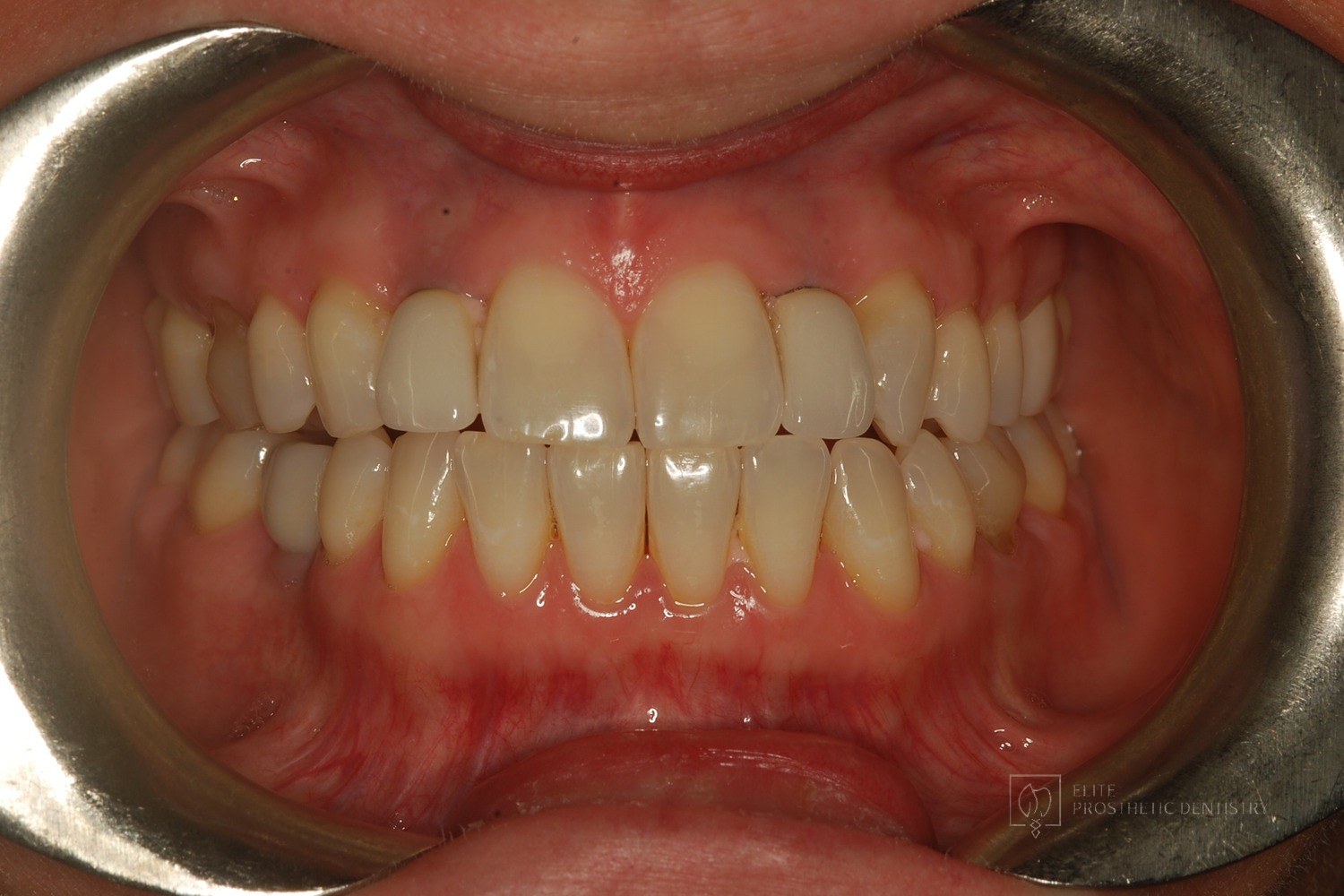
After How Older Implant Crowns Were Redesigned for a Better Bite and More Natural Appearance
The patient came in after years of living with implant-supported crowns placed more than twenty years earlier that no longer looked or functioned well. CBCT evaluation, reviewed with a radiologist colleague, showed the implants had been placed too far to the buccal in very thin bone and could not support a healthy long-term restoration.
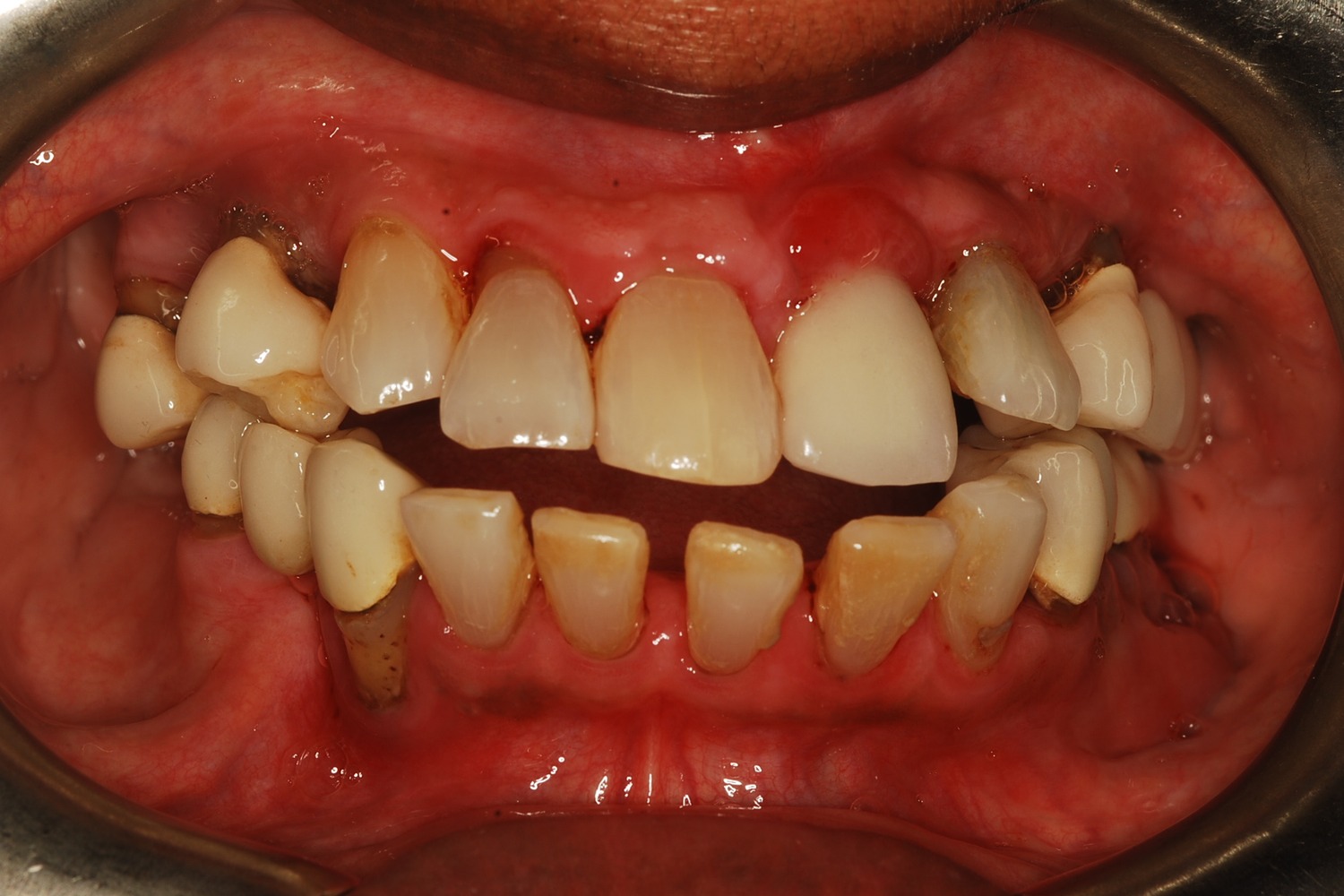 Before
 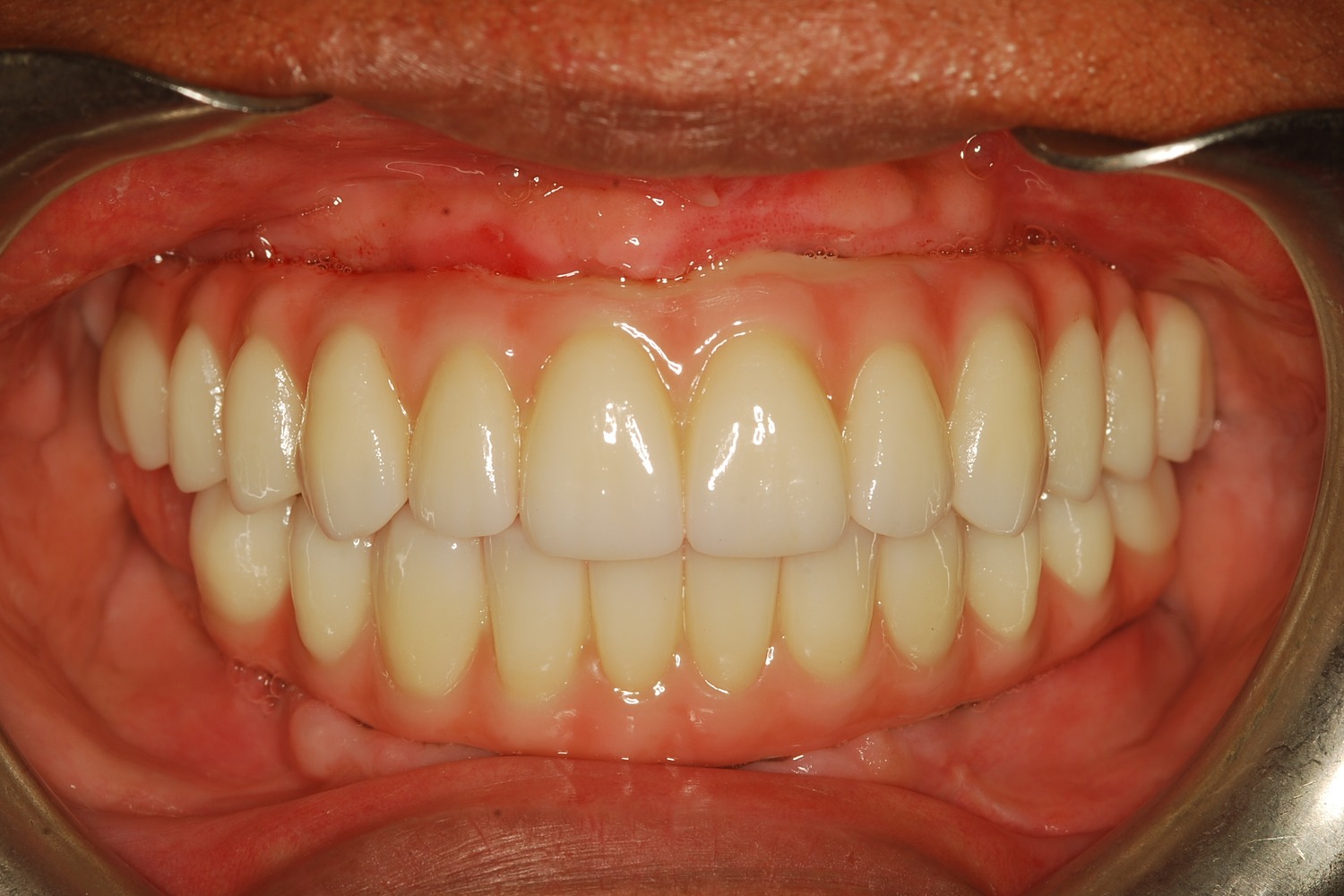 After
After How Severe Bone Loss and Bite Dysfunction Were Rebuilt with All-on-6 Implants and a Milled Zirconia Hybrid Prosthesis
The patient presented with severe bone loss, advanced periodontal disease, malocclusion, and a dysfunctional bite that required full-arch rebuilding.
Related Articles
Deepen your knowledge with additional insights on this topic.
Full Mouth Reconstruction When Jaw Surgery Fails: How Prosthodontic Care Helped a Patient Rebuild Her Smile
After a failed jaw surgery and multiple revisions, a preservation-based prosthodontic plan rebuilt this patient's bite and smile without more surgery.
 Full Mouth Reconstruction
 How Can I Have My Severely Worn Teeth Repaired?
Severely worn teeth can be fully rebuilt with custom crowns, not veneers. How a DC prosthodontist restores ground-down smiles, with a real case example.
 Full Mouth Reconstruction
 How Long Does a Full Mouth Reconstruction Take?
Most full mouth reconstructions take three months to a year, staged in phases. What drives the timeline and how an in-house lab compresses it. DC.