
When All-Ceramic Crowns Can Be Used for a Cosmetic Makeover
All-ceramic crowns are one of the most effective ways of creating a genuinely new look in a cosmetic smile makeover. But they should not be used in every situation. Each patient needs careful evaluation on two questions: whether enough sound tooth structure remains for the crowns to seat on for a durable, long-lasting result, and whether too many teeth are missing or loose for crowns alone to carry a comprehensive makeover. When the answer to either is no, the plan changes; when the answers are yes, the results can be transformative.
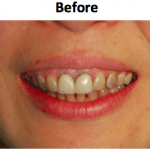
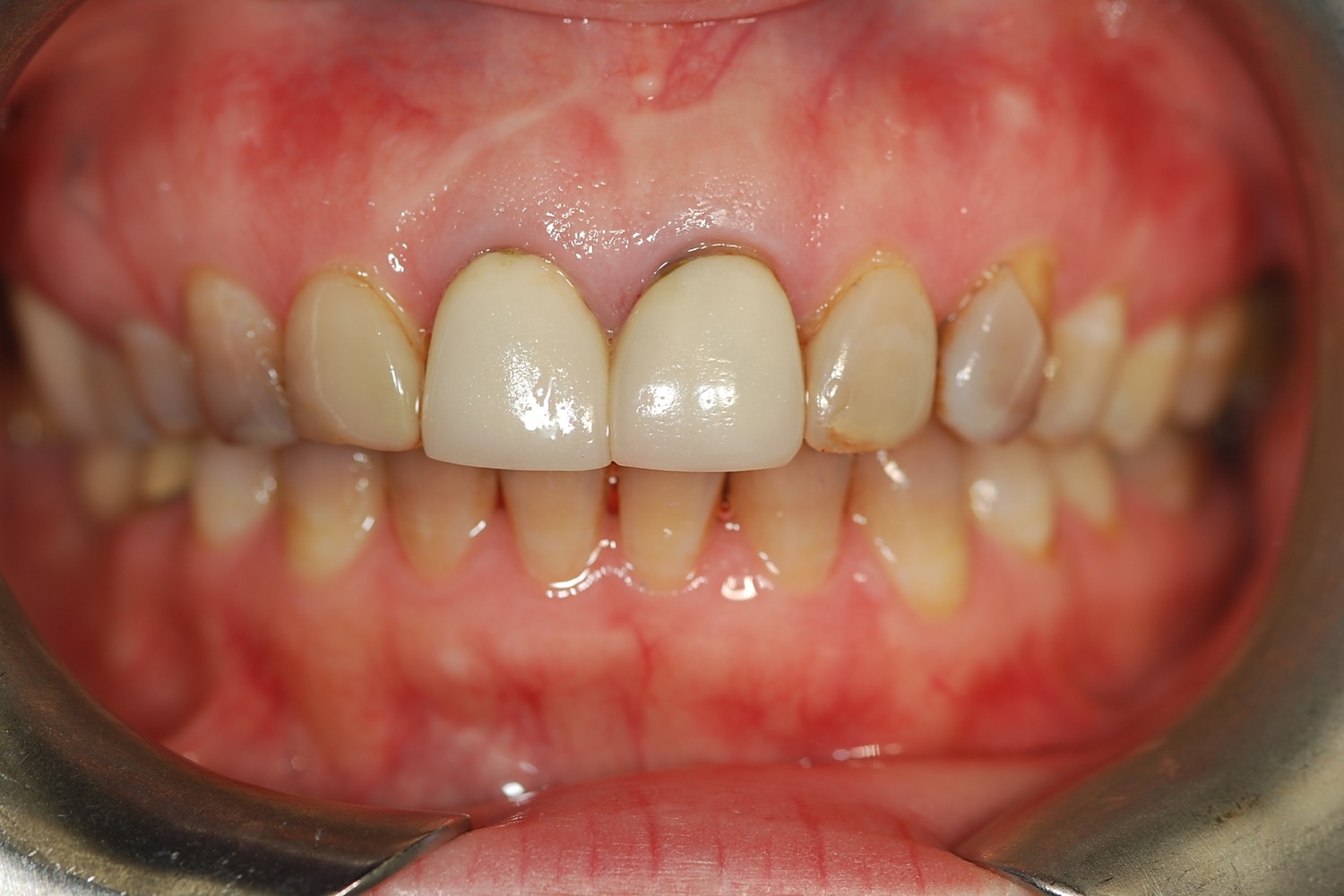
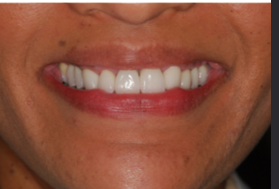
Before: Patient with dark discolored crowns and wide smile line
A Case: Dark, “Dead White” Crowns on a Wide Smile Line
This patient was seeking a significant cosmetic improvement. Over the years her teeth had grown darker and darker, and with her wide smile line she was unhappy with the look every time she smiled. The two crowns at the very front of her smile, on her upper central incisors, were the worst offenders: they read as flat, “dead white,” and unmistakably artificial. A high, gummy smile line magnified the problem, putting everything on display.
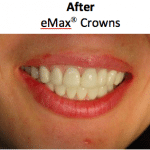
The solution was e.max® pressed-ceramic crowns over her dark-colored abutments: natural-colored, more translucent crowns that masked the darkness underneath without the chalky opacity that betrayed her old restorations. The choice of an all-ceramic system with hand-layered porcelain was driven by exactly the factors above: sound abutments to build on, and an aesthetic demand that only custom translucency could meet.
How All-Ceramic Crowns Are Made, and Why It Matters
There are two fundamentally different fabrication routes. In the first, a milling machine cuts the complete anatomic crown from a ceramic block, which is the approach behind most same-day crowns; we examine it in what is a milled crown. In the second, the base coping is pressed for a precise fit, and a technician then creatively applies porcelain by hand to build the final crown with the right look.
We use the second procedure, with our in-house technician creating custom color and translucency for each individual tooth. In this patient’s case, the tooth-colored copings were first pressed onto replicas of her prepared teeth for a tight, long-lasting fit, a more exact fit than machined-only zirconia crowns provide. The technician then customized the aesthetics, layering porcelain to her personal requirements: brightness where she wanted it, translucency where nature would put it.
This is a more intense, time-consuming way to make a crown. It is also the difference between a crown that is merely white and one that reads as a living tooth, a distinction we cover across the types of crowns and their indications and what separates crowns aesthetically.
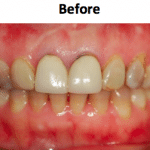
eMax pressed porcelain crown with natural tooth-colored appearance
Custom porcelain application showing color and translucency details
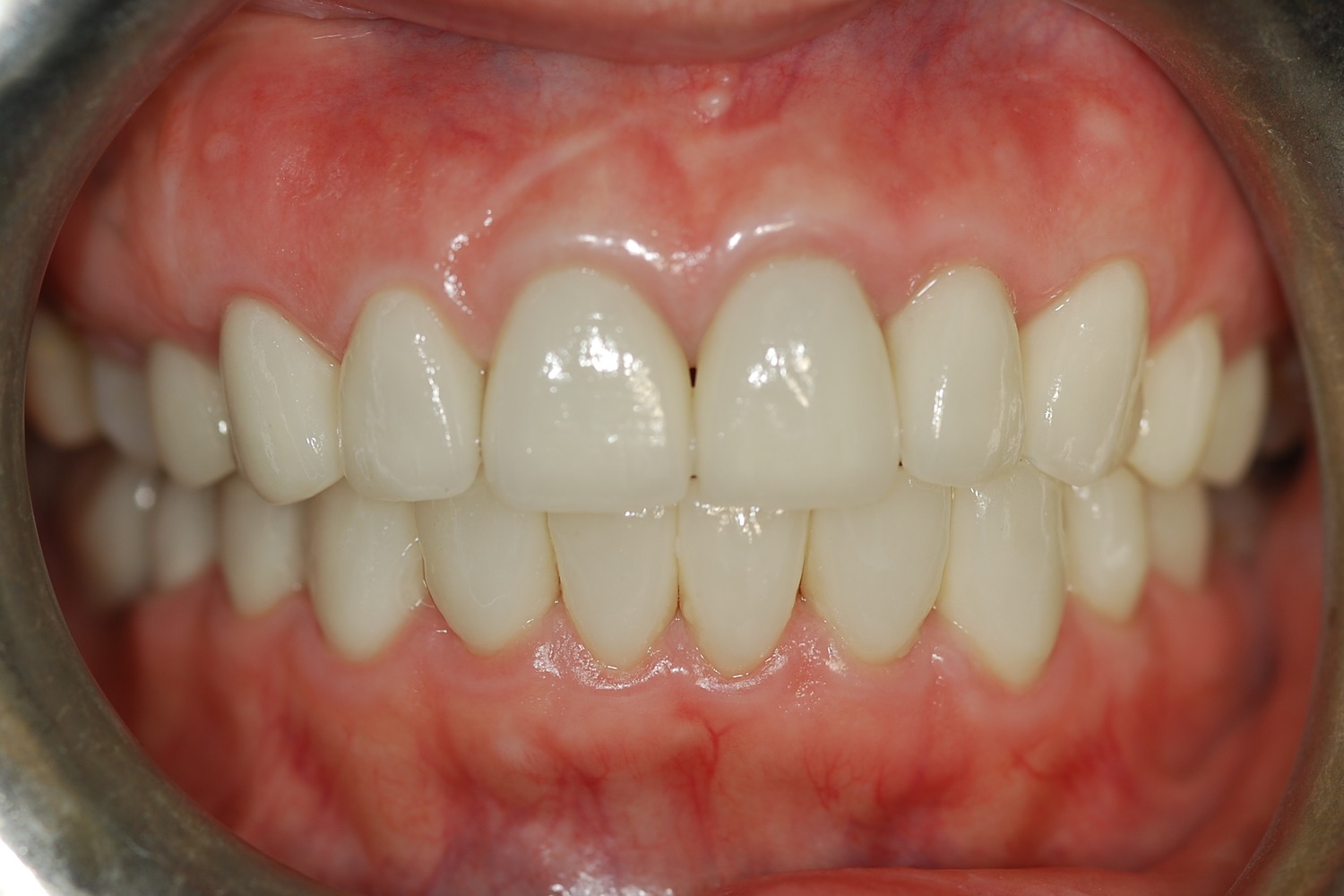
The Result
She ended up with natural-looking crowns and a smile nobody stares at for the wrong reasons, which is precisely the goal: restorations that disappear into the person. She is no longer self-conscious when she smiles.
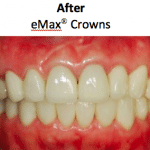
After: Natural-looking eMax crowns with beautiful smile
How to Know Which Situation Is Yours
You cannot diagnose your own tooth structure from the mirror, but you can recognize the patterns. If your front teeth carry old crowns that look flat, opaque, or too uniform, you are likely in this patient’s situation, and all-ceramic replacements can transform the smile. If your teeth are heavily filled, worn short, or loose, the evaluation needs to answer the structural questions first; the cosmetic layer comes after the foundation is secured. And if several teeth are missing, the conversation properly starts with replacement planning, because crowns need something sound to sit on. In every case the deciding step is the same: an examination that looks beneath the surface before promising anything about it.
Is an All-Ceramic Makeover Right for Your Smile?
The honest answer requires an examination: of your tooth structure, your existing restorations, your smile line, and what you want to change. Dr. Gerald Marlin, a specialty-trained prosthodontist, evaluates all-ceramic crowns tooth by tooth against every alternative, and our in-house laboratory has been building them with custom translucency since 1985; crowns from this laboratory have lasted 35 years and more. Call 202-244-2101 or request a consultation at Elite Prosthetic Dentistry in Friendship Heights, Washington, DC.
See How We Resolve These Problems
Our patient success stories show real cases and real results. Browse outcomes from a specialist prosthodontist with decades of experience and 3,900+ implants placed.
Key Takeaways
- ✓ All-ceramic crowns are one of the most effective tools for creating a new look, but they are not right for every situation.
- ✓ Candidacy depends on how much sound tooth structure remains to seat the crowns, and whether too many teeth are missing or loose for crowns alone.
- ✓ There are two fabrication routes: milling the complete crown by machine, or pressing a base and hand-layering porcelain over it.
- ✓ Hand-layered porcelain takes longer but produces custom color and translucency no fully milled crown matches.
- ✓ Opaque, dead-white crowns are the classic failure mode; translucency is what makes a very visible smile line look natural.
Frequently Asked Questions
What is an all-ceramic crown?
A crown made entirely of ceramic material with no metal substructure. Because ceramic transmits and scatters light much like natural enamel, all-ceramic crowns are the aesthetic standard for visible teeth in cosmetic makeovers, provided the tooth has enough sound structure to support one.
When are all-ceramic crowns not the right choice for a makeover?
Two main situations: when a tooth lacks enough sound structure for the crown to seat on durably, and when too many teeth are missing or loose for crowns alone to carry the case. In the second situation the makeover becomes a broader reconstruction, with implants or other foundations placed before the cosmetic layer.
What is the difference between milled and pressed-and-layered ceramic crowns?
A fully milled crown is machined to final shape from a ceramic block, which is efficient but limits the aesthetics to what a monolithic material offers. In the pressed-and-layered approach, a base coping is pressed for a precise fit, then a technician hand-applies porcelain to build custom color and translucency. It takes considerably more time and skill, and it looks considerably better.
Why do some crowns look chalky white and fake?
Because they lack translucency. Natural enamel lets light enter and scatter; an opaque crown blocks that light play and reads flat, especially against a wide or high smile line. The fix is custom layering matched to the patient, ideally by a technician who can see the patient rather than work from a shade number alone.
Related Patient Success Stories
Explore similar patient success stories demonstrating our expertise in advanced prosthetic dentistry.
 Before
  After
After How Aging, Opaque Restorations Were Replaced with Customized Ceramic Restorations Designed for Long-Term Natural Esthetics
The existing restorations appeared opaque, worn, and unnatural over time, affecting both confidence and overall smile harmony.

Temporary Crowns Restore a Patient's Smile in One Day with an Immediate Smile Makeover
A patient from Potomac, Maryland came to the practice in pain from a failing dental implant whose restoration was also compromising her appearance and her confidence.
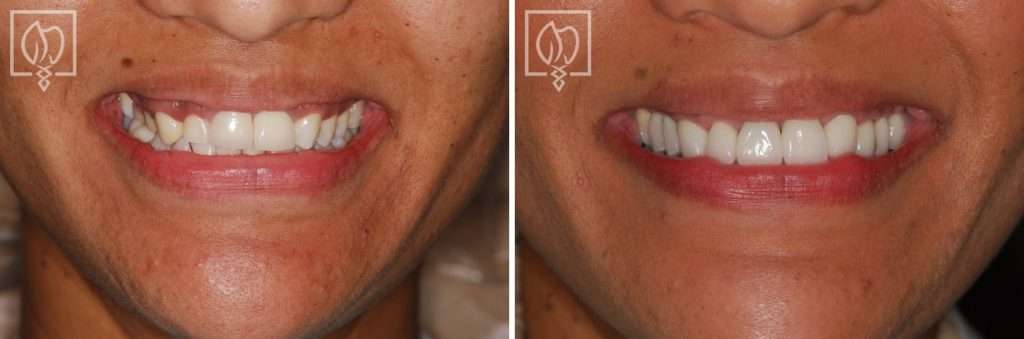
Multi-Faceted Treatment for a Patient Unhappy With the Appearance of Her Crowns, Teeth, and Gums
The patient was unhappy with how her teeth and gums affected her smile: front-tooth crowns that no longer blended with her natural teeth, a missing lateral incisor with the larger canine sitting in its space, and an uneven gum line.
Related Articles
Deepen your knowledge with additional insights on this topic.
 Cosmetic Dentistry
 Can My Tetracycline-Stained Teeth Be Made to Look Beautiful?
Tetracycline staining sits deep inside the tooth, so bleaching cannot fix it. See how translucent porcelain crowns create a bright, natural smile instead.
 Cosmetic Dentistry
 How Is a Gummy Smile Fixed?
From gum reshaping to custom crowns, a DC prosthodontist explains how a gummy smile is fixed, with a real patient transformation and healing timeline.
 Cosmetic Dentistry
 Discovering Cosmetic Dentistry Beyond Aesthetics
Cosmetic dentistry improves more than looks: easier hygiene, restored chewing function, and better long-term oral health. A DC prosthodontist explains.