
Restoring Multiple Old Dental Implants That Had Either Fractured or Failed
Documented before and after
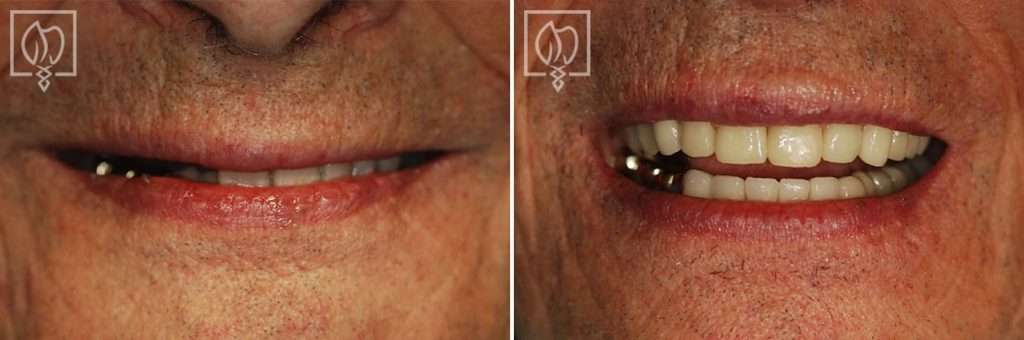
Final documented view
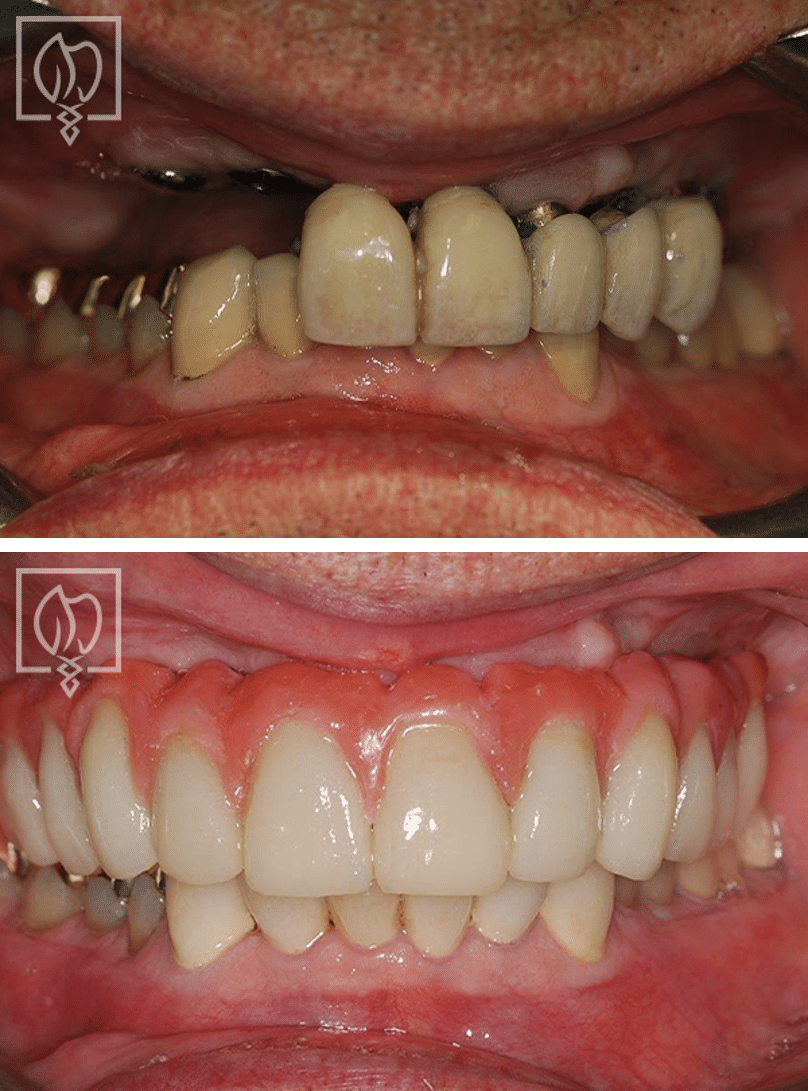
Restoring multiple older implants that had fractured or failed
Failed dental implant reconstruction in Washington, DC. This documented case at Elite Prosthetic Dentistry rebuilt the smile of an active 87-year-old patient whose older implants had fractured or failed, breaking the prosthesis they supported. Treatment was planned and completed by Dr. Gerald Marlin, D.M.D., M.S.D., a prosthodontist focused on implant reconstruction and complex restorative care.
Case at a Glance
- Treatment
- Comprehensive reconstruction salvaging restorable implants, replacing failed ones, and reopening a severely closed bite
- Approach
- Implant-by-implant assessment, legacy component sourcing, strategic new implant placement, custom restorations
- Case Type
- Corrective implant revision / Bite rehabilitation
- Patient Concern
- Several older dental implants had fractured or failed, breaking the prosthesis they supported, while other teeth had also fractured and the bite had collapsed significantly.
- Decision Point
- Determine implant by implant which could be salvaged through restoration and which had to be removed and replaced, while also deciding how to safely reopen the collapsed bite.
- Outcome
- Biting and chewing function were restored, facial appearance improved as the bite reopened to its proper dimension, and confidence in the results was renewed.
- Why It Matters
- The case demonstrates that failing implants, fractured teeth, and a collapsed bite could not be fixed in isolation, and had to be planned as one connected system for a lasting result.
The presenting condition
An active 87-year-old patient from Potomac, Maryland came to the practice wanting to improve his smile. What sat underneath that goal was considerably more involved. Multiple old dental implants in his mouth had either fractured or were failing, and those failures had broken the original prosthesis, the restoration that had been built upon them.
Implant failure can occur for many reasons: inadequate bone integration at the time of placement, progressive bone loss over the years, mechanical failure under excessive forces, or problems with the materials in the original restoration. When implants fail, they often cannot simply be repaired. They must be removed and replaced, which takes careful surgical planning and management.
There was more. His lower teeth had fractured, and his bite had closed severely. When the vertical dimension of a bite collapses, the space between the upper and lower jaws decreases. That impairs biting and chewing, and it also changes the face, distorting its proportions and making a person look prematurely aged.
Clinical Findings
- →Multiple older implants fractured or failing
- →The original implant-supported prosthesis broken as a result
- →Fractured lower teeth
- →A severely closed bite with lost vertical dimension
- →Compromised chewing function and reduced facial support
Why this case required prosthodontic-level planning
Nothing in this mouth had failed in isolation, so nothing could be fixed in isolation. Replacing implants without reopening the collapsed bite would have rebuilt new restorations to the wrong dimension. Opening the bite without resolving the failing implants would have loaded new restorations onto foundations that were already breaking. The vertical dimension, the implant decisions, and the final restorations had to be planned as one connected system, which is the core of prosthodontic thinking.
The patient’s age, combined with these compounding problems, made this a highly complex case requiring expertise across several areas of prosthodontic treatment. Cases like this are sometimes described as too difficult, or steered toward less comprehensive stopgaps. Planned correctly, they are demanding but solvable.
The decision behind the result: salvage what can be saved, replace what cannot
The process began with a careful assessment of which implants could potentially be salvaged through restoration and which would need to be removed and replaced. That distinction matters enormously. Every implant that can be responsibly kept spares the patient surgery, healing time, and expense. Every implant kept irresponsibly builds the new prosthesis on a failing foundation.
For the failed and fractured implants, the team worked to locate parts that would be compatible with the older implant systems. Some implant systems are no longer manufactured, which can present a significant challenge when trying to restore or replace them. Where compatible parts could not be found, the failed implants were extracted and replaced with new ones, and the new dental implants were strategically positioned to support the final restorations.
The treatment plan
-
1
Implant-by-implant assessment
Careful evaluation determined which existing implants could be salvaged through restoration and which needed removal and replacement.
-
2
Legacy component sourcing
The team worked to locate parts compatible with the older implant systems, some of which are no longer manufactured.
-
3
Removal and strategic replacement
Implants that could not be restored were extracted, and new implants were placed in positions planned to support the final restorations.
-
4
Integration of the new implants
The new implants were given time to integrate properly with the bone before the restorative phase began.
-
5
Custom restorations at the corrected bite
Custom restorations were fabricated to reopen the bite to its proper vertical dimension and restore complete function and esthetics.
The outcome
Once the implant therapy was complete and the new implants had integrated with the bone, custom restorations restored the patient’s complete function and esthetics. They were designed to open his bite to the proper vertical dimension, which immediately improved his facial appearance and support. The restorations were fabricated in coordination with the practice’s in-house laboratory, keeping fit, contour, and function under Dr. Marlin’s direct oversight.
His ability to bite and chew properly was fully restored, his facial appearance was dramatically improved, and his confidence in his smile was renewed. He now travels to Florida every winter with complete confidence in his smile, able to engage fully in social situations without concern about his restorations.
Result Highlights
- ✓Failing implants resolved: salvaged where components allowed, replaced where they did not
- ✓New implants strategically placed to support the final restorations
- ✓The bite reopened to its proper vertical dimension
- ✓Biting and chewing function fully restored
- ✓Facial appearance and support dramatically improved
- ✓Renewed confidence in social situations
Who this case may sound familiar to
This story tends to resonate with patients in a few recognizable situations:
- Your implants were placed decades ago, and something has started to loosen, fracture, or fail.
- The prosthesis your implants support has broken, and you are not sure what can be reused.
- Your bite has collapsed over the years, and it is changing the way your face looks.
- You have been told your case is too complicated, or your age has been treated as the obstacle.
- You want one coordinated plan that addresses everything, done correctly once.
If any of those describe where you are, a consultation with Dr. Marlin can establish the diagnostic picture and the specific options for your case.
Frequently asked questions
Can a failing dental implant be repaired instead of replaced?
Sometimes. It depends on why it is failing, how well it remains integrated in the bone, and whether compatible restorative components exist for it. That is why the first step is an implant-by-implant assessment rather than a blanket decision to remove everything.
What happens when an old implant system is no longer manufactured?
The restoring dentist tries to source compatible components for it. When compatible parts cannot be found, the implant usually cannot be restored and is removed and replaced with a current system, placed in a position planned around the final restoration.
What is a collapsed bite, and why does it change facial appearance?
When teeth fracture, wear down, or lose support, the vertical dimension, meaning the space the jaws hold between them, decreases. The lower face loses height and support, proportions shift, and the change can make a person look prematurely aged. Restoring the correct vertical dimension restores both function and facial support.
Is there an age limit for implant reconstruction?
There is no fixed limit. Overall health, bone condition, and careful planning matter far more than the number itself. The patient in this documented case completed comprehensive implant reconstruction at 87.
Why does failing-implant treatment belong with a prosthodontist?
Because the end result, the bite and the restorations, has to be planned before the implant decisions can be made intelligently. A prosthodontist works backward from that endpoint, deciding which implants serve it, which do not, and how the final restorations will hold it for the long term.
More about the work behind this case
This case draws on repairing failing implants, dental implant replacement, and the bite-reconstruction principles of full mouth reconstruction. The planning depth behind it reflects the practice philosophy that complex cases deserve comprehensive answers, not stopgaps.
Elite Prosthetic Dentistry treats patients from across the DMV including Bethesda, Chevy Chase, McLean, Arlington, Potomac, and Great Falls, with a record of out-of-area patients traveling to the practice for complex restorative care.
Related Patient Success Stories
Explore similar patient success stories demonstrating our expertise in advanced prosthetic dentistry.
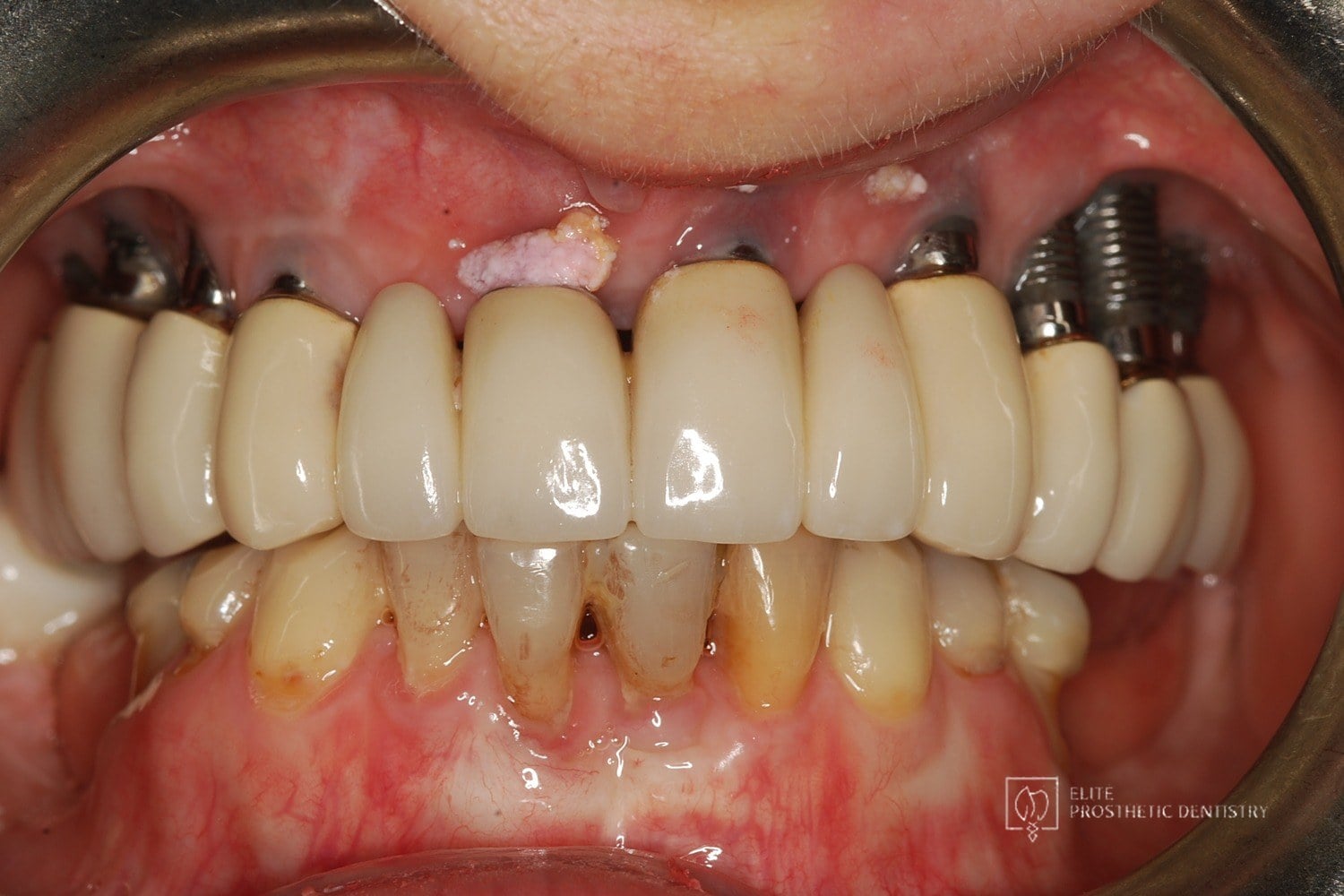
 Before
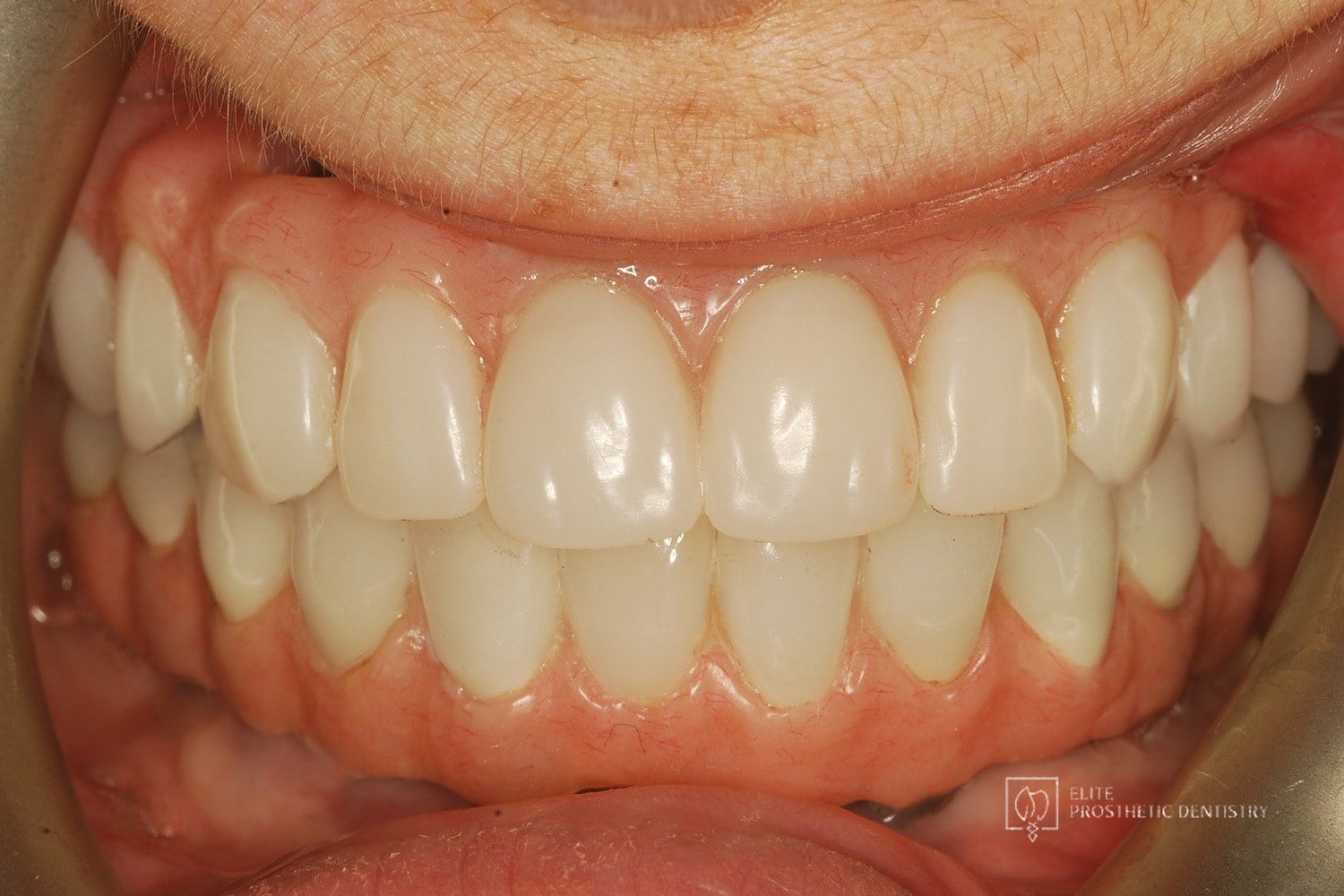
  After
After How Aging, Failing Dentistry Was Replaced with a Coordinated Full-Mouth Implant and Crown Reconstruction
The patient presented with throbbing upper-molar pain, long-standing infections, multiple root canals and unfinished prior treatment, generalized sensitivity, and several hopeless teeth.
 Before
  After
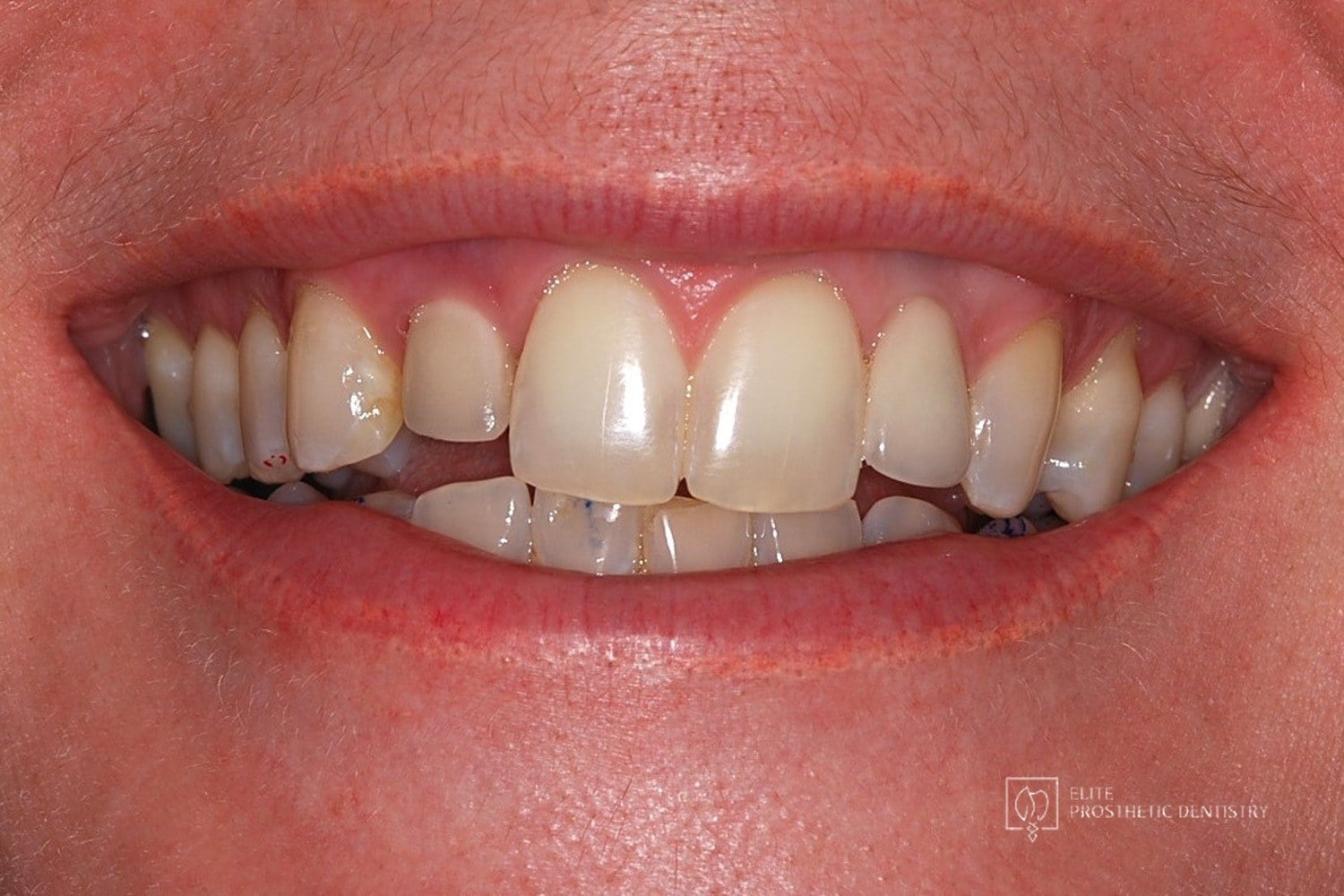
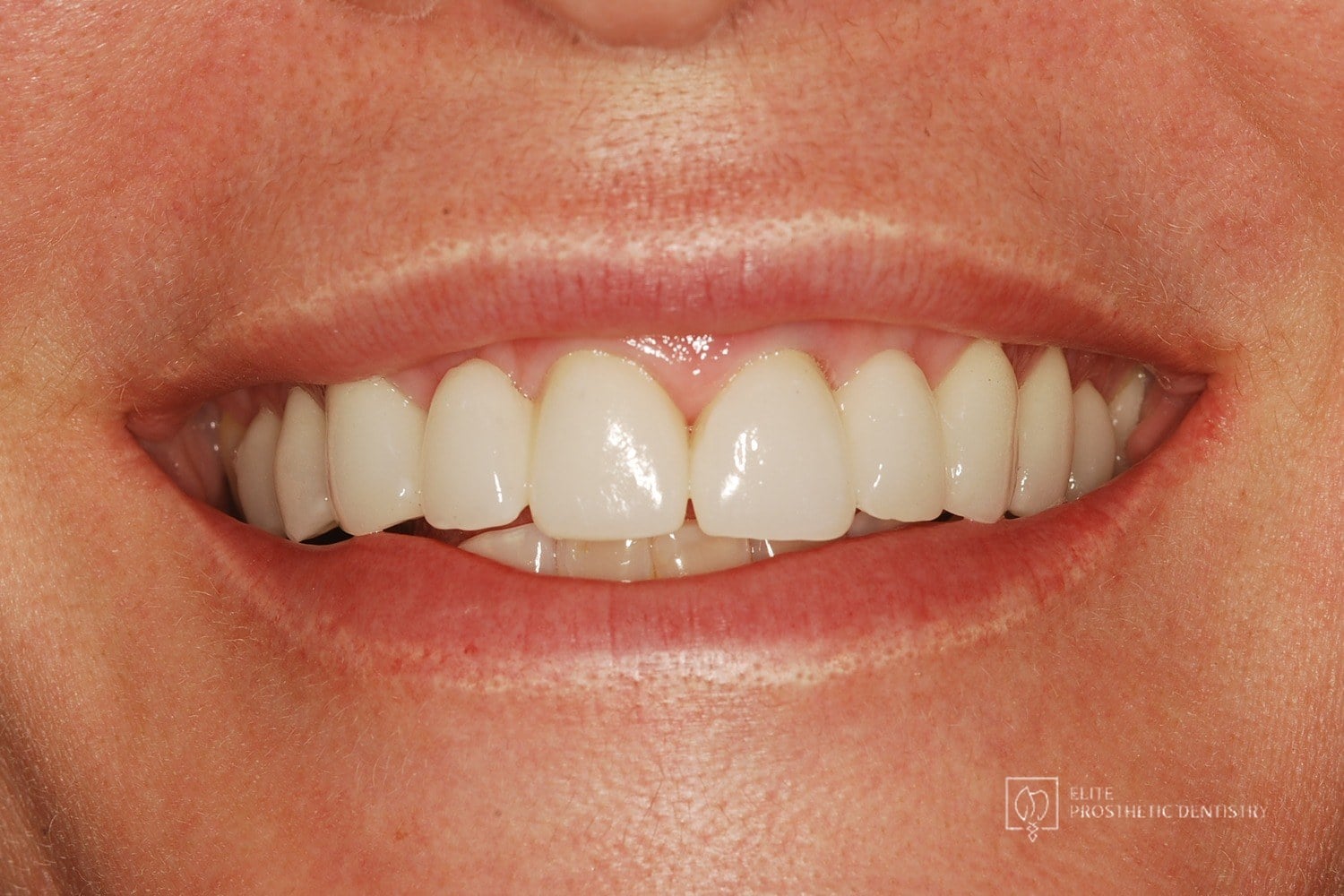
After How Failing Implants and Severe Bone Loss Were Rebuilt Into a Stable Full-Arch Implant Reconstruction
The patient presented with significant complications from previously placed implants, severe bone loss, failing posterior implants, and an unesthetic full-arch bridge. Both arches required full reconstruction, with the upper arch showing the most advanced bone loss and instability.
 Before
  After
After How Failing Lateral Incisor Implants Were Replaced with Custom Zirconia Bridges After Severe Bone Loss Made Replacement Implants Impossible
Comprehensive examination including CBCT imaging revealed significant bone loss surrounding implants that were placed outside the buccal plate, most likely due to placement without a CBCT-generated surgical guide. The implants were determined non-salvageable, and the alveolar ridge was too narrow to support replacement implants without extensive reconstruction.