
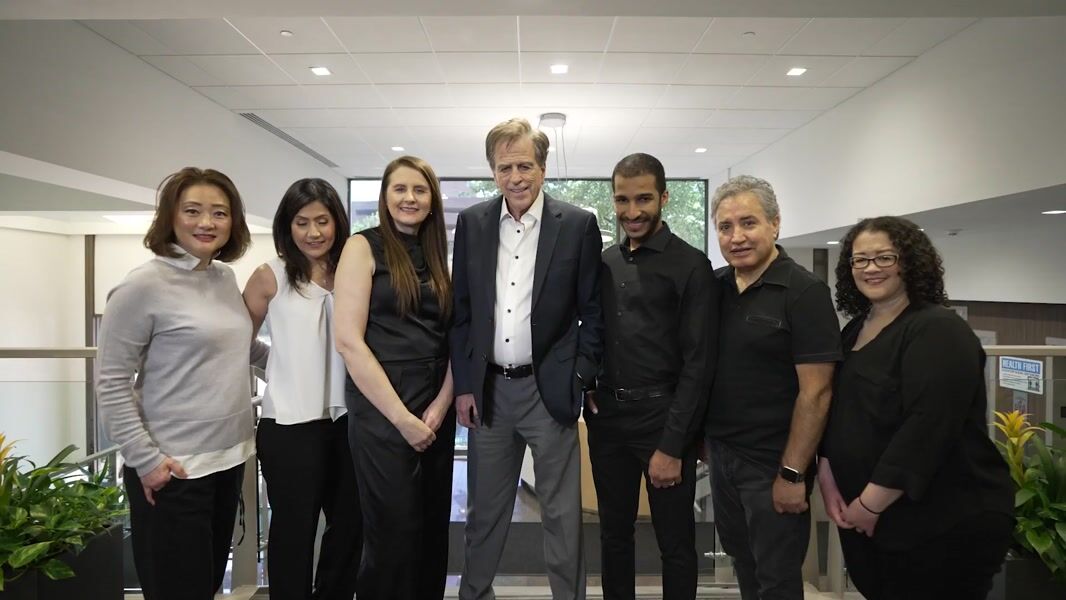
Failed All-on-4 Implants in Bethesda, MD
All-on-4 fracture repair in Bethesda. Expert prosthesis replacement for cracked, broken dental bridges. Upgrade to zirconia. Schedule your consultation.
Failed All-on-4 Implants in Bethesda, MD: Fracture Repair and Prosthesis Replacement
If your All-on-4 prosthesis has developed cracks, fractures, or breaks, you’re not alone. In our Bethesda practice, we see patients regularly who are frustrated with failing All-on-4 restorations that were supposed to last decades. The reality is that many All-on-4 cases fail not because of dental implant problems, but because of prosthesis design and material limitations that become apparent only after months or years of use.
Understanding All-on-4 Prosthesis Fracture
The All-on-4 concept relies on four implants to support an entire arch of teeth. This engineering approach concentrates all biting forces into four anchor points. While the implants themselves are typically strong enough for this load, the prosthesis that sits on top of those implants often is not.
Acrylic resin remains the most common material for All-on-4 bridges because it is relatively inexpensive, easy to adjust chairside, and can be repaired temporarily if a tooth fractures. However, acrylic has inherent mechanical limitations. It is hygroscopic, meaning it absorbs water from the oral environment. Over time, this water absorption causes the acrylic to become more brittle and prone to crack propagation. Additionally, the constant flexing under chewing forces eventually fatigues the material.
Most patients who develop cracks in their All-on-4 prosthesis report the fracture beginning at the junction between the acrylic denture base and the teeth, or along the palate where the base is thinnest. Once a crack starts, it propagates with every chew until the prosthesis breaks into multiple pieces, requiring prosthesis replacement to restore full function.
The problem is compounded if your bite is uneven. When chewing forces land preferentially on one side of the arch, the opposite side of the bridge acts as a cantilever, flexing upward and then returning to position with each bite. Over months, this repetitive stress creates stress concentrators in the material, and fractures follow.
Why Material Matters: Acrylic vs. Zirconia
The material you choose for your All-on-4 prosthesis directly impacts its longevity and your experience with the restoration. This choice deserves careful consideration because the material will influence every aspect of your restoration, from its initial cost to its durability, maintenance requirements, and aesthetic result.
Acrylic denture bases have dominated prosthodontics for decades. They are forgiving during fabrication, simple to repair, and offer excellent support for esthetic teeth. A chipped tooth or small crack can be filled and polished in the office. If a larger fracture occurs, a new prosthesis can be fabricated while a temporary solution keeps you functional. The downside is that acrylic is fundamentally a plastic material. Its strength-to-weight ratio is good, but its long-term durability under the specific stresses of an All-on-4 system is limited.
Zirconia, by contrast, is a ceramic material that is extremely hard, fracture-resistant, and dimensionally stable. Zirconia does not absorb water, so it does not become more brittle over time. It resists staining and discoloration. Most importantly, zirconia prostheses rarely fracture, even under significant chewing forces. Patients with zirconia All-on-4 restorations report confidence in their ability to eat a wide range of foods without fear of damage.
The tradeoff is rigidity. Zirconia prostheses cannot be easily adjusted or repaired in the office. If a modification is needed, the entire prosthesis must be sent to the lab. Additionally, zirconia is more demanding during the design phase. Because the material cannot flex, the implant positioning must be very precise. If the implants are not in the ideal position relative to each other, a zirconia bridge may not fit properly.
For many patients seeking revision of a failed acrylic All-on-4, upgrading to zirconia makes sense. The implants are already in place; the question is simply what material to place on top of them.
The Fracture-Risk Timeline
Understanding when fractures typically occur helps set realistic expectations. We generally see acrylic All-on-4 fractures fall into predictable patterns based on the age of the prosthesis and the patient’s habits.
Fractures within the first year usually indicate a design or fabrication problem. This may include inadequate thickness of the denture base, occlusal interference in the bite, or uneven implant spacing that creates stress concentration. Occasionally, we see fractures in new prostheses because the lab made an error or the original implant placement was not ideal.
Fractures between year two and five are more common and typically result from cumulative wear and material fatigue. Patients who are heavy chewers, or who have bruxism (nighttime grinding), are at higher risk in this window. The acrylic has absorbed enough water to become somewhat brittle, and the repetitive stress finally exceeds the material’s capacity.
Fractures after five years are very common and almost predictable. By this point, the acrylic has aged significantly. Stress points have accumulated. Repairs from earlier years have weakened the material further. A new fracture is often a sign that it is time for a new prosthesis.
Evaluating Your Implants During Revision
Before we replace your fractured prosthesis, we must assess the health of your implants. In many cases, the implants are perfectly fine, and only the overlying prosthesis needs to be replaced. However, if fractures have been recurrent, or if the prosthesis has been loose or unstable for months, the implants may have developed bone loss or other complications requiring bone grafting.
Our evaluation includes radiographic assessment to measure bone levels around each implant, clinical examination to test the stability of each implant, and sometimes computed tomography to assess the three-dimensional anatomy. This thoroughness is essential because implant health directly determines whether we can proceed with a simple prosthesis replacement or whether we need to address implant repair or other underlying issues first.
In some cases, one of the four implants may have failed or lost integration. This is a significant problem because the All-on-4 system depends on all four implants working together. If one implant is not supporting load, the other three carry an uneven burden, and the prosthesis will continue to fail. In these situations, we discuss options such as placing an additional implant to convert the case to an All-on-5 or All-on-6 system, or exploring alternative full-mouth reconstruction solutions entirely.
The Revision Process: What to Expect
Replacing a failed All-on-4 prosthesis is one of the most common procedures we perform, and our team has refined the process to minimize disruption to your daily life. The timeline typically spans two to three weeks from initial evaluation to final delivery of your new prosthesis.
First, we perform your complete evaluation. This includes impressions or digital scans of your implants and the surrounding tissues, bite records, and esthetic assessment. We also discuss your goals. Did you like the appearance and function of your previous All-on-4? Are there aspects you want to change? This feedback shapes the design of your new restoration.
Next, we prepare the prescription for your lab. We specify implant type and abutment design, prosthesis material, tooth shape and color, and any esthetic modifications. If you are considering zirconia, we confirm that your implant positioning allows for proper zirconia design.
While your new prosthesis is being fabricated, we manage your immediate needs. If your prosthesis is still intact but fractured, we may be able to reinforce it temporarily so you can continue wearing it. If your prosthesis is broken into pieces, we can fabricate a temporary acrylic bridge that allows you to eat and speak normally until your final prosthesis is ready.
Your new prosthesis is ready in approximately two weeks. We then remove your old prosthesis, check the fit and function of your new one, make any necessary adjustments, and cement or screw it into place. We teach you proper cleaning techniques and schedule a follow-up visit to ensure everything is functioning well.
Material Upgrade Pathways
Many patients who come to us with failed All-on-4 prostheses ask about upgrading to stronger materials. This is absolutely an option if your implants are healthy.
The most common upgrade is from acrylic to zirconia. Zirconia is substantially more durable, more esthetic in certain cases, and more resistant to staining and wear. The new prosthesis can be designed to sit on the same implant abutments as your previous prosthesis, making the transition straightforward.
Another option is hybrid acrylic, which uses a thin acrylic veneer over a zirconia or fiberglass framework. This approach combines some of the ease-of-adjustment of acrylic with the durability of zirconia. However, the acrylic facing can still fracture or discolor, so the advantage is primarily reduced cost.
In some cases, if your implants are very well positioned, we can fabricate a full-zirconia crown and bridge restoration, where each tooth is a separate crown. This approach offers exceptional esthetics and durability, but it is more expensive and the implant positioning must be nearly perfect.
We discuss these options thoroughly during your consultation so you understand the tradeoffs in cost, durability, repairability, and esthetics.
Prevention of Future Fractures
Once you have invested in a new All-on-4 prosthesis, protecting it from future damage is important. Several strategies significantly reduce fracture risk.
Avoid very hard foods. Nuts, hard candy, ice, and other extremely hard substances should be chewed carefully or avoided. Your prosthesis is designed for normal chewing forces, not extreme loads.
If you grind or clench your teeth, discuss this with us. Nighttime grinding can cause fractures in any prosthesis material, including zirconia. A nightguard worn while sleeping with sedation dentistry support during placement can substantially reduce this risk.
Maintain excellent oral hygiene. Plaque and inflammation around implants can lead to bone loss, which makes the implants less stable and increases prosthesis stress. Clean your All-on-4 restoration carefully every morning and evening.
Attend your regular follow-up appointments. We check the fit and stability of your prosthesis, monitor bone levels radiographically, and catch potential problems early.
If you notice any looseness, movement, or changes in your bite, contact us immediately. Early intervention often prevents fractures and more serious complications.
Why We Recommend a Specialists Approach
Your failed All-on-4 case requires specialized knowledge that goes beyond general dentistry. A prosthodontist has years of additional training in the design, fabrication, and management of complex prosthetic restorations. When dental implants are involved, you need a prosthodontist who has also trained extensively in implant prosthodontics.
At Elite Prosthetic Dentistry, Dr. Gerald Marlin brings both credentials and decades of clinical experience specifically focused on cases like yours. He understands the biomechanics of All-on-4 systems, the material science of different prosthesis options, and the clinical judgment required to make the right choice for your specific situation. His expertise in advanced restorative dentistry and custom crowns and bridges means your revision case receives the same careful attention that creates successful outcomes.
We also maintain an in-house laboratory. This means your new prosthesis is fabricated with direct oversight and quality control. We do not outsource to distant labs where communication is slow and revisions are difficult. Your restoration is made right here in our facility, and we can make adjustments quickly if needed.
Serving Bethesda with Specialized Care
Bethesda has a high concentration of patients who are informed, discerning about quality, and willing to invest in excellent healthcare. Many of our Bethesda patients had their initial All-on-4 treatment at high-volume implant centers that prioritize speed and volume over customization and long-term outcomes. When these cases fail, they come to us specifically because they want a different approach focused on repairing failing implants with expertise.
We take time to understand your goals, explain all options clearly, and design a solution that will serve you well for many years. You are not a case number processed through a protocol. You are a patient whose care deserves expertise, attention, and a long-term perspective.
If you are struggling with a failed All-on-4 prosthesis, we encourage you to schedule a consultation. We will evaluate your implants, discuss your options for implant denture repair, and propose a clear path forward. The fact that your first All-on-4 failed does not mean your implants cannot work. In most cases, the solution is straightforward with proper implant placement expertise. We look forward to restoring your confidence in your smile.
Additional Resources
For more information about our approach to implant care, visit our pages on full-mouth dental implants, repairing failing implants, and our in-house laboratory capabilities. You can also learn more about Dr. Marlin and our precision implant placement techniques. Explore specialized services like prosthodontic treatment and CAD/CAM restorations. Learn about payment options through our dental financing programs. If you are seeking a second opinion on your case, we welcome that conversation. When you are ready to move forward, request an appointment with our team.
Frequently Asked Questions
Why do All-on-4 prostheses fracture so frequently?
All-on-4 bridges experience forces concentrated on four implant anchor points. Acrylic resin denture bases, while initially comfortable, eventually flex and fatigue under chewing forces, leading to cracks that propagate over months or years. The problem accelerates if the bite is uneven or if patients clench or grind.
Is my broken All-on-4 prosthesis repairable, or do I need a complete replacement?
Small cracks can sometimes be repaired temporarily with composite bonding, but these repairs rarely last long because the underlying fracture line remains weak. A replacement prosthesis is usually the most reliable and cost-effective solution long-term.
What is the difference between acrylic and zirconia for All-on-4 bridges?
Acrylic is lighter and easier to adjust, but it absorbs water, discolors, and fractures more easily. Zirconia is extremely strong, fracture-resistant, and stain-proof, making it ideal for full-arch prostheses. The tradeoff is that zirconia is more rigid and requires more precision in the implant positioning.
Can I upgrade my failed acrylic All-on-4 to zirconia?
Yes, absolutely. If your implants are still healthy and well-integrated, we can design and fabricate a new zirconia prosthesis over the same implant attachments. This is one of the most common revision cases we perform in Bethesda.
How long does it take to replace a fractured All-on-4 prosthesis?
Once we evaluate your implants, the typical timeline is two to three weeks for fabrication of a new prosthesis. During that time, we can provide a temporary solution to keep you functional. If additional implant work is needed, the timeline may extend.
Related Patient Success Stories
Explore similar patient success stories demonstrating our expertise in advanced prosthetic dentistry.
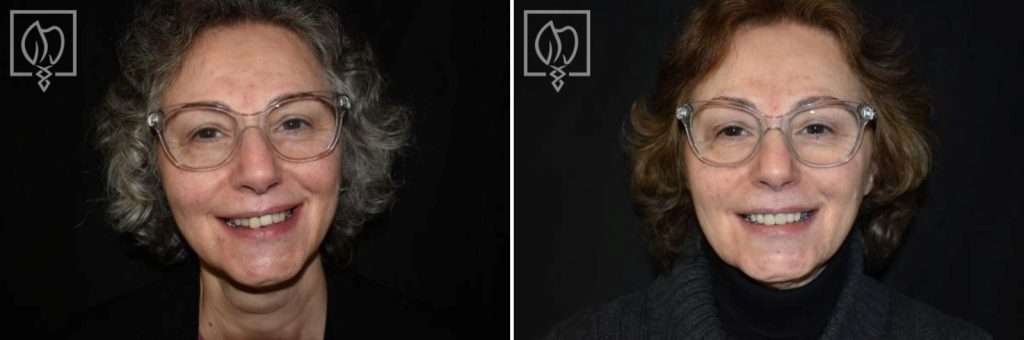
Temporary Crowns Restore Patient's Smile in Just One Day with an Immediate Smile Makeover
A patient from Potomac, Maryland, came to Elite Prosthetic Dentistry with the chief complaint of pain from a failing dental implant and its significant impact on her appearance.
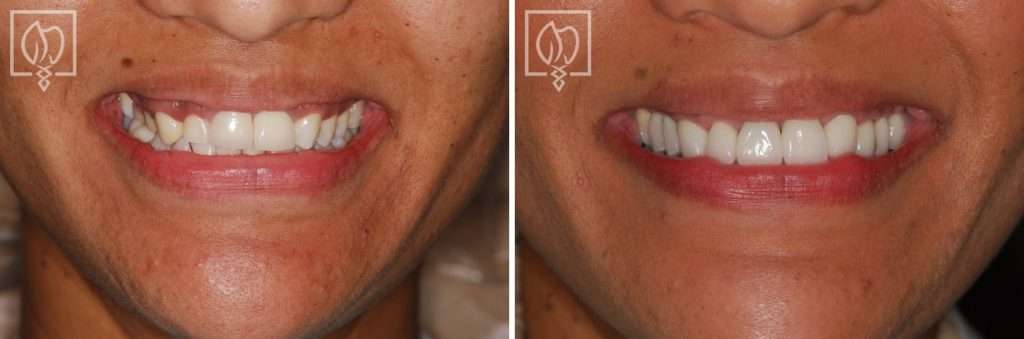
Multi-Faceted Treatment for Patient Unhappy With Her Artificial-Looking Crowns, Teeth and Gums
Many patients come to Elite Prosthetic Dentistry unhappy with the appearance of their smile. However, this particular patient presented with multiple interconnected problems that together created a smile she found deeply unsatisfying.
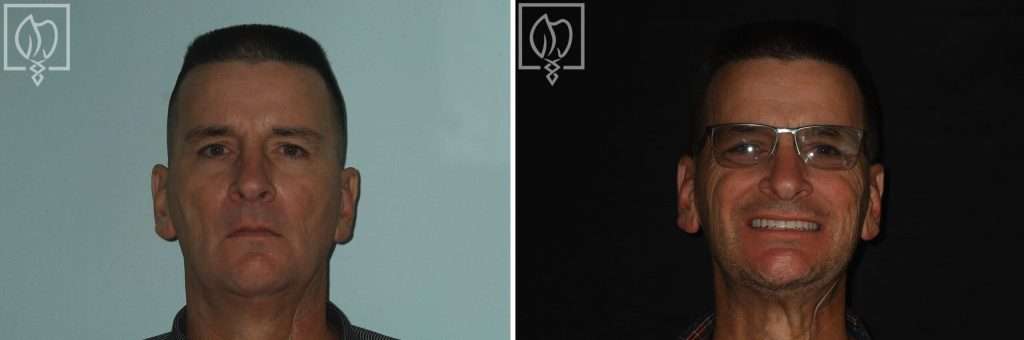
Treating Kevin’s Collapsed Bite with a Complete Smile Makeover with New Dentures
Dentures are sometimes not created to the ideal aesthetic and functional scheme. When improperly fabricated, dentures can make an individual appear almost a generation older than their actual age. They can have a poor fit that feels loose and unstable when eating or speaking, and they can actually accelerate bone loss over time.
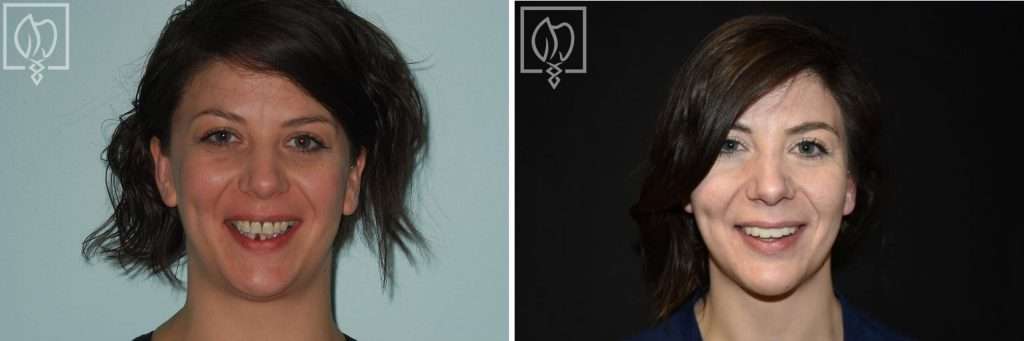
Salvaging Ms. N’s Severely Broken-Down Upper and Lower Teeth from Gum and Bone Disease
Many people in the U.S. suffer from extensive periodontal disease characterized by significant bone loss and shrinkage of the gum tissue. This condition can begin at a very young age and worsen quickly due to hereditary factors and lack of early diagnosis by their dentist.
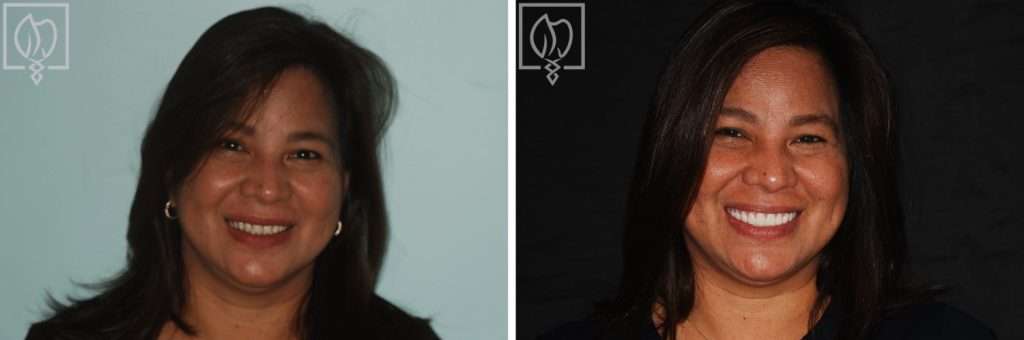
Rejuvenating Maria’s Severely Worn Down Implant Overdentures
Many times, per year, patients come to us frustrated because their implant prosthesis is so severely worn down that they are very self-conscious and cover up their smile. They look and feel much older than their age as a result of the extensive wear of their appliance(s).
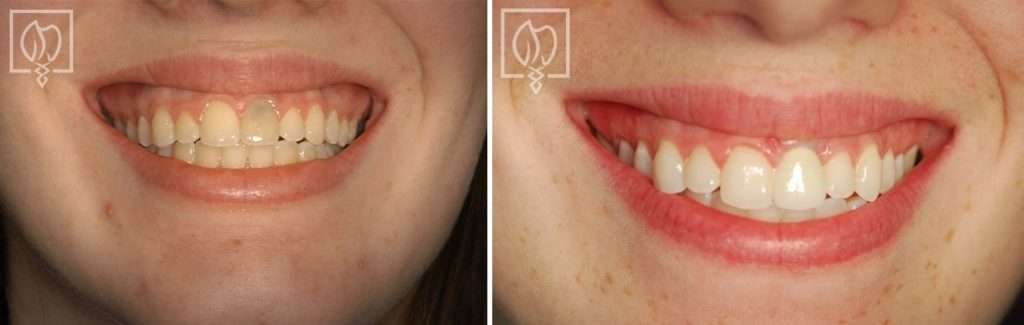
Replacing a Discolored Front Tooth with a Precision Placed Implant
Some of the most challenging restorations occur when fabricating an anterior crown to fit on an implant. Not only does one have the difficulty of matching the single front tooth to the other ones in the high visibility zone, but the dentist must also ensure the position of the underlying implant is precise through accurate preplanning and placement.
Related Articles
Deepen your knowledge with additional insights on this topic.
 Dental Implants
 If a Single Front Tooth is Replaced with an Implant, can it Look Natural?
A single front tooth implant can look completely natural with precision placement, custom abutments, and hand-crafted porcelain crowns. Washington, DC.
 Dental Implants
 What is Precision Implant Placement (PIP)?
Learn what Precision Implant Placement (PIP) is and how meticulous planning ensures optimal implant positioning for long-lasting results in Washington, DC.
 Dental Implants
 What is the ideal Surgical Guide for Precision Implant Placement?
CBCT-based surgical guides allow virtual implant planning for precise positioning in optimal bone, ensuring predictable results in Washington, DC.
 Dental Implants
 When Should an Implant not be Done?
Not every patient is a candidate for dental implants. Learn when healthy roots, fragile bone, or steep angles may make alternatives the better choice.
 Dental Implants
 What is Staged Implant Therapy?
Staged implant therapy replaces teeth gradually using existing teeth as temporary support. A personalized alternative to All-on-X for full-arch cases.
Unveiling the Four Types of Dental Implants: Which One's for You?
Learn about the four types of dental implants - endosteal, subperiosteal, zygomatic, and mini implants - and which option may be right for your needs.
Our Services in Bethesda
Beyond failed-all-on-4, Bethesda patients rely on Dr. Gerald Marlin for a full range of advanced dental care.
More services available in Bethesda:
failed-all-on-4 Near Bethesda
Dr. Gerald Marlin also provides failed-all-on-4 services for patients in these neighboring communities.
Getting Here from Bethesda
Elite Prosthetic Dentistry is conveniently located near Bethesda, MD.
Elite Prosthetic Dentistry is located just minutes from downtown Bethesda, easily accessible via Wisconsin Avenue or Old Georgetown Road.
Address:
4400 Jenifer Street NW, Suite 220
Washington, DC 20015
Phone: (202) 244-2101
Schedule ConsultationSchedule Your Consultation from Bethesda
Bethesda residents trust Dr. Gerald Marlin for precision dental care. With 3,900+ implants placed and 40+ years of experience, your smile is in expert hands.