

Failed All-on-4 Implants in Potomac, MD
Bite problems with your All-on-4? Uneven forces, jaw pain, TMJ issues. Expert occlusal revision in Potomac. Restore balance and comfort.
Failed All-on-4 Implants in Potomac, MD: Correcting Bite Problems and Occlusal Imbalance
Your All-on-4 implants are healthy. The prosthesis is stable and functional. But something is not quite right with your bite. You notice that when you chew, your teeth do not come together evenly. The back teeth on one side hit harder than the other. Or perhaps the opposite, and one side feels like it is making contact first, creating an awkward timing to your chew. You may have developed jaw pain or tension, clicking in your jaw joint, or headaches that seem related to chewing.
These bite problems, called occlusal imbalance, are more common after All-on-4 treatment than many patients realize. The good news is that they are often correctable through comprehensive advanced restorative dentistry, and correction can resolve jaw pain and muscle tension relatively quickly.
How All-on-4 Bite Problems Develop
A healthy bite is one where all your teeth contact evenly when you bite down, and where your jaw closes smoothly into its most comfortable position. The bite is achieved by careful measurement of your jaw relationships and precise fabrication of the prosthesis to match those relationships through precision implant placement.
However, several factors can lead to bite problems in All-on-4 cases.
First, the measurements of your jaw relationship may have been taken at a suboptimal jaw position. The patient’s jaw might have been positioned forward or to one side during the bite registration. The measurements might have been taken while the jaw was in a retrusive position rather than the patient’s natural centric relation. The result is a prosthesis fabricated to match an unnatural jaw position, which feels wrong once the patient is healed and their jaw settles into its true position.
Second, the prosthesis may have been fabricated with an uneven bite. The lab may have made an error in the bite relationship. The prosthesis may have warped slightly during processing. Or the delivery was not adjusted properly at the time of insertion.
Third, bone loss may have occurred after the prosthesis was delivered. As bone is lost around implants, the implants shift position slightly. The prosthesis, which was once balanced, now sits at a different angle, creating an uneven bite. This may require bone grafting and prosthesis redesign.
Fourth, the original bite may have been acceptable, but over time, the patient has developed a habit of favoring one side when chewing to avoid contact on the other side. This is sometimes a response to initial discomfort or perceived instability. Over months, this habit becomes entrenched, and the patient reports that their bite now feels wrong.
The Biomechanics of Uneven Load Distribution
When your bite is uneven, the forces you generate during chewing are distributed unevenly across your implants and prosthesis. This has several negative consequences.
First, it accelerates bone loss on the overloaded side. The implants receiving excessive force experience bone resorption as the body attempts to reduce stress. Over time, bone loss becomes significant, causing instability.
Second, uneven loading can cause the prosthesis itself to flex or rock slightly. This micromotion compromises the seal between the prosthesis and the implants, allowing bacteria to colonize underneath. Peri-implantitis may develop, leading to further bone loss.
Third, uneven forces stress the jaw joint and muscles. Your temporomandibular joint is not designed to handle asymmetrical forces. Over time, joint pain, muscle pain, or dysfunction can develop.
Fourth, an uneven bite often triggers or perpetuates bruxism, or nighttime grinding. The patient’s nervous system recognizes that something is wrong with the bite, and muscles tighten in response. The patient grinds at night attempting to equalize the forces. The grinding causes further stress on the implants and prosthesis.
Symptoms of Occlusal Imbalance
The symptoms of bite problems in an All-on-4 prosthesis are diverse and sometimes subtle.
You might notice that when you bite on a toothpick or small object, the contact is heavier on one side than the other. One tooth or tooth area always contacts first before the others.
You might notice that you have a preference for chewing on one side of your mouth. This preference was not present right after your prosthesis was delivered, but developed over time.
You might have jaw pain that is worse at the end of the day or worse during or after chewing. The pain might be in the jaw joint itself, in the muscles around the jaw, or in the temples.
You might notice clicking or popping in your jaw joint when you open or close your mouth. You might have restricted jaw opening. You might have difficulty with certain foods due to jaw discomfort.
You might have developed tension headaches or migraines related to chewing.
Some patients develop sensitivity or mobility of teeth, or they notice that one tooth seems to be contacting too heavily.
The Evaluation Process
When you come to us with concerns about your All-on-4 bite, we perform a comprehensive occlusal analysis. This is much more detailed than a simple check of how your teeth contact.
We assess your bite in what we call centric relation, which is the most stable position of your jaw. We examine how your teeth contact in this position. Are they even? Is there one tooth or group of teeth contacting first?
We assess your bite in maximum intercuspal position, which is where you naturally close into maximum contact. This may be different from centric relation. Some patients naturally close into a slide from centric relation to maximum intercuspal, and this is normal if the slide is small and smooth.
We assess your jaw opening and closing pattern. Does your jaw open straight, or does it deviate to one side? Deviations may indicate joint or muscle dysfunction.
We palpate your jaw muscles and joint. Are the muscles tender? Is the joint clicking or popping?
We examine your teeth for signs of uneven contact, such as wear patterns or high spots.
We take radiographs to assess bone levels. If bone loss has occurred unevenly, it supports the diagnosis that bite forces have been unbalanced.
In some cases, we may use a bite analysis device that can measure the force distribution across your bite. This technology allows us to see exactly where the heavy contacts are and where the light contacts are.
Solutions for Bite Problems
Once we have identified the nature of your bite problem, we discuss solutions. The appropriate solution depends on the severity of the problem and the cause.
For mild bite problems, simple occlusal adjustment may be sufficient. We refine the shape of your artificial teeth to create more even contact. This is done with small adjustments to the prosthesis surface. No permanent changes are made initially. We make adjustments, ask you if the feel has improved, and repeat until you are comfortable.
For more significant problems, we may recommend a period of trial with a bite splint. The splint is a thin covering for your teeth that places your jaw in a more neutral, stable position. You wear the splint at night and sometimes during the day. After several weeks of wearing the splint, if your symptoms resolve, we know that occlusal correction will help. We can then proceed with confidence to make permanent changes to your prosthesis.
For substantial bite problems, we may need to fabricate a new prosthesis with corrected occlusion. This involves taking a new bite record with your jaw in its most stable position, confirming that position radiographically and clinically, and then fabricating a new prosthesis to match that position.
In cases where bone loss has occurred unevenly, we may need to place bone grafts to level the ridge before we can create a balanced bite. This advanced restorative approach ensures your prosthesis functions optimally long-term and supports implant health.
The Role of Jaw Stability in Long-Term Success
One thing many patients do not understand is that a balanced bite is crucial for long-term implant success. If your bite is unbalanced, your implants are at higher risk for bone loss, failure, and other complications. Conversely, if your bite is balanced and your forces are distributed evenly, your implants are far more likely to remain healthy long-term.
This is why we take bite problems seriously. It is not just about your comfort in the moment. It is about the longevity of your dental implants. If you are experiencing bite problems, addressing them promptly through repairing failing implants strategies is an investment in the long-term success of your restoration.
Bruxism and Occlusal Problems
If you have a history of teeth grinding or clenching, or if you develop grinding after your All-on-4 is placed, this is often a response to an unbalanced bite. Your nervous system detects that something is wrong, and your muscles respond by clenching and grinding.
Once your bite is corrected, grinding often diminishes or stops. However, if grinding is severe, or if it has become a habit even after bite correction, a protective nightguard worn during sleep can help protect your prosthesis from damage.
TMJ Dysfunction and Its Relationship to All-on-4 Bite
Temporomandibular joint dysfunction, or TMJ disorder, is sometimes triggered or perpetuated by an unbalanced All-on-4 bite. The uneven forces stress the joint, the ligaments supporting the joint, and the muscles that move the jaw. Over time, this can cause joint pain, cartilage damage, or muscle dysfunction.
The good news is that TMJ pain related to an All-on-4 bite problem often improves significantly once the bite is corrected. The joint is relieved of the abnormal stress, inflammation subsides, and pain resolves.
In some cases, patients have severe TMJ dysfunction that requires additional treatment beyond bite correction. We work with TMJ specialists when needed to optimize outcomes.
Timeline for Correction
The timeline for correcting an All-on-4 bite problem depends on the solution chosen. If a simple occlusal adjustment is sufficient, correction may take one to two appointments, separated by a few days to allow you to adapt to the changes and report back on how you are feeling.
If a bite splint trial is recommended, you would wear the splint for four to eight weeks while we assess your response. If symptoms improve, we proceed with permanent correction.
If a new prosthesis is needed, fabrication typically takes two to four weeks. During that time, you may continue wearing your current prosthesis with any available adjustments made for comfort.
In cases requiring bone grafting before prosthesis revision, the timeline extends to allow bone graft maturation before proceeding with bite correction.
The Specialist Approach to Occlusal Problems
Bite problems in All-on-4 cases require expertise in implant prosthodontics and advanced restorative dentistry. A general dentist may make simple occlusal adjustments, but comprehensive assessment and correction of complex bite problems requires a prosthodontist who understands implant biomechanics, jaw function, and the interface between bite and implant longevity.
Dr. Gerald Marlin has decades of experience managing occlusal problems in complex implant cases. He understands how bite problems develop, how they manifest, and how to correct them systematically. He will take the time to assess your situation thoroughly and recommend the solution most likely to give you long-term success.
Serving Potomac with Advanced Occlusal Expertise
Potomac residents often have high standards for their healthcare and expect professionals to take time to understand complex problems and implement thoughtful solutions. Many Potomac patients come to us with bite problems that have persisted for months or years after their All-on-4 was placed. They have learned to live with discomfort or jaw pain, thinking that nothing could be done to improve the situation.
We want you to know that bite problems are correctable. If you have an unbalanced bite, jaw pain, TMJ dysfunction, or other symptoms related to your All-on-4 bite, we can help. The solution may be as simple as an occlusal adjustment, or it may require more involved treatment. Either way, the goal is to restore balance, comfort, and long-term implant stability.
Contact us for a comprehensive occlusal evaluation. We will assess your bite, explain what is happening, and recommend the most appropriate solution. Many patients are amazed at how much their comfort and confidence improve once their bite is corrected.
Additional Resources
Learn more about our approach to full-mouth dental implants and optimal bite design. Understand how our in-house laboratory ensures precision in prosthesis fabrication that directly impacts your bite and comfort. Explore our expertise in repairing failing implants and preventing complications through proper occlusal management. Review our precision implant placement philosophy and fixed prosthodontics approach. Learn about sedation dentistry options for comfortable revision. Explore financing solutions for bite correction. Visit Dr. Marlin’s biography and credentials. We welcome second opinions on bite and implant concerns. Request your comprehensive occlusal evaluation today.
Frequently Asked Questions
Why do some All-on-4 prostheses create bite problems?
Bite problems occur when the prosthesis is not adjusted precisely to match your jaw relationships or when the bite is designed based on measurements taken while your jaw is in an unusual position. The resulting bite may be heavy on one side, creating uneven forces. Over time, this uneven load distribution causes problems.
Can bite problems from All-on-4 cause TMJ pain?
Yes. An unbalanced bite creates asymmetrical forces that put stress on the jaw joint and the muscles that move the jaw. Over time, this can cause pain, clicking, or restriction of jaw opening. TMJ pain from All-on-4 bite problems typically improves significantly once the bite is corrected.
How can I tell if my All-on-4 bite is causing my jaw problems?
Signs include uneven contact with your back teeth when you bite, pain on one side of the jaw, clicking or popping in the jaw joint, restricted jaw opening, muscle tension or headaches, or preference for chewing on one side. Occlusal adjustment often provides relief.
Is correcting the bite in an All-on-4 complicated?
It depends on the extent of the problem. Small adjustments can be made chairside by adjusting the prosthesis itself. More significant problems may require splinting the teeth to a more neutral jaw position, creating a new bite record, and fabricating a new prosthesis with corrected occlusion. The solution is determined after careful evaluation.
How long does it take to correct an All-on-4 bite problem?
If a simple occlusal adjustment is sufficient, correction may take just one appointment. If prosthesis modification or replacement is needed, allow two to four weeks for fabrication. Some patients also benefit from a period with a temporary bite splint to confirm that occlusal correction will resolve their symptoms before committing to permanent changes.
Related Patient Success Stories
Explore similar patient success stories demonstrating our expertise in advanced prosthetic dentistry.

Temporary Crowns Restore Patient's Smile in Just One Day with an Immediate Smile Makeover
A patient from Potomac, Maryland, came to Elite Prosthetic Dentistry with the chief complaint of pain from a failing dental implant and its significant impact on her appearance.
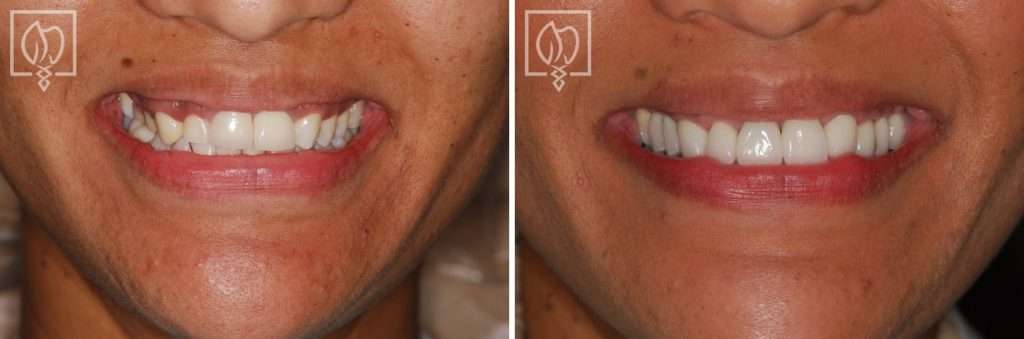
Multi-Faceted Treatment for Patient Unhappy With Her Artificial-Looking Crowns, Teeth and Gums
Many patients come to Elite Prosthetic Dentistry unhappy with the appearance of their smile. However, this particular patient presented with multiple interconnected problems that together created a smile she found deeply unsatisfying.
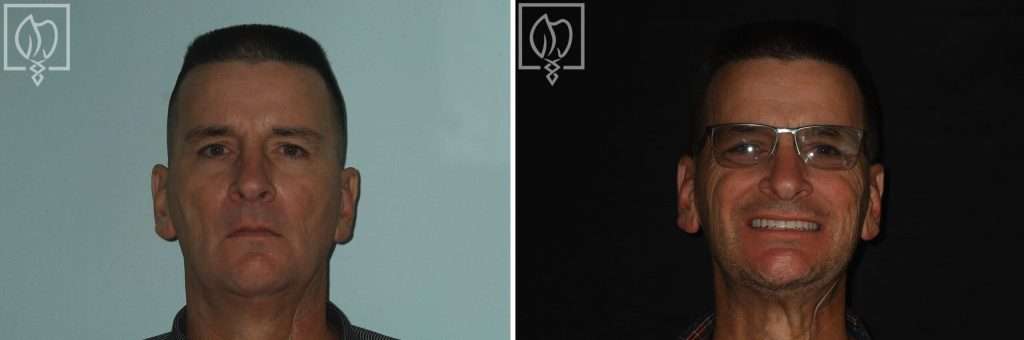
Treating Kevin’s Collapsed Bite with a Complete Smile Makeover with New Dentures
Dentures are sometimes not created to the ideal aesthetic and functional scheme. When improperly fabricated, dentures can make an individual appear almost a generation older than their actual age. They can have a poor fit that feels loose and unstable when eating or speaking, and they can actually accelerate bone loss over time.

Salvaging Ms. N’s Severely Broken-Down Upper and Lower Teeth from Gum and Bone Disease
Many people in the U.S. suffer from extensive periodontal disease characterized by significant bone loss and shrinkage of the gum tissue. This condition can begin at a very young age and worsen quickly due to hereditary factors and lack of early diagnosis by their dentist.

Rejuvenating Maria’s Severely Worn Down Implant Overdentures
Many times, per year, patients come to us frustrated because their implant prosthesis is so severely worn down that they are very self-conscious and cover up their smile. They look and feel much older than their age as a result of the extensive wear of their appliance(s).
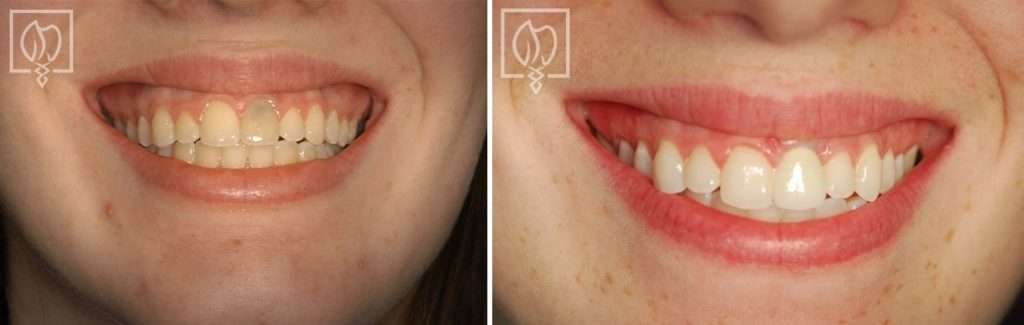
Replacing a Discolored Front Tooth with a Precision Placed Implant
Some of the most challenging restorations occur when fabricating an anterior crown to fit on an implant. Not only does one have the difficulty of matching the single front tooth to the other ones in the high visibility zone, but the dentist must also ensure the position of the underlying implant is precise through accurate preplanning and placement.
Related Articles
Deepen your knowledge with additional insights on this topic.
 Dental Implants
 If a Single Front Tooth is Replaced with an Implant, can it Look Natural?
A single front tooth implant can look completely natural with precision placement, custom abutments, and hand-crafted porcelain crowns. Washington, DC.
 Dental Implants
 What is Precision Implant Placement (PIP)?
Learn what Precision Implant Placement (PIP) is and how meticulous planning ensures optimal implant positioning for long-lasting results in Washington, DC.
 Dental Implants
 What is the ideal Surgical Guide for Precision Implant Placement?
CBCT-based surgical guides allow virtual implant planning for precise positioning in optimal bone, ensuring predictable results in Washington, DC.
 Dental Implants
 When Should an Implant not be Done?
Not every patient is a candidate for dental implants. Learn when healthy roots, fragile bone, or steep angles may make alternatives the better choice.
 Dental Implants
 What is Staged Implant Therapy?
Staged implant therapy replaces teeth gradually using existing teeth as temporary support. A personalized alternative to All-on-X for full-arch cases.
Unveiling the Four Types of Dental Implants: Which One's for You?
Learn about the four types of dental implants - endosteal, subperiosteal, zygomatic, and mini implants - and which option may be right for your needs.
Our Services in Potomac
Beyond failed-all-on-4, Potomac patients rely on Dr. Gerald Marlin for a full range of advanced dental care.
More services available in Potomac:
failed-all-on-4 Near Potomac
Dr. Gerald Marlin also provides failed-all-on-4 services for patients in these neighboring communities.
Getting Here from Potomac
Elite Prosthetic Dentistry is conveniently located near Potomac, MD.
Elite Prosthetic Dentistry is located 12 minutes from Potomac, easily accessible via River Road or the Clara Barton Parkway.
Address:
4400 Jenifer Street NW, Suite 220
Washington, DC 20015
Phone: (202) 244-2101
Schedule ConsultationSchedule Your Consultation from Potomac
Potomac residents trust Dr. Gerald Marlin for precision dental care. With 3,900+ implants placed and 40+ years of experience, your smile is in expert hands.