

Failed All-on-4 Implants in Arlington, VA
Food trapping in All-on-4? Impossible to clean? Redesign your bridge for better access and easier maintenance. Expert solution in Arlington.
Failed All-on-4 Implants in Arlington, VA: Addressing Food Trapping and Hygiene Problems
You bite down on a piece of bread, and immediately you feel it wedge underneath your All-on-4 bridge. Throughout your meal, you are acutely aware of food accumulating in spaces you cannot access with your toothbrush. After eating, you spend ten minutes using floss threaders, water irrigation devices, and picks trying to excavate the food that is trapped underneath. Despite your best efforts, you still feel debris lingering. You wonder if this is normal, or if your All-on-4 has a design flaw.
The uncomfortable truth is that some All-on-4 prostheses are more prone to food trapping than others. The design itself, the way the artificial gum contours are shaped, the positioning of the dental implants, and the angles of the bridge all influence how easy or difficult it is to maintain. In poorly designed cases, even conscientious patients struggle to keep the restoration clean, and bone loss accelerates as bacteria thrive in the areas they cannot access.
The Biomechanics of Food Trapping
Food trapping occurs when the undersurface of your All-on-4 bridge has spaces where food can accumulate but cannot be easily removed by normal cleaning. Several design factors contribute to this problem.
The contour of the artificial gum line is critical. If the gums are highly scalloped with deep interdental spaces, food is more likely to be pushed down into these crevices when you bite. If the gums have a flatter contour with gentle slopes, food is more likely to be shed away from the teeth.
The position of the implants relative to each other is also important. If implants are too close together, the space between the teeth is very narrow, making it difficult to floss. If implants are farther apart, there is more space for cleaning tools. This is where precision implant placement becomes critical.
The angle and contour of the undersurface of the bridge influences accessibility. A bridge with a smooth, flat undersurface is easier to clean than one with crevices, overhangs, or recesses that promote loose dental implants.
The material and texture of the prosthesis matters as well. Acrylic surfaces can develop rough spots or grooves where food can lodge. Highly polished surfaces shed food more readily than textured surfaces.
Finally, your personal anatomy and how you bite influences food trapping. Patients with a wide palate may have more difficulty accessing the undersurface of their bridge. Patients with a deep bite may force food up under the bridge with more force.
The Consequences of Poor Cleansability
Many patients underestimate the consequences of food trapping and poor cleansability. They think it is simply an inconvenience that makes eating less enjoyable.
However, persistent food trapping has serious implications for your implant health. Trapped food becomes a reservoir for bacteria. The bacteria ferment the food, creating acids that demineralize tooth structure and damage the acrylic of your prosthesis. More importantly, the bacteria attack your gums and the bone around your implants.
Over weeks and months, the persistent bacterial challenge overwhelms your immune response. Inflammation develops around the implants. Bone loss accelerates. The implants become less stable. Your prosthesis begins to rock or move. You develop the sensation that your bridge is loose or shifting.
Eventually, if the problem is not addressed, peri-implantitis becomes established, and implant failure follows.
This is why food trapping is not simply an inconvenience. It is a design problem that threatens the longevity of your implants.
Evaluating Your Specific Food Trapping Problem
When you come to us with complaints about food trapping, we perform a detailed evaluation to understand the specific design factors contributing to your problem.
We visually inspect the undersurface of your prosthesis and the contour of the artificial gums. We look for crevices, overhangs, or other features that create spaces where food can lodge.
We clinically demonstrate which areas trap food most readily by having you eat a test food and observing where accumulation occurs.
We assess your oral anatomy, particularly your palatal depth and the positioning of your implants relative to your natural anatomy.
We discuss your personal factors, such as how much you enjoy eating certain foods, your tolerance for the time required for cleaning, and your overall goals for revision.
Based on this evaluation, we determine whether the problem is addressed through a design modification to your existing bridge, or whether a new bridge with improved design is indicated.
Design Solutions for Food Trapping
If the problem is primarily localized to specific areas, we may be able to modify your existing prosthesis. We can smooth crevices, eliminate overhangs, and reshape the undersurface to reduce accessibility for food. This approach is less expensive than prosthesis replacement and can often be accomplished within a week or two.
However, if food trapping is inherent to the original bridge design, modification is often limited in what it can achieve. More substantial improvements require fabricating a new bridge specifically designed to minimize food trapping.
When we design a new bridge to address food trapping, we incorporate several principles:
A flatter undersurface with minimal recesses or crevices. This reduces the number of places where food can lodge.
Gentle slopes and contours rather than sharp angles. Food is more likely to be shed away from the bridge with gentle contours.
Properly spaced implants that allow adequate access for cleaning tools. Implants should be separated enough that floss threaders and water irrigation can reach between teeth.
Artificial gum contours that slope away from the teeth rather than creating deep interdental spaces. This directs food away rather than into crevices.
A smooth, polished surface that does not trap or hold food as readily as a textured surface.
Consideration of your specific anatomy so that the bridge design accommodates your palatal anatomy and the way your jaw and tongue naturally move during eating.
Cleansability Versus Esthetics: The Balance
One challenge in addressing food trapping is that the design features that minimize food trapping sometimes compromise esthetics. A bridge with a completely flat undersurface and minimal interdental spaces looks less natural than one with sculpted gums and natural-appearing spaces between teeth.
We discuss this balance with each patient. How much esthetics are you willing to trade for improved cleansability? For some patients, minimal food trapping is worth a slight compromise in esthetics. For others, appearance is paramount, and they are willing to tolerate food trapping and the extra maintenance it requires.
The good news is that modern prosthesis designs allow us to optimize both cleansability and esthetics to a degree that was not possible years ago. With careful planning and design, we can often achieve both.
The Transition to Individual Implants
Some patients with severe food trapping problems from their All-on-4 bridges ask whether switching to individual crowns on separate implants might be better. This is a valid question worthy of careful consideration.
Individual implant crowns do trap less food than a fixed All-on-4 bridge, because there is access around and between each tooth. Food is less likely to accumulate. Cleaning is somewhat easier.
However, the tradeoff is that individual crowns require more implants, which means more surgical procedures and higher cost. Additionally, individual crowns placed on implants at different levels may not look as esthetically harmonious as a single fixed bridge where all teeth are at the same level.
We discuss this option with patients who have severe food trapping and for whom modification of their All-on-4 is insufficient. In some cases, conversion to individual implant crowns or a hybrid approach using both fixed and removable components may be appropriate, similar to approaches for managing bite collapse after reconstruction.
Material Considerations
The material of your All-on-4 bridge influences how prone it is to food trapping and how easily it can be kept clean. Acrylic, which is common and less expensive, is more porous and more likely to develop surface irregularities where food can lodge.
Zirconia, by contrast, has a very smooth, non-porous surface that does not trap food as readily. Food tends to slide off zirconia more easily than off acrylic. If you are having significant food trapping problems, consideration of material upgrade to zirconia may be part of the solution. Material selection is part of comprehensive advanced restorative dentistry and fixed prosthodontics that considers both function and longevity.
Teaching Patients Optimal Cleaning Techniques
Beyond design changes, teaching you optimal cleaning techniques can reduce food trapping challenges. Some patients are not using their cleaning tools correctly, or they are using inadequate tools.
We teach proper flossing under the bridge using floss threaders. Many patients do not realize that the floss needs to go under the bridge and then be worked back and forth under each tooth. We demonstrate the correct technique.
We recommend and sometimes demonstrate water irrigation devices that can flush food from under the bridge. These devices, when used correctly, are often more effective than floss threading.
We discuss the best tools for your specific situation, such as soft picks, specialized interdental brushes, or other devices designed for implant and bridge cleaning.
We emphasize that cleaning should be done immediately after meals to prevent food from hardening and becoming difficult to remove. A quick rinse or floss threading right after eating is far more effective than waiting hours to clean.
Timeline for Addressing Food Trapping Issues
If your bridge is modified in-office to reduce food trapping, the timeline is very short. You might have the modification completed within days.
If a new bridge is designed and fabricated to address food trapping, allow two to four weeks for design, fabrication, and delivery.
During the time your new bridge is being fabricated, you continue wearing your current bridge. You are not without teeth or with a temporary prosthesis.
When your new bridge is ready, we remove your old bridge and place the new one. We make adjustments to ensure perfect fit and optimal comfort. You immediately begin experiencing the improved cleansability of the new design.
Prevention of Future Food Trapping
Once we have addressed your food trapping problem, preventing recurrence is important. This involves both conscientious use of the optimal design and careful daily maintenance.
Continue using the cleaning techniques we have recommended. Do not discontinue water irrigation or floss threading just because the new design is more accessible. Continued diligence prevents problems from recurring.
Attend professional cleaning visits as recommended. We can assess any areas that may be developing new deposits and address them before bone loss begins. In some cases, if bone loss has already occurred around implants, bone grafting may be necessary to restore support and stability.
Watch your diet. While you should be able to eat most foods, be especially careful with sticky or stringy foods that are particularly prone to trapping.
Serving Arlington with Design Expertise
Arlington residents often work in high-pressure environments and have limited time to spend on extensive dental maintenance. We understand that you want a solution that works, that you can maintain reasonably easily, and that you do not have to think about constantly.
We design solutions with your lifestyle in mind. Your All-on-4 should work for you, not against you. If your current bridge traps food excessively, that is a design problem that we can address with full-mouth reconstruction expertise.
Contact us for an evaluation of your food trapping issues. We will assess your specific situation, explain the design factors contributing to the problem, and propose solutions that work for your anatomy and your lifestyle. You deserve an All-on-4 that is clean, functional, and esthetically beautiful.
Additional Resources
Learn more about our full-mouth dental implants design principles. Understand how our precision implant placement affects downstream prosthesis design and cleansability. Explore our in-house laboratory capabilities for custom design solutions. Review Dr. Marlin’s credentials in prosthodontic design. Learn about our approach to repairing failing implants and preventing complications. Consider bone grafting options if ridge rebuilding would improve results. Explore sedation dentistry for comfortable revision procedures. We welcome second opinions on design and maintenance concerns. Schedule your cleansability evaluation today.
Frequently Asked Questions
Why do some All-on-4 bridges trap food so much more than others?
Food trapping occurs when the undersurface of the bridge has crevices or tight spaces where food accumulates and cannot be cleaned out. The design of the bridge, the angles of the artificial gums, and the positioning of the implants all influence how prone a bridge is to food trapping. Some designs are inherently easier to clean than others.
Is food trapping just an inconvenience, or is it a serious problem?
Food trapping is more than inconvenient. Trapped food becomes home to bacteria that cause inflammation and bone loss around your implants. Over time, food trapping accelerates peri-implantitis and implant failure. It is a serious problem that should be addressed.
Can my current All-on-4 bridge be modified to reduce food trapping?
Sometimes, yes. We can modify the undersurface of the bridge to eliminate tight spaces and create a design that is easier to clean. However, major redesign often requires fabricating a new bridge rather than modifying the existing one.
What is the best All-on-4 design for minimal food trapping?
Designs with a flatter, more accessible undersurface, with gentle angles rather than sharp crevices, and with implant spacing that allows access for cleaning tools, trap less food. We can also design the artificial gum contours to slope away from the teeth rather than creating deep spaces between teeth.
Would switching to individual implant crowns eliminate food trapping?
Individual crowns on separate implants do reduce food trapping compared to a fixed bridge, because there is access between each tooth. However, individual crowns have other considerations including higher cost, more implants needed, and sometimes slightly less esthetic results. We discuss this as an option if it aligns with your goals.
Related Patient Success Stories
Explore similar patient success stories demonstrating our expertise in advanced prosthetic dentistry.

Temporary Crowns Restore Patient's Smile in Just One Day with an Immediate Smile Makeover
A patient from Potomac, Maryland, came to Elite Prosthetic Dentistry with the chief complaint of pain from a failing dental implant and its significant impact on her appearance.
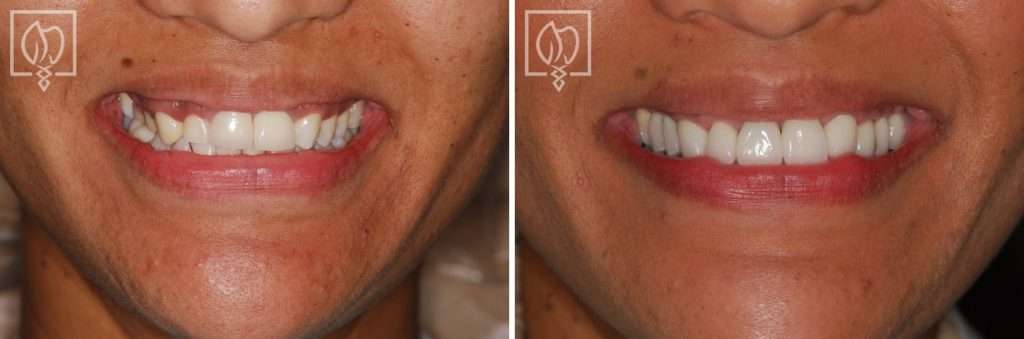
Multi-Faceted Treatment for Patient Unhappy With Her Artificial-Looking Crowns, Teeth and Gums
Many patients come to Elite Prosthetic Dentistry unhappy with the appearance of their smile. However, this particular patient presented with multiple interconnected problems that together created a smile she found deeply unsatisfying.

Treating Kevin’s Collapsed Bite with a Complete Smile Makeover with New Dentures
Dentures are sometimes not created to the ideal aesthetic and functional scheme. When improperly fabricated, dentures can make an individual appear almost a generation older than their actual age. They can have a poor fit that feels loose and unstable when eating or speaking, and they can actually accelerate bone loss over time.
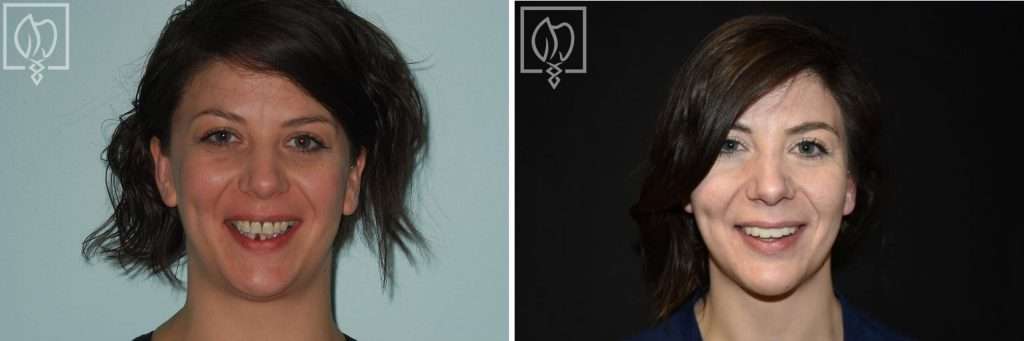
Salvaging Ms. N’s Severely Broken-Down Upper and Lower Teeth from Gum and Bone Disease
Many people in the U.S. suffer from extensive periodontal disease characterized by significant bone loss and shrinkage of the gum tissue. This condition can begin at a very young age and worsen quickly due to hereditary factors and lack of early diagnosis by their dentist.

Rejuvenating Maria’s Severely Worn Down Implant Overdentures
Many times, per year, patients come to us frustrated because their implant prosthesis is so severely worn down that they are very self-conscious and cover up their smile. They look and feel much older than their age as a result of the extensive wear of their appliance(s).
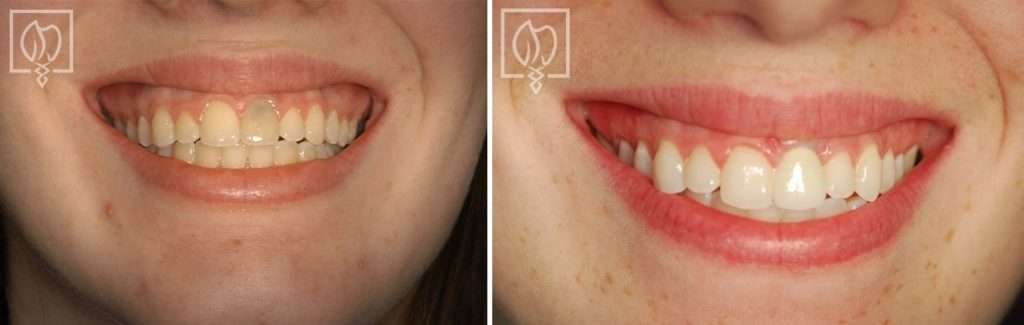
Replacing a Discolored Front Tooth with a Precision Placed Implant
Some of the most challenging restorations occur when fabricating an anterior crown to fit on an implant. Not only does one have the difficulty of matching the single front tooth to the other ones in the high visibility zone, but the dentist must also ensure the position of the underlying implant is precise through accurate preplanning and placement.
Related Articles
Deepen your knowledge with additional insights on this topic.
 Dental Implants
 If a Single Front Tooth is Replaced with an Implant, can it Look Natural?
A single front tooth implant can look completely natural with precision placement, custom abutments, and hand-crafted porcelain crowns. Washington, DC.
 Dental Implants
 What is Precision Implant Placement (PIP)?
Learn what Precision Implant Placement (PIP) is and how meticulous planning ensures optimal implant positioning for long-lasting results in Washington, DC.
 Dental Implants
 What is the ideal Surgical Guide for Precision Implant Placement?
CBCT-based surgical guides allow virtual implant planning for precise positioning in optimal bone, ensuring predictable results in Washington, DC.
 Dental Implants
 When Should an Implant not be Done?
Not every patient is a candidate for dental implants. Learn when healthy roots, fragile bone, or steep angles may make alternatives the better choice.
 Dental Implants
 What is Staged Implant Therapy?
Staged implant therapy replaces teeth gradually using existing teeth as temporary support. A personalized alternative to All-on-X for full-arch cases.
Unveiling the Four Types of Dental Implants: Which One's for You?
Learn about the four types of dental implants - endosteal, subperiosteal, zygomatic, and mini implants - and which option may be right for your needs.
Our Services in Arlington
Beyond failed-all-on-4, Arlington patients rely on Dr. Gerald Marlin for a full range of advanced dental care.
More services available in Arlington:
failed-all-on-4 Near Arlington
Dr. Gerald Marlin also provides failed-all-on-4 services for patients in these neighboring communities.
Getting Here from Arlington
Elite Prosthetic Dentistry is conveniently located near Arlington, VA.
Elite Prosthetic Dentistry is located 15 minutes from Arlington, accessible via the Key Bridge, Wilson Boulevard, or Route 50.
Address:
4400 Jenifer Street NW, Suite 220
Washington, DC 20015
Phone: (202) 244-2101
Schedule ConsultationSchedule Your Consultation from Arlington
Arlington residents trust Dr. Gerald Marlin for precision dental care. With 3,900+ implants placed and 40+ years of experience, your smile is in expert hands.