

Veneer Fell Off in McLean, VA
Why do composite veneers debond more often than porcelain? McLean patients learn when upgrading material is the answer to prevent future failure.
Composite Versus Porcelain Veneer Failures: Why Your Restoration Debonded and When Upgrading Material Is the Answer
Your veneer fell off. Before you decide whether to rebond or replace, you need to know something critical: what type of veneer was it? If it was composite, the failure pattern you experienced is common. If it was porcelain, the failure is less common but still possible. Understanding the difference determines your best path forward.
What Is a Composite Veneer and Why Do They Debond?
A composite veneer is made from tooth-colored resin (the same material used for fillings) applied directly to your tooth in the dental chair. It’s sculpted and shaped while soft, then hardened with a curing light.
The bonding mechanism for composite is entirely resin-to-tooth bonding. The composite resin flows into an acid-etched preparation. As it cures, it micro-mechanically interlocks with the etched enamel. The strength of the restoration depends entirely on this single interface.
This creates a vulnerability. Composite is bonded only to your tooth through resin. If that resin bond fails, the entire restoration is unsupported. Water infiltration, thermal cycling, or stress can degrade that resin interface over time. Once degradation starts, failure accelerates.
Additionally, composite itself absorbs water. Composite resins are hydrophilic to some degree, meaning they absorb moisture from saliva. Over months and years, the composite swells slightly as it absorbs water. This swelling creates stress within the restoration and at the margins. The stress eventually causes marginal separation and debonding.
Furthermore, composite is less stiff than tooth structure. It flexes under load. When you bite, the composite may flex more than the underlying tooth structure. This creates relative movement that fatigues the resin bond. After 3-5 years of constant flexing, the bond fails.
Finally, composite margins are difficult to seal perfectly. The junction between composite and tooth is prone to marginal leakage if the bond isn’t flawless. And even a perfect composite margin deteriorates over years as the resin and tooth experience different thermal expansion rates.
For these reasons, composite veneer failure is common. Studies show composite veneers have failure rates around 15-20% at 5 years and 30-40% at 10 years when debonding is included as a failure mode.
If your composite veneer fell off, you’re experiencing a predictable failure pattern, not a rare event. This is why upgrading to porcelain veneers or exploring advanced restorative dentistry options often provides better long-term solutions.
What Is a Porcelain Veneer and Why Is It More Retention-Resistant?
A porcelain veneer (also called a ceramic veneer) is fabricated in a dental laboratory based on impressions and specifications from your dentist. It’s a thin shell of ceramic material bonded to your tooth.
Porcelain veneers bond to your tooth through two mechanisms: resin-to-ceramic micro-mechanical locking and adhesive chemical bonding. Here’s how it works.
First, the back surface of the porcelain veneer is etched with hydrofluoric acid. This acid dissolves the glass component of the ceramic, creating microscopic pits and valleys. This is a permanent alteration of the ceramic surface.
Second, bonding resin is applied to the etched ceramic surface. The resin flows into the microscopic pits and locks in place mechanically as it cures.
Third, your tooth is also acid-etched and a bonding agent is applied.
Fourth, the veneer is positioned and the resin is cured. Now the veneer is locked to your tooth through two interfaces: the resin-to-ceramic interface (which is permanently locked in those microscopic pits) and the resin-to-tooth interface.
This dual-lock mechanism makes porcelain veneers much more retention-resistant than composite veneers. Even if the resin-to-tooth interface degrades over time, the resin-to-ceramic interface remains locked. The veneer stays in place.
Additionally, porcelain is rigid and doesn’t flex like composite. Under your bite force, the porcelain transmits force directly to your tooth without flexing. This prevents the cyclic stress that fatigues composite resin bonds.
Also, porcelain is hydrophobic (water-repelling) rather than hydrophilic. It doesn’t absorb water. The resin bonding to it doesn’t experience the swelling stress that water causes in composite.
Furthermore, the porcelain-resin interface at the etched surface is extremely strong. Studies show resin-ceramic bonding strength actually increases over time as the resin cures fully. With composite, bonding strength decreases over time as the composite absorbs water. For long-term restorations, fixed prosthodontics approaches using ceramics are inherently more durable.
For these reasons, porcelain veneer failure is less common. Studies show porcelain veneer failure rates around 5% at 5 years and 10-15% at 10 years. This is dramatically lower than composite.
If your veneer was porcelain, your failure is less predictable. Porcelain veneers should not debond routinely if bonded properly.
Identifying What Type of Veneer You Had
If you don’t know whether your veneer was composite or porcelain, the answers to these questions help identify:
Did your dentist place the veneer in one appointment, or did it require a lab and a second appointment? One appointment suggests composite. Lab fabrication and two appointments suggests porcelain.
Did your veneer feel slightly rough initially, or very smooth? Composite is often slightly rough initially before polishing. Porcelain is very smooth and hard.
Did your veneer feel slightly flexible or very rigid? Composite has minimal flex. Porcelain is more rigid.
When the veneer fell off, did it arrive in one piece or did it break into chunks? Composite often breaks into fragments. Porcelain usually stays intact as a single shell.
Did the veneer feel heavy or light in your hand? Porcelain is relatively heavy for its size. Composite is lighter.
If you still have your fallen veneer, show it to us. We can immediately identify the material and explain what you had and why it failed.
Composite Veneer Failures: Predictable and Common
If you had a composite veneer and it debonded, here’s why it likely happened:
First, your tooth preparation was probably minimal or no preparation was done. Composite veneers can be placed with almost no tooth removal. The preparation might have been limited to cleaning the surface and roughening it slightly.
This minimal preparation means less retention geometry. There’s less surface area for bonding. The preparation has no mechanical features like pins or grooves that would increase retention.
Second, the bonding surface may have been contaminated with saliva, blood, or moisture during placement. Composite bonding is extremely sensitive to moisture. Even tiny moisture droplets compromise the bond.
Third, your bite forces may have been concentrated on the restoration. If your bite is edge-to-edge or if you clench or grind, the composite undergoes stress that exceeds its ability to maintain the bond.
Fourth, composite absorbs water over time. As it absorbed moisture from your saliva over 3-5 years, it swelled and the resin bond weakened.
Fifth, the margins of the composite may not have been perfectly sealed. Marginal leakage gradually created voids and weakened the interface.
Any or all of these factors combined to cause your composite veneer to debond.
Porcelain Veneer Failures: Rarer and Indicative of Technique Issues
If you had a porcelain veneer and it debonded, failure suggests a technical problem:
First, your tooth preparation may have been inadequate. Porcelain veneers require proper preparation to seat fully and maintain proper margins. Insufficient preparation creates gaps that fail to bond.
Second, the bonding surface may have been contaminated during bonding. Porcelain is sensitive to moisture contamination during bonding, just like composite. If the preparation wasn’t isolated with a rubber dam or if moisture was introduced during bonding, the resin interface fails.
Third, the hydrofluoric acid etch of the porcelain may have been inadequate. If etching time was too short or concentration was too low, the ceramic surface wasn’t properly prepared for mechanical locking. The resin couldn’t grip the surface.
Fourth, the porcelain veneer itself may have been fabricated poorly. If the internal surface wasn’t etched correctly by the lab before sending it to your dentist, or if it was contaminated before bonding, the interface failed.
Fifth, your preparation may have involved significant dentin exposure. Dentin bonding is less reliable than enamel bonding. If your preparation was aggressive and largely exposed dentin, the resin-to-tooth interface was compromised from the start.
Porcelain veneer debonding is usually a sign that the bonding protocol wasn’t optimal. With proper technique, porcelain veneers rarely debond.
The Decision: Rebond Composite or Upgrade to Porcelain?
If you had a composite veneer that debonded, rebonding is one option. We can clean the surface, reetch it, and rebond it with modern adhesive protocols.
However, if composite failed once, the inherent material limitation will likely cause failure again in 3-5 years. We can improve bonding technique, but we can’t change the fact that composite absorbs water and flexes under load.
Upgrading to porcelain is the stronger long-term choice. Yes, it requires lab time and costs more upfront. But the porcelain veneer will likely last 15-20 years with good care. Over that timeframe, the increased longevity justifies the upfront cost.
If you had a porcelain veneer that debonded, rebonding is absolutely appropriate. We’ll use improved bonding protocol to ensure it stays bonded. Porcelain is the right material; the bonding technique just needs optimization.
However, if porcelain rebonding fails again, then we explore whether the tooth preparation itself is compromised. Replacement might be necessary.
Material Upgrading: The Economics of Longevity
Many McLean patients ask about the cost difference between rebonding composite and upgrading to porcelain. We don’t discuss pricing online, but the economics are important to consider.
Scenario A: You rebond your composite veneer. It costs less upfront. But it likely fails again in 3-5 years. You face another rebonding or replacement. Over 15 years, you spend money multiple times.
Scenario B: You upgrade to porcelain. It costs more upfront. But it lasts 15-20 years with good care. Over 15 years, you spend money once.
From a per-year cost perspective, porcelain is more economical even though the upfront cost is higher.
Additionally, repeated restorations aren’t risk-free. Each time we remove and rebond a restoration, we remove some resin, change the preparation slightly, and create microscopic stress in the tooth. After multiple cycles, your tooth may become compromised. Starting with a durable restoration minimizes the cumulative damage.
Modern Bonding Technique: Maximizing Retention Regardless of Material
Whether you choose to rebond composite or upgrade to porcelain, modern bonding technique dramatically improves retention.
We use complete rubber dam isolation to ensure absolute moisture control. We use selective-etch technique, properly etching enamel for 30 seconds. For dentin exposure, we use modern dentin bonding agents that provide better water resistance.
We use premium bonding agents that have been tested and proven to provide superior retention over 10-15 years. We control resin thickness precisely, avoiding thick layers that absorb water and experience higher shrinkage stress.
We cure thoroughly with high-intensity light, ensuring complete polymerization. Incomplete curing creates soft spots in the resin that fail prematurely.
We place margins sub-gingivally when possible, below the saliva line, protecting the bond from daily moisture exposure.
These techniques apply whether we’re rebonding your composite veneer or bonding a new porcelain veneer. The technique improvement alone increases retention significantly.
Your McLean Options Moving Forward
When we see you at our McLean office, we’ll examine your fallen veneer and determine whether it’s composite or porcelain. We’ll assess your tooth preparation. We’ll discuss whether rebonding or replacement makes sense.
If you had composite and want to try rebonding, we’ll use modern technique and give you the best chance of success. We’ll also explain that long-term, porcelain is more reliable.
If you had composite and want to upgrade, we’ll work with our premium lab to create a porcelain veneer designed for longevity. We’ll bond it using optimal technique.
If you had porcelain and want rebonding, we’ll do exactly that using improved technique.
The key is that going forward, you deserve a restoration that stays bonded. Whether that’s through rebonding with improved technique or upgrading to a more durable material is your choice, informed by our clinical assessment.
Exploring Your Restoration Options
If you want to learn more about veneers in McLean specifically, our veneers in McLean page explains how we approach initial design. Our veneer problems in McLean page covers other failure modes. For cosmetic dentistry context, our cosmetic dentistry in McLean page explores smile design options.
We also have resources on broader topics. Our prosthodontist in McLean page outlines Dr. Marlin’s specialized expertise. Our in-house lab page explains why we maintain on-site capabilities for some restorations. Our failing veneers page addresses systemic veneer problems. Our botched cosmetic dentistry page covers cases where material choices need correction. Our custom crowns and bridges page discusses stronger alternatives to veneers. Our ultimate smile makeover page covers comprehensive design approaches. Our emergency dental restorations page details rapid response availability.
If you’re considering a second opinion on your situation, our second opinion dentistry page explains that process. And when you’re ready to move forward, our request an appointment page helps you schedule your evaluation and discuss your options with Dr. Marlin directly.
Your smile deserves a restoration that lasts.
Frequently Asked Questions
Is my composite veneer really more prone to falling off than a porcelain veneer would be?
Yes. Composite veneers bond through resin-to-resin bonding, which relies entirely on the adhesive interface staying intact. Porcelain veneers bond through resin-to-ceramic micro-mechanical locking plus adhesive, creating a dual-lock mechanism. This makes porcelain veneers inherently more retention-resistant to debonding.
Why would someone choose composite veneers if they debond more easily?
Composite veneers can be done in one appointment without lab time. They're less expensive upfront. They allow more tooth preservation because preparation can be minimal. For patients prioritizing time and cost over longevity, composite is sometimes chosen. But long-term failure risk is higher.
If I upgrade to porcelain veneers, will they definitely stay bonded forever?
Porcelain veneers are more retention-resistant than composite, but not immune to debonding. They can still fail if preparation was poor, bonding technique was inadequate, or your bite forces are extreme. However, assuming good technique, porcelain veneers have significantly lower debonding rates than composite veneers.
Can I just have the composite veneer rebonded with better technique this time?
Possibly. If the original veneer is still intact and bonding failure was due to poor technique rather than material limitations, rebonding with modern adhesive protocols can work. However, given composite's inherent lower retention, upgrading to porcelain may be the wiser choice for long-term success.
How much more does a porcelain veneer cost compared to rebonding my composite veneer?
We don't discuss pricing online, but the cost difference varies based on your specific situation. What matters more is considering the cost over 15 years. A composite that debonds every 3-5 years, requiring repeated rebonding, becomes expensive. A porcelain veneer, lasting 15-20 years, is more economical long-term.
Related Patient Success Stories
Explore similar patient success stories demonstrating our expertise in advanced prosthetic dentistry.

Temporary Crowns Restore Patient's Smile in Just One Day with an Immediate Smile Makeover
A patient from Potomac, Maryland, came to Elite Prosthetic Dentistry with the chief complaint of pain from a failing dental implant and its significant impact on her appearance.
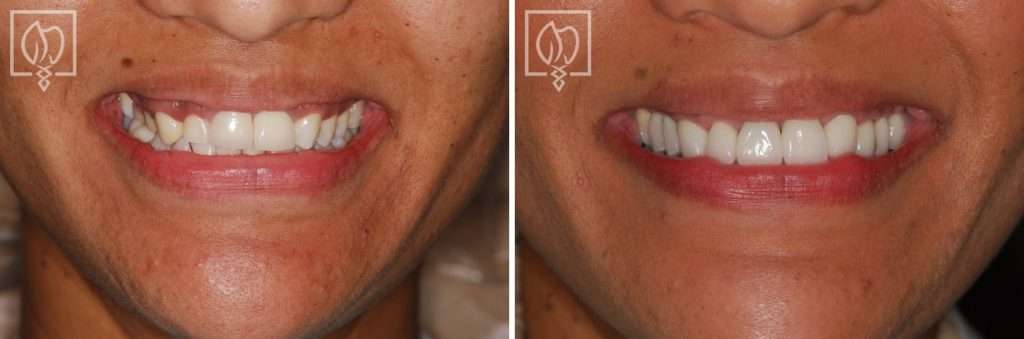
Multi-Faceted Treatment for Patient Unhappy With Her Artificial-Looking Crowns, Teeth and Gums
Many patients come to Elite Prosthetic Dentistry unhappy with the appearance of their smile. However, this particular patient presented with multiple interconnected problems that together created a smile she found deeply unsatisfying.

Treating Kevin’s Collapsed Bite with a Complete Smile Makeover with New Dentures
Dentures are sometimes not created to the ideal aesthetic and functional scheme. When improperly fabricated, dentures can make an individual appear almost a generation older than their actual age. They can have a poor fit that feels loose and unstable when eating or speaking, and they can actually accelerate bone loss over time.

Salvaging Ms. N’s Severely Broken-Down Upper and Lower Teeth from Gum and Bone Disease
Many people in the U.S. suffer from extensive periodontal disease characterized by significant bone loss and shrinkage of the gum tissue. This condition can begin at a very young age and worsen quickly due to hereditary factors and lack of early diagnosis by their dentist.

A Smile Transformation in Just Four Months: A Patient’s Dental Crown Restoration for a TV Series
A patient with dental crowns that were in poor shape was going to appear on a streaming video series on a major TV network that was scheduled to begin filming soon. Our patient, John, an author about to embark on a book tour, was anxious as his teeth were not up to his standards to appear on television.
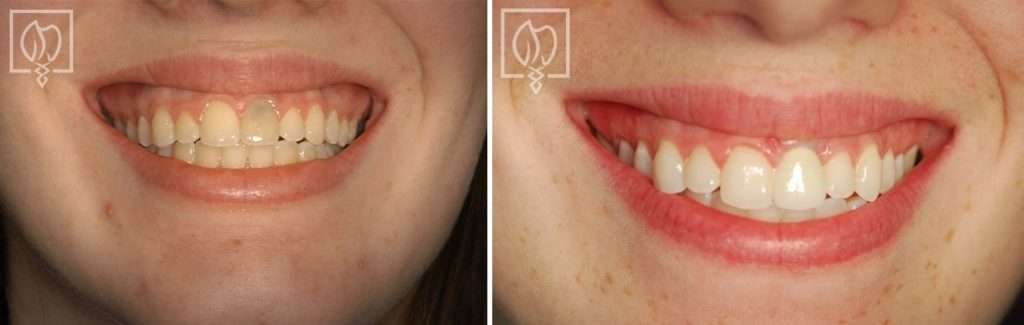
Replacing a Discolored Front Tooth with a Precision Placed Implant
Some of the most challenging restorations occur when fabricating an anterior crown to fit on an implant. Not only does one have the difficulty of matching the single front tooth to the other ones in the high visibility zone, but the dentist must also ensure the position of the underlying implant is precise through accurate preplanning and placement.
Our Services in McLean
Beyond veneer-fell-off, McLean patients rely on Dr. Gerald Marlin for a full range of advanced dental care.
More services available in McLean:
veneer-fell-off Near McLean
Dr. Gerald Marlin also provides veneer-fell-off services for patients in these neighboring communities.
Getting Here from McLean
Elite Prosthetic Dentistry is conveniently located near McLean, VA.
From McLean center, take Chain Bridge Road or Route 123 toward the District. Our practice is conveniently located with ample parking.
Address:
4400 Jenifer Street NW, Suite 220
Washington, DC 20015
Phone: (202) 244-2101
Schedule ConsultationSchedule Your Consultation from McLean
McLean residents trust Dr. Gerald Marlin for precision dental care. With 3,900+ implants placed and 40+ years of experience, your smile is in expert hands.