
Veneer Fell Off in Great Falls, VA
Why in-house lab capabilities matter for veneer replacement. Great Falls patients benefit from same-day color matching and custom characterization.
The In-House Lab Advantage: Why Your Replacement Veneer Will Match Perfectly
Your veneer fell off. Now you’re facing replacement. But you’re wondering: will the replacement match your other teeth perfectly, or will it look obviously new?
The difference between a perfect match and a noticeable mismatch often comes down to one critical factor: whether the dentist has an in-house laboratory. This guide explains why that matters and how it transforms the quality of your replacement veneer.
External Labs Versus In-House Labs: The Fundamental Difference
When you need a replacement veneer, it has to be fabricated in a dental laboratory. But where that lab is located fundamentally impacts the quality of your restoration.
External labs are separate businesses. Your dentist sends impressions, photos, and specifications. The lab technician fabricates the veneer based on those impressions and photos. The veneer is shipped back. It’s bonded to your tooth.
This process has inherent limitations. The technician is color-matching from photographs, which never perfectly represent the actual shade and translucency of your tooth in three-dimensional living light. The lab has no ability to see your mouth directly or make real-time adjustments based on your specific tooth.
An in-house lab is located in the dental office. The prosthodontist and lab technician work in close proximity. The technician can examine your tooth directly. Adjustments can be made quickly. Communication happens in real-time.
These differences compound into dramatically better esthetics and fit.
Color Matching: The Critical Difference
Color matching is where in-house labs excel.
With external labs, your dentist takes a photograph of your tooth in natural light. They use a shade tab to estimate the shade. They send the photo and shade information to the lab.
The lab technician looks at the photo on a computer screen. Computer monitors don’t perfectly represent real-world color. The technician fabricates a veneer they think matches the photo.
When the veneer arrives, it’s often slightly off-shade. It’s darker than you wanted, or warmer in undertone, or less translucent. Adjustments require sending it back to the lab, waiting 7-14 days, and hoping the adjustments are correct.
With an in-house lab, your dentist brings the technician into the operatory. The technician sees your tooth in natural light, in natural color, with the surrounding teeth context.
The technician notes the specific shade, the translucency, the surface texture, the characterization (spots, lines, slight color variation). They communicate directly with your dentist about what they observe.
They then fabricate the veneer using that direct observation. If something seems off, they make adjustments immediately while the dentist is in the room watching.
If the match still needs refining, the veneer isn’t shipped; it’s on your shelf a few feet away. A technician can make tweaks while you’re still in the office. You see the adjustment. If it’s perfect, you proceed to bonding. If not, one more quick revision.
This real-time feedback loop is impossible with external labs. It’s the core advantage.
Translucency and Opacity: Matching the Internal Light Properties
Shade alone isn’t the whole story. Translucency matters enormously.
Some teeth have high translucency. Light passes through the veneer to the underlying tooth. The veneer looks alive and natural.
Other teeth have lower translucency. The veneer is more opaque. This is necessary if the underlying tooth is very dark or gray.
Your specific tooth has a specific translucency. An external lab estimates this from a photo. They guess.
An in-house technician observes it directly. They see how light transmits through your tooth. They fabricate a veneer with matching translucency.
The result is a veneer that looks like it belongs on your tooth because it truly matches the internal light properties of your tooth.
Characterization: The Fine Details That Create Realism
Real teeth aren’t uniform in color. They have subtle variations. Spots. Lines. Areas of slightly different color. This is called characterization.
Without characterization, a tooth looks artificial and uniform. With subtle characterization that matches your tooth’s natural pattern, the restoration looks like it’s part of your mouth. This attention to detail is what distinguishes ultimate smile makeover work from basic cosmetic dentistry.
External labs apply generic characterization. They add some lines and spots in a standard pattern. It might not match your specific tooth’s characterization at all.
An in-house lab observes your specific characterization. They replicate it in your veneer. When the veneer is bonded, it has the same character as your natural teeth.
Material Selection and Quality Control
An in-house lab has direct control over which ceramic material to use and how it’s fabricated.
Your veneer can be made from premium ceramic with optimal translucency and strength characteristics. If a specific material offers advantages for your situation, the in-house lab can select it immediately.
Quality control is continuous. As the veneer is being fabricated, the lab technician ensures optimal thickness distribution, proper internal surface preparation for bonding, and precise margin design. This precision mirrors the standards we apply to fixed prosthodontics and advanced restorative dentistry cases.
With external labs, you’re dependent on whatever material and quality control process they use. You have less choice and less visibility.
Margin Design and Fit
The margin is the edge of the veneer where it meets your tooth. How precisely it fits determines whether it seals well and resists marginal leakage.
An in-house lab can fabricate a veneer with margins that match your specific preparation precisely. If your margin has specific geometry, the veneer is designed to match it.
The veneer can also be tried in before bonding. If the margin is slightly heavy or if the fit is imperfect, minor adjustments can be made immediately in the lab. The veneer can be adjusted and tried again.
With external labs, the veneer arrives. If the margin is imperfect, you proceed anyway or send it back for revision.
Speed and Convenience
From a practical standpoint, in-house labs are dramatically faster.
Standard timeline for external lab: Impressions taken, lab work 7-14 days, veneer arrives, bonding appointment scheduled. Total time: 2-3 weeks.
In-house lab timeline: Impressions and preparations taken, lab work potentially 2-3 days, veneer adjusted as needed in office, bonded within a week. Total time: 1-2 weeks.
More importantly, if revisions are needed, in-house labs are measured in hours, not weeks.
Internal Surface Preparation for Bonding
An in-house lab controls exactly how the internal surface of your veneer is prepared for bonding.
The back surface must be properly etched and primed so bonding resin can create a strong mechanical and chemical lock.
An in-house lab can verify that this preparation meets standards before the veneer leaves the lab. With external labs, you’re trusting their process.
We also have the opportunity to inspect the veneer’s internal surface under magnification before bonding. If anything seems suboptimal, we can request corrections immediately.
Cost Implications Over Time
While we don’t discuss pricing online, there’s an economic advantage to in-house labs.
If an external lab veneer requires revision, you pay for lab time twice and wait two weeks. You may need multiple revisions before you’re satisfied.
If an in-house veneer needs revision, it takes a few hours and one additional appointment. Your total cost is often lower despite the convenience.
Additionally, better-fitting and better-matched veneers are more likely to bond successfully and last longer. You avoid the cost and inconvenience of another failure.
The Great Falls Advantage: Access to In-House Lab Quality
Our Great Falls patients benefit from our in-house lab capabilities. You don’t travel to the office and get sent away for external lab work. You get direct access to laboratory quality control and the ability to see your restoration being created and adjusted.
For your replacement veneer, this means:
Perfect color match through direct observation and real-time adjustment.
Optimal translucency and characterization specific to your tooth.
Precise margin fit verified before bonding.
Rapid revision capabilities if adjustments are needed.
Superior bonding surface preparation verified before placement.
The result is a restoration that matches your natural teeth so perfectly that no one would guess it’s a restoration.
Your Great Falls Path Forward
When you come to our office with your debonded veneer, here’s how we proceed:
We examine your tooth and assess what needs to happen for replacement.
We take impressions and photographs for our lab.
We bring our lab technician into the consultation to observe your tooth color directly.
The technician begins working on your veneer while we’re bonding other cases.
Within a few days, we have a veneer that closely matches your tooth.
We try it in. If perfect, we proceed to bonding. If minor adjustments are needed, the lab makes them immediately.
We bond using modern adhesive protocols.
You leave with a restoration that looks like it’s always been there.
Exploring Restoration Fabrication and Quality
If you want to learn more about veneers in Great Falls, our veneers in Great Falls page explains our design and material approach. Our veneer problems in Great Falls page covers other failure modes.
For context on our laboratory partnership, our in-house lab page details how we maintain quality control and capabilities. Our cosmetic dentistry in Great Falls page explores smile design approach. If you’re interested in comprehensive smile design, our ultimate smile makeover page discusses integrated approaches.
We also have resources on broader topics. Our prosthodontist in Great Falls page outlines Dr. Marlin’s expertise in complex restorative cases. Our porcelain veneers in Washington DC page covers best practices for veneer material and longevity. Our failing veneers page addresses systemic veneer problems. Our CAD/CAM restorations page discusses modern fabrication precision. Our emergency dental restorations page describes rapid response capabilities. Our meet Dr. Gerald Marlin page details his background and approach to prosthodontic excellence.
If you want to understand our quality control process or have questions about how we ensure perfect color matching, our second opinion dentistry page explains how we assess existing cases. When you’re ready to replace your veneer with in-house lab quality, request an appointment to begin the process.
Your smile deserves a restoration that matches so perfectly it looks like nature created it.
Frequently Asked Questions
Does an in-house lab actually improve the quality of my replacement veneer, or is it just marketing?
In-house labs significantly improve quality. We can match color exactly to your natural teeth by examining them in real-time and making adjustments in minutes. External labs match from photographs, which is imperfect. We can customize translucency, surface texture, and characterization based on what we see in your mouth.
If the original dentist used an external lab and my veneer failed, would an in-house lab prevent failure?
The lab's quality affects initial fit and esthetics, but failure is usually caused by bonding technique, preparation design, or material selection. However, an in-house lab gives us immediate quality control and allows adjustments if something isn't right before bonding. External labs have less flexibility.
Can an in-house lab make adjustments quickly if my replacement veneer needs tweaking?
Yes. If the veneer we fabricate doesn't match perfectly or if adjustments are needed, we can often make those changes within hours instead of days. We can also take impressions for a second veneer and have it ready within a day or two. External labs require 7-14 days for revisions.
Does having an in-house lab cost more, or does it somehow save money?
We don't discuss pricing online, but in-house capabilities sometimes reduce total cost because revisions are faster and less expensive. We also have more control over material selection and fabrication choices, which we optimize for quality rather than speed.
Should I choose a dentist based on whether they have an in-house lab?
It's one factor among many. More important is the dentist's expertise in bonding, preparation design, and bite analysis. However, having in-house lab capabilities means you get better quality control, faster revisions, and better color matching. Combined with excellent clinical technique, in-house labs support superior outcomes.
Related Patient Success Stories
Explore similar patient success stories demonstrating our expertise in advanced prosthetic dentistry.
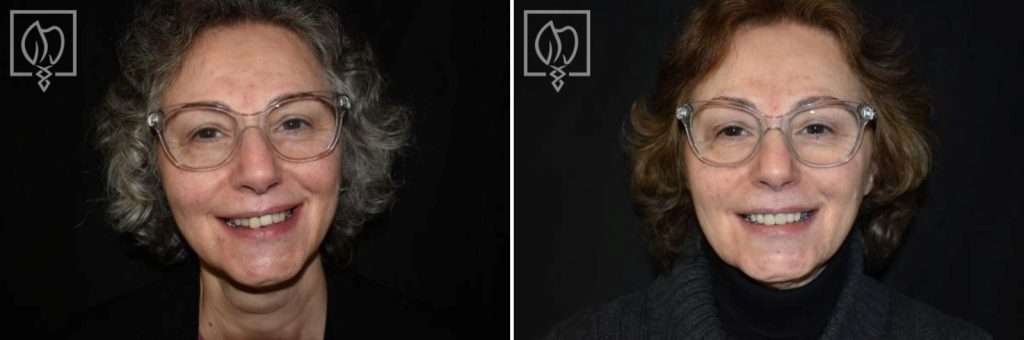
Temporary Crowns Restore Patient's Smile in Just One Day with an Immediate Smile Makeover
A patient from Potomac, Maryland, came to Elite Prosthetic Dentistry with the chief complaint of pain from a failing dental implant and its significant impact on her appearance.
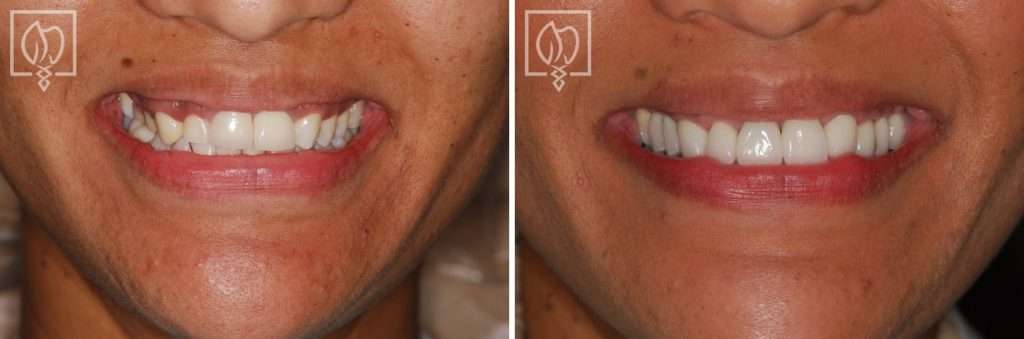
Multi-Faceted Treatment for Patient Unhappy With Her Artificial-Looking Crowns, Teeth and Gums
Many patients come to Elite Prosthetic Dentistry unhappy with the appearance of their smile. However, this particular patient presented with multiple interconnected problems that together created a smile she found deeply unsatisfying.
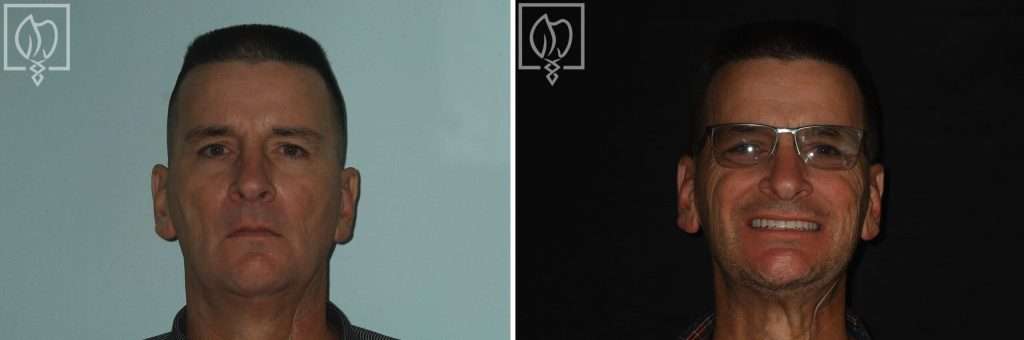
Treating Kevin’s Collapsed Bite with a Complete Smile Makeover with New Dentures
Dentures are sometimes not created to the ideal aesthetic and functional scheme. When improperly fabricated, dentures can make an individual appear almost a generation older than their actual age. They can have a poor fit that feels loose and unstable when eating or speaking, and they can actually accelerate bone loss over time.
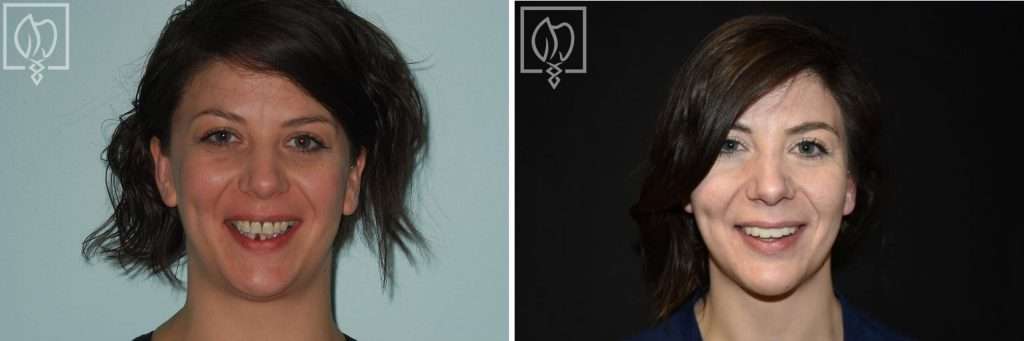
Salvaging Ms. N’s Severely Broken-Down Upper and Lower Teeth from Gum and Bone Disease
Many people in the U.S. suffer from extensive periodontal disease characterized by significant bone loss and shrinkage of the gum tissue. This condition can begin at a very young age and worsen quickly due to hereditary factors and lack of early diagnosis by their dentist.
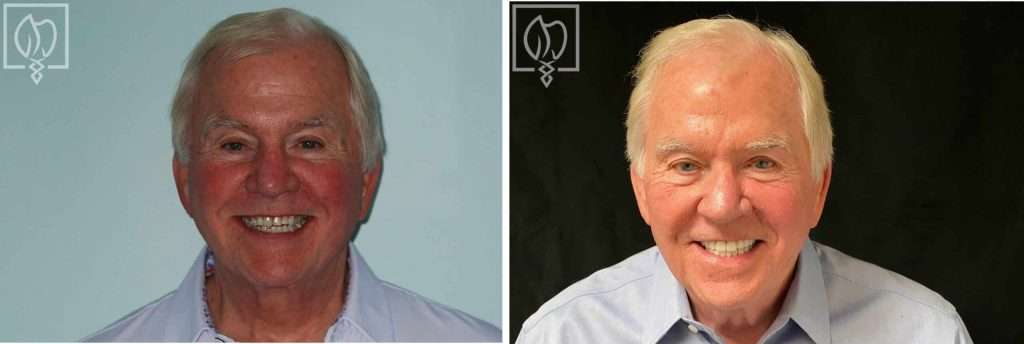
A Smile Transformation in Just Four Months: A Patient’s Dental Crown Restoration for a TV Series
A patient with dental crowns that were in poor shape was going to appear on a streaming video series on a major TV network that was scheduled to begin filming soon. Our patient, John, an author about to embark on a book tour, was anxious as his teeth were not up to his standards to appear on television.
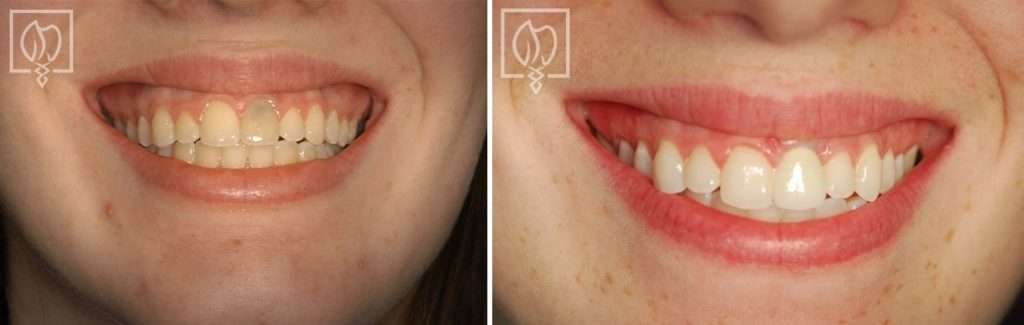
Replacing a Discolored Front Tooth with a Precision Placed Implant
Some of the most challenging restorations occur when fabricating an anterior crown to fit on an implant. Not only does one have the difficulty of matching the single front tooth to the other ones in the high visibility zone, but the dentist must also ensure the position of the underlying implant is precise through accurate preplanning and placement.
Our Services in Great Falls
Beyond veneer-fell-off, Great Falls patients rely on Dr. Gerald Marlin for a full range of advanced dental care.
More services available in Great Falls:
veneer-fell-off Near Great Falls
Dr. Gerald Marlin also provides veneer-fell-off services for patients in these neighboring communities.
Getting Here from Great Falls
Elite Prosthetic Dentistry is conveniently located near Great Falls, VA.
From Great Falls, take Route 7 toward the District. Our practice is accessible with a scenic 20-minute drive.
Address:
4400 Jenifer Street NW, Suite 220
Washington, DC 20015
Phone: (202) 244-2101
Schedule ConsultationSchedule Your Consultation from Great Falls
Great Falls residents trust Dr. Gerald Marlin for precision dental care. With 3,900+ implants placed and 40+ years of experience, your smile is in expert hands.