
Veneer Fell Off in Georgetown, DC
Why do some veneers last 20 years while others fail in 3? Georgetown patients learn about design, preparation depth, material quality, and lab artistry factors.
Why Some Veneers Last 20 Years and Others Fail in 3: The Georgetown Guide to Longevity Factors
Your veneer fell off. You trusted it would last 15-20 years based on what you were told. Now you’re wondering if all veneers fail or if something went wrong. The answer is both. Some veneers absolutely last 20 years. Others fail in three. The difference is design, preparation depth, material quality, and lab artistry. This guide explains why.
The Three Categories of Veneer Longevity
Before we dive into what failed with yours, understand the reality of veneer lifespan. Veneers fall into three categories regarding longevity.
First, the short-lived veneer. These fail between 3-7 years. They were designed poorly, prepared inadequately, bonded with outdated technique, or fabricated in a budget lab that cut corners. Debonding is common. So is chipping, cracking, and margin breakdown. Patients who experience this pattern often benefit from second opinion dentistry before investing in replacement.
Second, the moderate-life veneer. These last 8-12 years. They were made with reasonable care but not exceptional attention to detail. They were bonded adequately but not optimally. The lab was competent but not premium. Over time, marginal microleakage and resin bond fatigue occur, leading to failure.
Third, the long-life veneer. These last 15-20+ years. They were designed with exceptional attention to geometry and stress distribution. Preparation was meticulous. Material selection was premium. Bonding was flawless using modern adhesive protocols. The lab was experienced and used precision techniques. These veneers are worn by patients who care for them and don’t grind excessively.
Your veneer that failed in 4 years likely falls into category one. That doesn’t mean all veneers fail. It means yours was in the short-lived category from the beginning.
Preparation Design: The Foundation of Everything
How your tooth was prepared before the veneer was placed determines nearly everything about how long that veneer can last. Poor preparation design is usually the root cause of premature failure.
Ideal preparation has several characteristics. First, it has a taper of 6-10 degrees, guiding forces into the veneer rather than toward the margins. Excessive taper (over 10 degrees) removes too much tooth structure. Insufficient taper (under 6 degrees) creates an undercut that holds the veneer but concentrates stress at that undercut during biting.
Second, it has proper line angles. Sharp line angles create stress concentration points. Properly rounded line angles with generous radii distribute stress smoothly. If your preparation had sharp angles, stress accumulated there and eventually failed the resin bond.
Third, it has appropriate reduction in each dimension. Incisal reduction should be 0.8-1.2mm. Labial reduction should be 0.5-0.7mm. Lingual reduction minimal or absent. Proximal reduction minimal but adequate for emergence profile. If reduction was excessive in one dimension and insufficient in another, the restoration was over-contoured in some areas and under-contoured in others, creating uneven stress distribution.
Fourth, it has proper margin placement. Margins should be in the clearance, slightly supra-gingivally or at the gumline. Sub-gingival margins are harder to isolate, seal, and polish, leading to eventual margin breakdown. Margins placed on rounded incisal edges are subject to extreme stress. Poorly positioned margins fail sooner.
Fifth, it has a path of insertion. The preparation geometry should guide the veneer into position without binding or interferences. If the preparation has undercuts or a non-ideal path, the veneer either doesn’t seat fully or seats with binding that generates stress.
If your original preparation lacked these characteristics, your veneer was compromised from the start. No amount of excellent bonding or premium material compensates for poor preparation design.
Tooth Preparation Depth: Enamel Versus Dentin
This is critical and often misunderstood. Enamel bonds to resin adhesive through micro-mechanical interlock. The phosphoric acid etch creates thousands of micro-pits. Resin flows into them and locks in place. This bond is very strong and very water-resistant.
Dentin bonding is more complicated. Dentin has more water in its structure. The dentin-adhesive interface is inherently more susceptible to water infiltration and hydrolytic degradation. Dentin bonds are initially strong but deteriorate faster over time than enamel bonds.
If your preparation involved excessive dentin exposure, your bonding interface started off compromised. As water gradually infiltrated the dentin-resin interface, the bond weakened. Within 3-5 years, the bond was weak enough to fail.
Conversely, if preparation was conservative and involved primarily enamel bonding, the adhesive interface is inherently more durable. The veneer can last 15-20 years if other factors are also favorable.
Some dentists are overly aggressive with preparation, removing too much tooth structure. They believe more reduction equals better esthetics. But aggressive preparation exposes dentin and sacrifices longevity. Other dentists are overly conservative, removing too little, leading to a thick veneer that looks bulky and feels odd in the mouth.
The sweet spot is 0.5-1.0mm total reduction, primarily removing enamel and minimizing dentin exposure. This preserves tooth structure, maximizes enamel bonding, and allows a veneer of optimal thickness.
If your preparation was aggressive, that’s likely a contributor to your failure.
Material Quality: Ceramic Systems and Artistry
The ceramic material selected impacts aesthetics, strength, longevity, and bonding characteristics.
Traditional feldspathic porcelain is beautiful, esthetic, and bonds reliably. It’s been the gold standard for decades. However, it’s brittle and prone to chipping. It also requires a strong resin bond to compensate for its brittleness. For patients concerned about longevity, exploring alternative materials through advanced restorative dentistry may offer advantages.
Lithium disilicate (IPS e.max) is stronger and tougher than feldspathic porcelain. It’s highly esthetic and bonds well. It’s more resistant to chipping. Many modern labs use lithium disilicate because it offers better longevity, making it ideal for full-mouth reconstruction cases.
Zirconia is extremely strong but less esthetic. It’s used in some back teeth veneers but less common for anterior veneers where esthetics matter. For cases where strength must be maximized, we often recommend custom crowns and bridges over veneers.
Material selection should be based on your specific situation. If you have a strong bite or grind, stronger material is appropriate. If esthetics are critical, more translucent material is appropriate even if slightly weaker.
Beyond material type, the specific product matters. Premium lab manufacturers produce ceramics with consistent firing, proper crystalline structure, and reliable bonding characteristics. Budget ceramic suppliers cut corners. Their materials may fire unevenly, develop micro-inclusions, or have poor internal surface texture for bonding.
A veneer fabricated from budget ceramic by a budget lab, even if bonded perfectly, is more likely to fail than a veneer fabricated from premium ceramic by a premium lab.
Veneer Thickness Distribution: Balance and Strength
How thick the veneer is varies across its surface. The proximal edges might be thin for a natural emergence profile. The incisal edge might be thick for strength. The labial surface might be variable thickness based on esthetic demands.
A well-designed veneer has thickness that distributes forces evenly. Thin areas are where strength isn’t critical, like proximal transitional areas. Thick areas are where strength is needed, like the incisal edge.
A poorly designed veneer might be excessively thin at the incisal edge (prone to chipping) or excessively thick overall (bulky appearance and difficult to bond due to resin shrinkage stress).
Thickness distribution is a function of lab design and the dentist’s preparation geometry. If your veneer was fabricated with poor thickness distribution, structural failure or bonding failure was more likely.
Internal Surface Texture and Bonding Characteristics
The surface of the veneer that bonds to your tooth must be properly conditioned. For ceramic veneers, this involves etching with hydrofluoric acid, which creates micro-roughness and opens micro-pores in the ceramic.
A premium lab will precisely control hydrofluoric acid etching time and concentration, creating optimal surface texture. A budget lab may etch too little (inadequate texture) or too long (weakening the ceramic surface). Improper etching directly impacts bonding strength.
Also, the internal surface must be completely clean. Dust, debris, or film on the internal surface prevents resin from wetting the surface, creating voids in the resin layer that become stress concentration points.
If your veneer was insufficiently etched or not properly cleaned before bonding, the resin bond was compromised. Over time, marginal failure occurred.
Laboratory Artistry and Precision Manufacturing
Not all dental labs are created equal. A premium lab staffed by experienced technicians with decades of veneer fabrication produces veneers with superior anatomic accuracy, optimal translucency, and precise margin design.
A budget lab staffed by less experienced technicians produces veneers more quickly but with lower precision. Margins might be slightly thick or slightly rough. Anatomic form might be generic rather than customized to your tooth. Color and translucency might be off, requiring multiple tries to match.
The difference between labs is evident under magnification. A premium lab veneer has micro-beveled margins that blend seamlessly with your tooth. A budget lab veneer has obvious margins.
More relevant to debonding, premium labs design margins to minimize water infiltration. Budget labs may have margin designs that trap moisture and lead to early failure.
When you choose to replace your failed veneer, ask specifically which lab will fabricate it. Don’t assume the dentist’s office picks the best lab. Some offices use budget labs to maximize profit. Others partner with premium labs because they believe in quality. You deserve to know.
The Bonding Protocol: Modern Versus Outdated Technique
Even with perfect preparation, material, and lab work, poor bonding technique causes premature failure.
Outdated bonding protocols use three separate steps: separate etch, separate primer, separate adhesive. Modern protocols use selective-etch or self-etch systems that are faster and create stronger bonds with less contamination risk. Our prosthodontist stays current with the latest advanced restorative dentistry protocols.
Outdated protocols sometimes skip rubber dam isolation, relying on cotton rolls and saliva ejectors. Modern protocols use complete rubber dam isolation to ensure absolute moisture control. This is especially important in cases where emergency dental restorations must be done quickly without compromising quality.
Outdated protocols use older resin formulations that absorb more water. Modern protocols use nanofilled and nano-hybrid resins with superior water resistance, similar to what’s used in inlays and onlays restoration work.
If your veneer was bonded using 20-year-old technique at a 20-year-old office that hasn’t updated equipment or protocol, bonding was compromised from the start.
Systemic Patient Factors: Bite Forces and Bruxism
Some of the failure is on you, frankly. If you grind your teeth at night, you’re putting cyclic stress on every restoration in your mouth. Over time, that stress fatigues the resin bond. Veneers that would last 15 years in a non-grinding patient fail in 5 years in a grinding patient.
Similarly, if you have edge-to-edge bite, where your front teeth contact directly without overlap, every bite concentrates force on that thin contact line. This creates stress concentration that fails veneers and bonds faster.
If you clench heavily during the day or night, same problem. The sustained stress and cyclic loading both weaken resin bonds.
This is why we ask about grinding and bruxism history. A patient with known grinding should have different restoration options: thicker, stronger materials, or acceptance that restorations may need replacement more frequently.
Oral Hygiene and Marginal Failure Progression
Poor oral hygiene accelerates veneer failure. Plaque at the restoration margin initiates decay and demineralization. Bacterial acids attack both the resin and the tooth margin. Marginal leakage progresses. After 3-5 years, the margin is sufficiently compromised that the veneer debonds.
Excellent oral hygiene slows this process. Flossing daily and brushing twice daily keep margins plaque-free. Regular professional cleanings remove plaque buildup. Over 15 years, marginal leakage progresses very slowly.
If your hygiene was poor, your veneer failure was accelerated.
Putting It Together: Why Yours Failed
Your veneer failed in 4 years. This likely involved multiple factors:
- Preparation was probably more aggressive than ideal, exposing dentin and reducing your enamel-bonding surface area.
- Preparation design likely had some suboptimal characteristics, creating stress concentration.
- The veneer was likely fabricated by a budget lab with less precision.
- The bonding protocol may have used older technique without rubber dam isolation.
- Your bite forces or bruxism may have been higher than average.
- Your oral hygiene may have been mediocre.
Any one of these factors alone might reduce veneer life from 15 years to 10 years. Three or four factors combined reduce it to 4 years.
What You Can Change This Time
When we replace your veneer, several factors are in your control.
First, you control the lab choice. Ask us specifically which lab will fabricate your new veneer. Ask about their experience, their bonding surface preparation, their material selection. You want a premium lab, not a budget lab.
Second, you control bruxism management. If you grind, commit to a custom nightguard. Wear it every night without fail. This single habit can extend your veneer life by 5-10 years.
Third, you control oral hygiene. Commit to daily flossing and twice-daily brushing. These habits protect your margins and slow veneer aging.
Fourth, you control bite force awareness. If you catch yourself clenching during the day, relax your jaw. Don’t grind on hard candies or ice.
What you can’t control is the lab’s quality or the dentist’s technique. But you can choose a dentist committed to quality, which we are.
Our Approach: Designing for 20-Year Longevity
When we replace your veneer, we design for longevity. We prepare conservatively, removing only what’s necessary. We preserve enamel and minimize dentin exposure. This conservative philosophy extends to all our fixed prosthodontics work.
We work with a premium lab we’ve partnered with for decades. We communicate the specific design and material we want. We don’t accept generic veneers. Our in-house lab capabilities also allow us to refine designs with precision.
We bond using modern protocols. We use rubber dam isolation and selective-etch technique. We use premium bonding agents. We control resin thickness precisely. If your replacement includes additional cosmetic work, we coordinate with teeth whitening sequencing for optimal results.
We also explain what we can control and what depends on your care and your biology. We’re not promising a forever restoration. We’re promising a restoration designed and placed to last 15-20 years with good care. This approach is consistent across our ultimate smile makeover designs.
If your veneer failed prematurely, the responsibility likely lies with the original dentist’s choices, not with you. But going forward, your choices matter. We’ll explain what you need to do. If you’re interested in comprehensive smile transformation, our cosmetic dentistry team can evaluate whether smile makeover services would benefit your entire smile.
Exploring Broader Context
If you’re interested in learning more about veneers in Georgetown specifically, our veneers in Georgetown page details how we approach initial design and placement. Our veneer problems in Georgetown page covers other issues beyond debonding. For context about cosmetic dentistry more broadly, our cosmetic dentistry in Georgetown page explains smile design. And if you want to understand our prosthodontic expertise, our prosthodontist in Georgetown page outlines Dr. Marlin’s background.
We also have resources on broader topics. Our in-house lab page explains why we maintain an on-site laboratory for some restorations. Our failing veneers page addresses systemic veneer problems. Our botched cosmetic dentistry page covers cases where prior treatment requires correction. Our chipped or cracked veneers page covers damage assessment. And our meet Dr. Gerald Marlin page outlines his qualifications and experience with long-term prosthetic cases.
If you’re concerned about bite factors affecting your restoration, our full-mouth reconstruction page discusses comprehensive approaches to addressing multiple dental concerns. For specific concerns about whether sedation dentistry would help you feel comfortable during your procedure, inquire when scheduling.
For a second opinion or to discuss your specific situation, our second opinion dentistry page explains how we approach existing cases. When you’re ready to replace your veneer with a restoration designed for longevity, request an appointment to get started.
Frequently Asked Questions
Why did my veneer fail in 4 years when the dentist promised it would last 15 years?
Veneer longevity is determined by design choices made during planning, tooth preparation depth and geometry, the specific material selected, and the laboratory artistry involved. If any of these factors are mediocre, the veneer can fail much earlier than 15 years. One poor choice compounds over time.
Does the dentist's lab choice affect whether my veneer stays bonded, or is the lab just about appearance?
Lab choice affects everything. A premium lab with experienced lab technicians will create veneers with ideal thickness distribution, optimal internal surface texture for bonding, and precise margin design that seals well. A budget lab may create thick, heavy veneers with poor internal texture, leading to bonding failures years down the line.
Can a veneer be designed poorly and still last 20 years, or does design directly cause failure?
Design directly impacts longevity. A veneer designed with poor line angles, inadequate preparation taper, or excessive incisal thickness concentrates stress and accelerates bonding failure. Conversely, a veneer with optimal design and geometry distributes occlusal forces favorably and can last decades even under heavy use.
If my veneer failed due to poor design or material, will a better veneer definitely not fail?
If we replace your veneer with superior design, better material, and meticulous preparation and bonding technique, your failure risk drops dramatically. However, veneer longevity also depends on your bite forces, bruxism, and oral hygiene. A patient who grinds heavily will challenge any restoration. But with proper design and patient behavior, 15-20 year success is very realistic.
Should I ask about the specific lab my next veneer comes from, or does the dentist's technique matter more?
Both matter, but they're inseparable. A great dentist using a mediocre lab will have mediocre results. A mediocre dentist using a great lab will have mediocre results. The best outcome requires both excellent design and preparation technique from the dentist, plus excellent lab artistry and material quality. You should feel confident in both when you move forward with replacement.
Related Patient Success Stories
Explore similar patient success stories demonstrating our expertise in advanced prosthetic dentistry.

Temporary Crowns Restore Patient's Smile in Just One Day with an Immediate Smile Makeover
A patient from Potomac, Maryland, came to Elite Prosthetic Dentistry with the chief complaint of pain from a failing dental implant and its significant impact on her appearance.
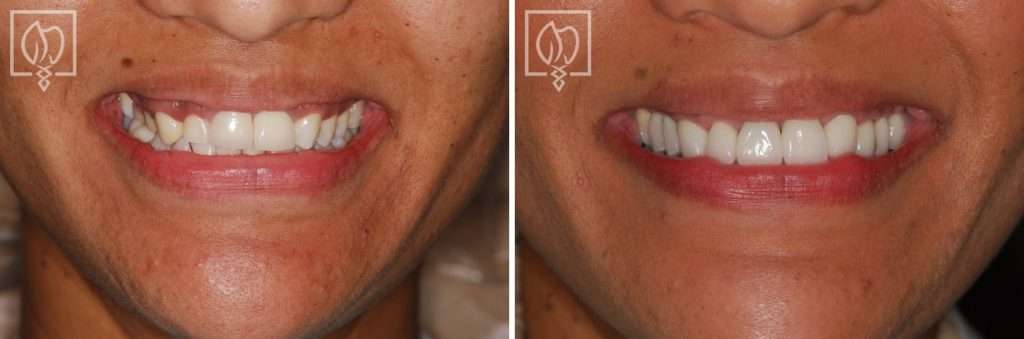
Multi-Faceted Treatment for Patient Unhappy With Her Artificial-Looking Crowns, Teeth and Gums
Many patients come to Elite Prosthetic Dentistry unhappy with the appearance of their smile. However, this particular patient presented with multiple interconnected problems that together created a smile she found deeply unsatisfying.

Treating Kevin’s Collapsed Bite with a Complete Smile Makeover with New Dentures
Dentures are sometimes not created to the ideal aesthetic and functional scheme. When improperly fabricated, dentures can make an individual appear almost a generation older than their actual age. They can have a poor fit that feels loose and unstable when eating or speaking, and they can actually accelerate bone loss over time.

Salvaging Ms. N’s Severely Broken-Down Upper and Lower Teeth from Gum and Bone Disease
Many people in the U.S. suffer from extensive periodontal disease characterized by significant bone loss and shrinkage of the gum tissue. This condition can begin at a very young age and worsen quickly due to hereditary factors and lack of early diagnosis by their dentist.
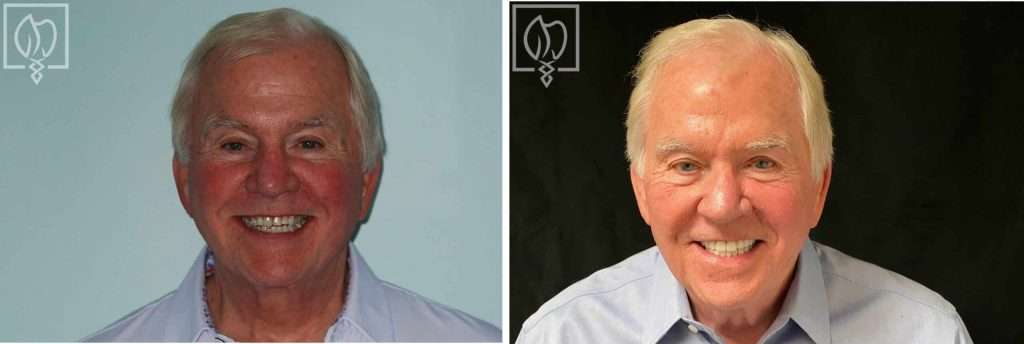
A Smile Transformation in Just Four Months: A Patient’s Dental Crown Restoration for a TV Series
A patient with dental crowns that were in poor shape was going to appear on a streaming video series on a major TV network that was scheduled to begin filming soon. Our patient, John, an author about to embark on a book tour, was anxious as his teeth were not up to his standards to appear on television.
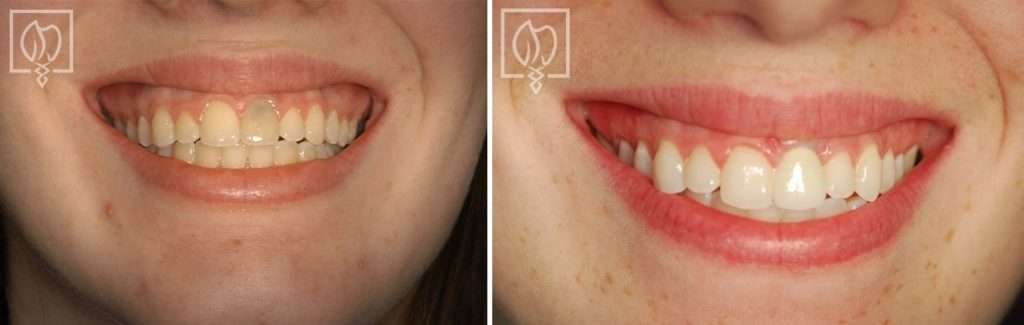
Replacing a Discolored Front Tooth with a Precision Placed Implant
Some of the most challenging restorations occur when fabricating an anterior crown to fit on an implant. Not only does one have the difficulty of matching the single front tooth to the other ones in the high visibility zone, but the dentist must also ensure the position of the underlying implant is precise through accurate preplanning and placement.
Our Services in Georgetown
Beyond veneer-fell-off, Georgetown patients rely on Dr. Gerald Marlin for a full range of advanced dental care.
More services available in Georgetown:
veneer-fell-off Near Georgetown
Dr. Gerald Marlin also provides veneer-fell-off services for patients in these neighboring communities.
Getting Here from Georgetown
Elite Prosthetic Dentistry is conveniently located near Georgetown, DC.
From Georgetown, take M Street toward the District. Our practice is conveniently located with easy parking and public transportation access.
Address:
4400 Jenifer Street NW, Suite 220
Washington, DC 20015
Phone: (202) 244-2101
Schedule ConsultationSchedule Your Consultation from Georgetown
Georgetown residents trust Dr. Gerald Marlin for precision dental care. With 3,900+ implants placed and 40+ years of experience, your smile is in expert hands.