
Veneer Fell Off in Tenleytown, DC
When one veneer falls off and others follow, it's systemic bonding failure. Tenleytown patients learn why and how to prevent cascade failures.
Multiple Veneer Debonding: Why One Failure Triggers Others and How to Prevent Cascade Failure
Your veneer fell off. Now you’re noticing that your other veneers are starting to feel loose or move slightly. This is the cascade failure pattern, and it’s a sign of systemic bonding problems.
When one veneer in a series fails, it often triggers failure of adjacent veneers. Understanding why this happens and how to prevent it is critical to protecting your smile. This guide explains the mechanics of cascade failure and how we interrupt the pattern.
The Domino Effect: How One Failure Triggers Others
When you have multiple veneers bonded to adjacent front teeth, they work as an integrated system. Each veneer impacts how force is distributed to the adjacent ones.
Imagine your four upper front teeth. They’re all veneered. Each veneer bears some of your biting force. Under normal circumstances, force is distributed roughly evenly across all four veneers.
But when one veneer falls off, the dynamics change dramatically.
Suddenly, one tooth is exposed. That exposed tooth is sensitive and you’re careful not to bite on it. Your bite pattern changes. Force concentrates more on the three remaining veneers.
The veneer adjacent to the now-exposed tooth takes extra force. It was designed for normal force distribution, not the elevated force it’s now experiencing.
Additionally, when one veneer is missing, the other veneers are no longer held rigidly in place. There’s slight movement between them. When you bite, the adjacent veneers flex slightly, creating stress at their bonding interfaces.
If the original veneers were all bonded with marginal technique or suboptimal material, that adjacent veneer is now under elevated stress and its bonding is already compromised. The elevated stress combined with compromised bonding causes it to debond.
Now two veneers are missing. Force concentrates even more on the remaining two. Their stress increases. If their bonding is also marginal, they begin failing.
Within months or a year, you can lose all four veneers in sequence. This is cascade failure. Understanding systemic failure patterns is why prosthodontist expertise in full-mouth reconstruction planning is so valuable.
Systemic Bonding Failure: A Sign of Technique or Material Problems
Cascade failure usually indicates that the bonding approach has systemic issues affecting multiple veneers.
Common systemic problems include:
Poor moisture control: The dentist bonded all veneers without complete rubber dam isolation. All of them were exposed to saliva contamination during bonding. All are equally vulnerable to failure.
Outdated bonding technique: The dentist used older adhesive protocols that have since been superseded by better systems. All veneers bonded with the outdated technique are equally prone to water infiltration and failure.
Suboptimal material selection: The dentist used cheaper bonding resin or lower-quality lab-fabricated veneers. All veneers share the same material limitations.
Inadequate preparation design: The dentist prepared all teeth with suboptimal geometry, creating stress concentration or inadequate retention. All veneers are compromised.
Over-aggressive preparation: The dentist removed too much tooth structure from all four teeth, exposing dentin and sacrificing bonding surface. All veneers have the same bonding disadvantage.
Poor laboratory quality: All veneers were fabricated by a budget laboratory with inadequate quality control. All share the same fabrication defects.
When the same underlying problem affects multiple restorations, you get cascade failure. It’s not random. It’s predictable given the systemic flaw. This is why we emphasize advanced restorative dentistry planning that coordinates across multiple teeth.
Why Adjacent Veneers Are Most Vulnerable
When one veneer fails, the adjacent veneers are most vulnerable to fail next.
This is because the bonding interface is shared at the contact point. When the failed veneer is missing, that contact is gone. The adjacent veneer loses support at that contact.
Additionally, stress concentrates at the margin of the adjacent veneer that was next to the failed one. That margin is now exposed and under elevated stress.
The margins at the contact points between veneers are mechanically weaker than other margins. They’re narrower and harder to seal perfectly. When stress concentrates there, failure is likely.
So the typical pattern is:
One front tooth veneer fails. Within months, the adjacent tooth’s veneer starts moving or feeling loose. Within another few months, it debonds. The failure spreads.
Identifying When Cascade Failure Is Occurring
If one of your veneers already fell off, watch for these signs that others are beginning to fail:
Slight movement or mobility in adjacent veneers. The veneer may move slightly when you push it with your tongue or when you bite. If you previously had completely stable veneers, this change is a warning sign.
Tooth sensitivity in adjacent veneers. Sensitivity develops when margins are breaking down and underlying tooth is becoming exposed. If you’re experiencing new sensitivity in adjacent teeth, their veneers are failing.
Visible changes in veneer color or appearance. A veneer that’s starting to debond may look slightly opaque or discolored as water is absorbed. This is a visual warning.
Rough or irregular feeling at the margins. Run your tongue along the margin of your adjacent veneers. If they feel rough, have a step, or are irregular, margin breakdown is occurring.
Discomfort or pain when biting. Margin breakdown exposes tooth structure. Exposed dentin is sensitive to biting pressure. If you feel discomfort when you bite on an adjacent veneer, failure is progressing.
The earlier you catch these signs, the better. If you notice any of these, contact us immediately. We can assess the situation and discuss whether proactive replacement makes sense.
The Cascade Failure Timeline
Different patients experience different timelines, but common patterns include:
First veneer debonds: Month 0.
Second veneer shows instability: Months 2-6.
Second veneer debonds: Months 4-12.
Third veneer shows instability: Months 6-18.
Third veneer debonds: Months 12-24.
Fourth veneer shows instability: Months 12-24.
Fourth veneer debonds: Months 18-36.
In the worst case, you lose all four veneers within 3 years of the first one failing. In the best case, only the first one fails and the others remain stable (which suggests the failure was localized, not systemic).
The speed of cascade failure depends on how aggressively your bite and oral hygiene interact with the compromised veneers.
Prevention: Interrupting the Cascade
Once one veneer has failed, preventing cascade failure requires prompt action. This is where in-house lab capabilities become invaluable for coordinated, rapid restoration of multiple teeth.
The best approach is proactive replacement of all veneers simultaneously using modern bonding technique and premium materials.
Advantages of comprehensive replacement:
You design all four veneers as a coordinated restoration rather than trying to maintain three compromised ones while replacing one.
You ensure all use the same modern bonding technique rather than having a mix of old bonding and new bonding.
You address whatever systemic problem caused the original failure (if it was preparation design, bruxism, material, or technique).
You eliminate the uncertainty of waiting for the next veneer to fail.
You avoid the cumulative cost of replacing veneers one by one over 3 years.
Disadvantages of comprehensive replacement:
It’s a larger financial commitment upfront.
It requires 2-3 weeks for lab fabrication and bonding rather than being able to place one replacement immediately.
You’re replacing veneers that aren’t yet failing (although they’re likely to fail).
An alternative approach is waiting for each veneer to fail, then replacing it individually.
Disadvantages of individual replacement:
You live with uncertainty about when the next veneer will fail.
You have the inconvenience and sensitivity of a missing veneer each time one fails.
You accumulate higher total cost over 3 years (each replacement costs money).
You undergo more procedures and more chair time across multiple appointments.
Advantages of individual replacement:
Each replacement is a smaller upfront cost.
You only replace what’s actually failed.
At least one veneer at a time is being addressed rather than a four-veneer overhaul.
Assessing Your Situation: Is Cascade Failure Likely?
When you come to our Tenleytown office with your failed veneer, we examine the remaining veneers. We assess:
Are the remaining veneers stable or do they move slightly?
Are the margins intact or showing breakdown?
Is sensitivity present in the adjacent teeth?
Are there signs of marginal leakage or decay?
What is the condition of all bonding interfaces?
From this assessment, we predict whether cascade failure is likely.
If the remaining veneers appear stable and the failure seems localized to the one that fell off, replacement of just that one makes sense.
If the remaining veneers show signs of compromised bonding, we discuss the risk of cascade failure and recommend considering comprehensive replacement.
We present both options: replace one now and risk cascade failure later, or replace all four now using modern technique that prevents future failure.
You choose based on your timeline, budget, and comfort with risk.
Modern Technique: Preventing Future Cascade Failure
If you choose comprehensive replacement, we bond all veneers using modern protocols that prevent cascade failure.
For each veneer:
Complete rubber dam isolation to prevent saliva contamination.
Selective-etch protocol with proper etch times for enamel.
Modern bonding agents with proven water resistance.
Precise control of resin thickness to minimize shrinkage stress.
Thorough curing with high-intensity light.
Optimal margin design and sealing.
This approach, applied uniformly to all veneers, ensures they all have the strongest possible bonding and minimal vulnerability.
Additionally, we design all four veneers as a coordinated system. We account for your bite pattern using fixed prosthodontics principles. If you grind, we recommend a nightguard to protect all four at once. If your bite has particular characteristics, we design all four to work favorably with your specific bite. For comprehensive planning, we discuss whether broader full-mouth reconstruction might serve your long-term interests.
Addressing Underlying Causes of Cascade Failure
Beyond improving bonding technique, we identify and address whatever caused the original failure.
If bruxism is a factor, we discuss and fit a nightguard.
If preparation design was suboptimal, we prepare the replacement teeth properly.
If your bite has characteristics that stress restorations, we design the veneers to distribute those stresses better.
If oral hygiene is a factor, we provide guidance on protecting margins.
We treat the replacement as an opportunity to correct the systemic issues that caused cascade failure, not just a quick repair.
Your Tenleytown Path Forward
When you contact our office with your fallen veneer, we examine thoroughly. We assess whether cascade failure is likely.
If you want to replace just the failed veneer and accept the risk of others failing later, we can do that. We bond it excellently and give you the best chance of success.
If you want to address the problem comprehensively by replacing all veneers at once, we discuss the timeline, process, and investment required.
Either way, you’re getting modern technique and premium materials that dramatically improve longevity compared to whatever the original dentist provided.
The key is making an informed decision based on what we find and what your comfort level is with the risks.
Exploring Multiple Restoration Cases
If you want to learn more about veneers in Tenleytown specifically, our veneers in Tenleytown page explains design approach. Our veneer problems in Tenleytown page covers other failure modes beyond debonding.
For cosmetic dentistry context, our cosmetic dentistry in Tenleytown page explores smile design options. Our prosthodontist in Tenleytown page outlines Dr. Marlin’s specialized expertise with multi-tooth restorative cases. Our ultimate smile makeover page discusses how multiple restorations coordinate for optimal results.
We also have resources on broader topics. Our failing veneers page addresses systemic veneer problems and when comprehensive replacement is the right answer. Our botched cosmetic dentistry page covers cases where multiple restorations need to be corrected. Our chipped or cracked veneers page covers damage assessment for cascade failures. Our in-house lab page explains our laboratory partnership for coordinated multi-tooth cases. Our full-mouth reconstruction page discusses comprehensive approaches to multiple failing restorations. Our emergency dental restorations page details rapid response for multiple debondings. Our CAD/CAM restorations page discusses precision fabrication for coordinated cases.
If you want a second opinion on your situation, our second opinion dentistry page explains that process. When you’re ready to discuss your options, request an appointment to meet with Dr. Marlin and develop a comprehensive plan.
Your smile deserves restorations that work as an integrated system and last for years.
Frequently Asked Questions
Why did one veneer falling off trigger my other veneers to start failing?
When one veneer debonds, it alters the bite pattern and force distribution across your front teeth. The adjacent veneers now experience different stress loads. If all your veneers were bonded with the same suboptimal technique or material, they all have the same vulnerability. The failure of one veneer stresses the others into failure.
Is systemic veneer failure always a sign that the original dentist made mistakes?
Usually yes. Multiple veneers from the same treatment failing in sequence suggests a systemic bonding issue. This could be technique, material, or preparation approach that applied to all of them. A good dentist wouldn't have all their veneers fail. Multiple failures suggest fundamental approach problems.
If I get one veneer replaced, will my other veneers eventually fall off too?
If the others were bonded with the same technique as the one that failed, there's significant risk they'll fail similarly. The timeline depends on how aggressive the failure process is, but yes, you may face sequential failures over months or years. Proactive replacement of all affected veneers may be more efficient than replacing them one at a time.
Would it be smarter to replace all my veneers at once rather than wait for them to fail one by one?
In many cases, yes. Replacing all veneers at once using modern technique is more efficient than living with the uncertainty of sequential failures. You also get the advantage of designing all of them together as a coordinated restoration. However, this depends on your timeline and preference. We can discuss both approaches.
How can you prevent my replacement veneers from failing like the original ones?
By identifying and correcting whatever caused the original failure. We assess the bonding technique, material selection, preparation design, and whether bruxism was addressed. We apply our expertise to implement preventive strategies for long-term success. We correct the systemic issues that caused cascade failure.
Related Patient Success Stories
Explore similar patient success stories demonstrating our expertise in advanced prosthetic dentistry.

Temporary Crowns Restore Patient's Smile in Just One Day with an Immediate Smile Makeover
A patient from Potomac, Maryland, came to Elite Prosthetic Dentistry with the chief complaint of pain from a failing dental implant and its significant impact on her appearance.
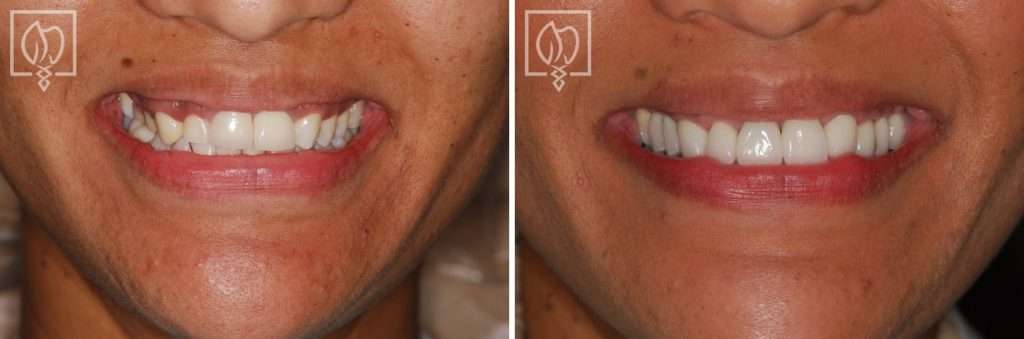
Multi-Faceted Treatment for Patient Unhappy With Her Artificial-Looking Crowns, Teeth and Gums
Many patients come to Elite Prosthetic Dentistry unhappy with the appearance of their smile. However, this particular patient presented with multiple interconnected problems that together created a smile she found deeply unsatisfying.
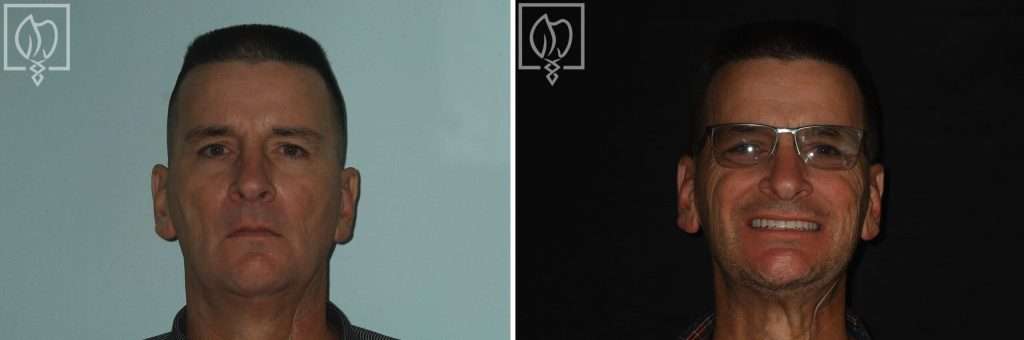
Treating Kevin’s Collapsed Bite with a Complete Smile Makeover with New Dentures
Dentures are sometimes not created to the ideal aesthetic and functional scheme. When improperly fabricated, dentures can make an individual appear almost a generation older than their actual age. They can have a poor fit that feels loose and unstable when eating or speaking, and they can actually accelerate bone loss over time.

Salvaging Ms. N’s Severely Broken-Down Upper and Lower Teeth from Gum and Bone Disease
Many people in the U.S. suffer from extensive periodontal disease characterized by significant bone loss and shrinkage of the gum tissue. This condition can begin at a very young age and worsen quickly due to hereditary factors and lack of early diagnosis by their dentist.
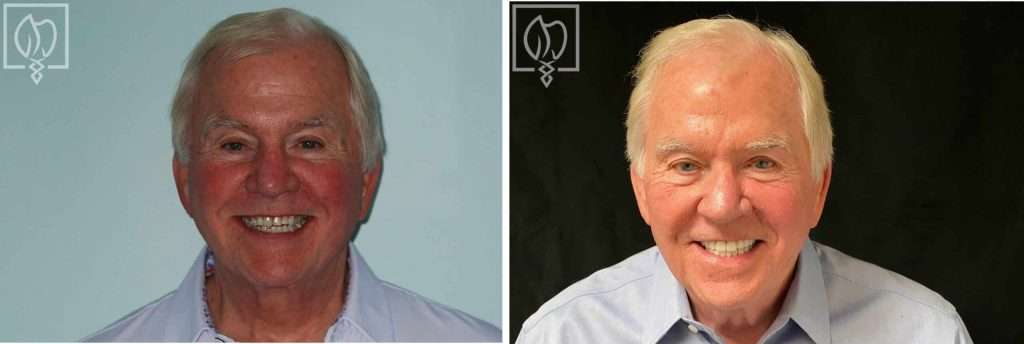
A Smile Transformation in Just Four Months: A Patient’s Dental Crown Restoration for a TV Series
A patient with dental crowns that were in poor shape was going to appear on a streaming video series on a major TV network that was scheduled to begin filming soon. Our patient, John, an author about to embark on a book tour, was anxious as his teeth were not up to his standards to appear on television.
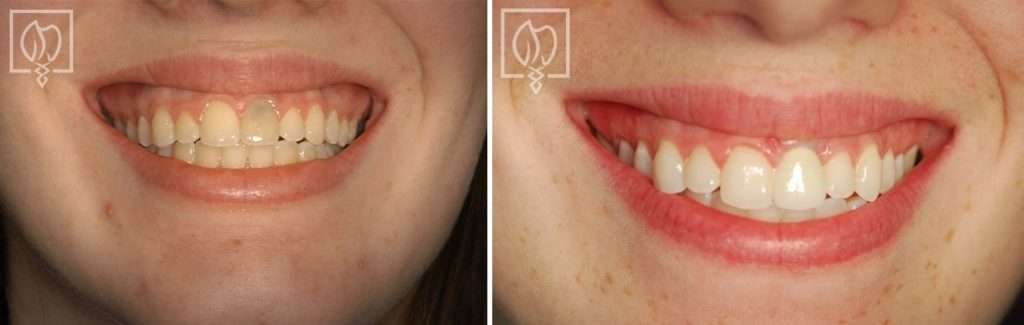
Replacing a Discolored Front Tooth with a Precision Placed Implant
Some of the most challenging restorations occur when fabricating an anterior crown to fit on an implant. Not only does one have the difficulty of matching the single front tooth to the other ones in the high visibility zone, but the dentist must also ensure the position of the underlying implant is precise through accurate preplanning and placement.
Our Services in Tenleytown
Beyond veneer-fell-off, Tenleytown patients rely on Dr. Gerald Marlin for a full range of advanced dental care.
More services available in Tenleytown:
veneer-fell-off Near Tenleytown
Dr. Gerald Marlin also provides veneer-fell-off services for patients in these neighboring communities.
Getting Here from Tenleytown
Elite Prosthetic Dentistry is conveniently located near Tenleytown, DC.
From Tenleytown, take Wisconsin Avenue toward the District. Our practice is just minutes away near the Van Ness Metro station.
Address:
4400 Jenifer Street NW, Suite 220
Washington, DC 20015
Phone: (202) 244-2101
Schedule ConsultationSchedule Your Consultation from Tenleytown
Tenleytown residents trust Dr. Gerald Marlin for precision dental care. With 3,900+ implants placed and 40+ years of experience, your smile is in expert hands.