

Veneer Fell Off in Palisades, DC
Bruxism and clenching weaken veneer bonds. Palisades patients learn why bite force analysis prevents recurrence and protects future restorations.
Bite Forces, Bruxism, and Veneer Debonding: The Palisades Guide to Prevention
Your veneer fell off. Before you decide on replacement, you need to know something your original dentist may not have assessed properly: your bite forces and whether you grind or clench your teeth.
If your veneer failed because of uncontrolled bruxism, simply placing another veneer without addressing the underlying bite problem means your replacement will fail too. This guide explains bite force factors, how they cause veneer debonding, and how occlusal analysis prevents recurrence.
Understanding Bite Force and Stress on Restorations
Your bite generates force. A normal bite generates 150-200 pounds of force per square inch during chewing. That force is distributed across your back teeth and designed to protect your front teeth, which are made for biting and tearing, not grinding.
A restoration like a veneer must withstand that force without failing. But veneers are thin. The resin bonding the veneer to your tooth is even thinner, maybe 1-2mm thick. That thin resin layer experiences significant stress when you bite.
In a healthy situation, stress is distributed smoothly. You bite on your back molars with full force. Your front teeth contact gently with just enough force to grip food. The resin bond on your front veneer experiences minimal stress.
But if you grind or clench, everything changes. Grinding is side-to-side or front-to-back movement of your teeth. Clenching is sustained pressure. Both occur unconsciously, often at night but sometimes during the day when you’re stressed.
When you grind, your front teeth are grinding against each other with full jaw muscle force. That’s 150-200 pounds per square inch, all concentrated on your veneers and their resin bonds. You’re doing that 20-50 times per night if you’re a heavy grinder.
Multiply one night of grinding by 365 nights per year by 5 years, and you’ve accumulated tens of thousands of stress cycles. That’s cyclic stress, the same type that breaks metal bridges from repeated flexing. Resin bonds fail under cyclic stress. This is why advanced restorative dentistry approaches must account for bite force in every design decision.
That’s why veneers fail in bruxing patients. It’s not because the veneer is defective. It’s because the forces being applied exceed the bond’s fatigue strength.
Assessing Your Personal Bite Force and Grinding Patterns
Not everyone grinds or clenches. But many people do, and many don’t realize it.
Signs that you may grind include:
Facial pain or soreness in your jaw joint upon waking. If your jaw hurts when you wake up, you were likely clenching or grinding during sleep.
Worn-down back teeth with flattened surfaces. Normal teeth have cusps (pointed ridges). Grinding wears these cusps flat over years.
Fractured or chipped back teeth or fillings. Grinding applies force that exceeds what your teeth can withstand. They fracture.
Indentations on your tongue edges. If your tongue is indented or has scalloped edges, you’re likely clenching your teeth, which pushes your tongue against them.
Headaches upon waking. Clenching your jaw and masseter muscles creates tension that radiates to your head.
Notched teeth at the gumline. Grinding and clenching create stress that causes tooth structure to fracture at the gumline, leaving notches.
If you have any of these signs, you’re likely grinding or clenching.
We assess your grinding pattern by examining your teeth. We look for wear patterns, chipped cusps, fractured restorations, and other signs of heavy grinding. We ask about your sleep (does your partner report hearing grinding sounds?), your stress level, and your daytime clenching awareness.
Based on this assessment, we classify you as a non-grinder, moderate-grinder, or heavy-grinder. This classification impacts how we design your veneer and what preventive measures we recommend.
Bite Relationship: Edge-to-Edge, Overbite, Underbite
Your bite relationship also impacts veneer longevity. Three common relationships exist:
Normal overlap bite: Your upper front teeth overlap your lower front teeth by about 2-3mm horizontally. The overlapping provides a mechanical advantage where forces are distributed to back teeth. Your front veneers experience minimal biting stress.
Edge-to-edge bite: Your upper and lower front teeth meet edge-to-edge, with no horizontal overlap. When you bite, all the force concentrates on that thin edge-to-edge contact. This creates stress concentration on front teeth and their restorations.
Underbite: Your lower front teeth protrude beyond your upper front teeth. This creates a force concentration on the lower front teeth. It’s mechanically disadvantageous.
An edge-to-edge bite is particularly problematic for veneer longevity. If your veneer failed and you have an edge-to-edge bite, that bite relationship was probably a factor.
How Grinding Fatigues Resin Bonds
Let’s get specific about why grinding breaks resin bonds.
A resin bond has a certain fatigue strength. It can withstand a certain level of stress, and it can withstand repeated loading up to a certain frequency. If you exceed those limits, the bond fails.
Normal chewing doesn’t exceed those limits. You chew on your back teeth 1,000 times per day. Front teeth aren’t heavily loaded. The resin bond experiences modest stress.
But grinding creates loads that far exceed this. A heavy grinder may grind 50-100 times per night with full jaw muscle force. That’s 50-100 cycles of high stress on your veneers every night. Over a year, that’s 18,250 to 36,500 high-stress cycles.
Resin doesn’t recover completely between cycles. Each stress cycle causes minute deformation. After many cycles, the deformation accumulates. Micro-cracks develop in the resin. Water infiltrates the micro-cracks. The resin weakens further.
After 3-5 years of constant grinding stress, the resin bond is so weakened that it fails. The veneer debonds.
This is called fatigue failure, and it’s a predictable consequence of grinding without protection.
How Clenching Accelerates Resin Degradation
Clenching is different from grinding but equally damaging. Clenching is sustained pressure without movement.
When you clench, you’re applying maximum jaw muscle force continuously, often unconsciously. You might clench for hours during a stressful workday or night of bad sleep.
This sustained pressure creates constant stress on your resin bond. Unlike grinding, which has cycles of stress and relief, clenching is continuous stress.
Continuous stress accelerates water infiltration into resin. It also causes creep, where the resin slowly deforms under sustained load. After enough clenching, the resin becomes permanently deformed. The restoration no longer seats properly. The bond fails.
The Role of Bite Design in Stress Distribution
When your veneer is designed, we can influence how stress is distributed during biting.
If we design your veneer with optimal contact anatomy, forces distribute favorably. If we design it poorly, forces concentrate at stress points.
For example, the incisal edge of your veneer contacts your lower teeth during biting. If that edge is pointed or sharp, stress concentrates at that point. If the edge is rounded and slightly lingual (inward), stress distributes over a broader area.
Similarly, the lingual (inner) surface of your veneer can be contoured to guide forces lingually rather than vertically. This distributes forces along the root structure where your tooth is stronger.
A prosthodontist with expertise in occlusal analysis designs veneers with stress distribution in mind. A general dentist may not consider these factors and creates a veneer that looks good but fails under heavy loading. This specialized knowledge extends to all fixed prosthodontics and full-mouth reconstruction cases.
If your veneer failed, the design may not have optimized stress distribution for your specific bite.
Occlusal Analysis: Assessing Your Specific Situation
Occlusal analysis is a detailed examination of how your teeth contact, how forces move through your mouth, and where stress concentrations exist.
We use articulating paper to identify which teeth you contact first when you bite. We use a T-scan (digital bite analysis) to see exactly where and how hard you bite. We examine the angulation of your front teeth. We assess your muscle strength and jaw joint function.
From this analysis, we determine whether your bite is favorable for veneers or whether your bite pattern requires special design considerations.
If you grind heavily, we know your veneer must be extra-strong and positioned to minimize grinding stress. If you have an edge-to-edge bite, we know we need to guide forces more carefully. If you clench, we emphasize the importance of a nightguard.
Occlusal analysis at the planning stage prevents failure downstream. If your original dentist didn’t perform occlusal analysis, your veneer was designed without understanding your specific bite pattern.
Nightguards: The Essential Prevention Tool
If you grind or clench, a custom nightguard is non-negotiable if you want your veneers to last.
A nightguard is a thin plastic device you wear while sleeping. It separates your upper and lower teeth so grinding or clenching occurs against the plastic rather than tooth-to-tooth contact.
Benefits of a nightguard include:
Reduced stress on your teeth and restorations. The plastic absorbs and distributes force rather than your teeth experiencing direct contact stress.
Reduced wear on your teeth. Your natural teeth don’t wear down from grinding if you’re wearing a guard.
Protection of your restorations. Your veneers, crowns, and implants don’t experience the grinding stress.
Reduced jaw muscle tension. Many people experience less morning facial pain and jaw soreness when wearing a guard.
Reduced headaches. Many grinding-related headaches resolve with nightguard use.
A nightguard must be custom-made from your dental impressions. Drugstore boil-and-bite guards are inadequate. They don’t fit properly, and they often cause discomfort that leads patients to stop wearing them.
A custom guard made by your dentist fits perfectly, is comfortable, and most importantly, you’ll actually wear it every night. And that’s the key: it only works if you wear it consistently.
Daytime Clenching Awareness and Stress Management
Nightguards address nighttime grinding. But many people also clench during the day, often unconsciously when they’re stressed.
Daytime clenching is harder to manage with a physical device (wearing a nightguard all day is impractical). Instead, awareness is key.
Notice your jaw tension during the day. When you’re stressed or concentrating hard, you may be clenching without realizing. Consciously relax your jaw. Let your teeth part slightly.
Stress management also helps. Stress-related clenching is higher in people with high anxiety or stress. Exercise, meditation, or other stress-reduction techniques decrease daytime clenching.
Material and Design Adjustments for Grinders
If you’re a known grinder, your replacement veneer should be designed differently than a standard veneer.
First, we may recommend porcelain veneers if you had composite veneers. Porcelain is harder and more resistant to the stress of grinding than composite.
Second, we design the veneer with slightly thicker material in areas that experience grinding stress. This provides more strength.
Third, we optimize the occlusal (biting) surfaces and contacts to distribute forces favorably.
Fourth, we may recommend slightly different tooth contours that guide forces more favorably during grinding.
These design modifications increase longevity for grinding patients. For comprehensive solutions, we also discuss dental implants or other restorative options that might better withstand your specific bite patterns.
Your Palisades Plan: Preventing Recurrence
When you come to our Palisades office with your debonded veneer, here’s what we do:
First, we perform comprehensive occlusal analysis to determine your bite pattern and whether grinding or clenching contributed to the failure.
Second, if grinding or clenching is significant, we discuss a custom nightguard as essential prevention.
Third, we design your replacement veneer with occlusal factors in mind, optimizing stress distribution for your specific bite.
Fourth, we use premium materials and bonding technique to maximize retention.
Fifth, we provide explicit guidance on nightguard use and daytime clenching awareness.
With this comprehensive approach, we dramatically reduce the risk of your replacement veneer failing like your original one did.
Exploring Broader Bite and Restoration Topics
If you want to learn more about veneers in Palisades, our veneers in Palisades page explains design approach. Our veneer problems in Palisades page covers other failure modes. For cosmetic dentistry context, our cosmetic dentistry in Palisades page explores smile design.
We also have resources on broader topics. Our prosthodontist in Palisades page outlines Dr. Marlin’s specialized expertise in complex bite cases. Our failing veneers page addresses systemic veneer problems. Our chipped or cracked veneers page covers structural damage assessment. Our custom crowns and bridges page discusses alternative restorations for grinding patients. Our ultimate smile makeover page covers comprehensive design coordinated for bite. Our meet Dr. Gerald Marlin page details his background in prosthodontics. Our in-house lab capabilities allow us to make bite-specific adjustments rapidly.
If you’re uncertain whether grinding contributed to your failure, our second opinion dentistry page explains how we assess existing restorations. When you’re ready to move forward with a veneer designed for your specific bite pattern, request an appointment to begin the process.
Your smile deserves a restoration that withstands your specific bite.
Frequently Asked Questions
How much do bite forces really impact whether a veneer stays bonded?
Significantly. Veneers on patients with normal bite forces last 15-20 years. Veneers on patients with heavy clenching or grinding fail 50% more often. Bruxism creates constant cyclic stress on the resin bond. Over years, that stress fatigues and breaks the bond.
I don't think I grind my teeth, but how would I know if I actually do?
Signs include facial pain or jaw soreness upon waking, worn-down back teeth, tooth sensitivity, fractured fillings, indentations on your tongue edges (from clenching), or headaches. Some people grind quietly without obvious symptoms. We can examine your teeth for wear patterns that indicate grinding.
If I have a nightguard made after my veneer is bonded, will it prevent future failure?
Yes, if you wear it every night without fail. A nightguard distributes grinding forces across your mouth rather than concentrating them on front teeth. It also prevents direct tooth-to-tooth contact, which is where maximum grinding stress occurs. Patients with nightguards have significantly fewer restoration failures.
Does an edge-to-edge bite really cause veneer failure, or is that overstated?
It's significant. An edge-to-edge bite means your front teeth meet edge-to-edge rather than with overlap. This concentrates all biting force on a thin line at the incisal edge. Veneers fail more frequently in edge-to-edge bites. If you have this bite relationship, we design veneers differently to distribute forces better.
What's the difference between clenching and grinding, and do they both damage veneers?
Clenching is sustained pressure, usually unconscious during the day or night. Grinding is side-to-side or front-to-back movement with tooth-to-tooth contact. Both create stress that fatigues resin bonds. Grinding is typically louder and causes more visible wear. Both require nightguard protection if you're wearing restorations.
Related Patient Success Stories
Explore similar patient success stories demonstrating our expertise in advanced prosthetic dentistry.

Temporary Crowns Restore Patient's Smile in Just One Day with an Immediate Smile Makeover
A patient from Potomac, Maryland, came to Elite Prosthetic Dentistry with the chief complaint of pain from a failing dental implant and its significant impact on her appearance.
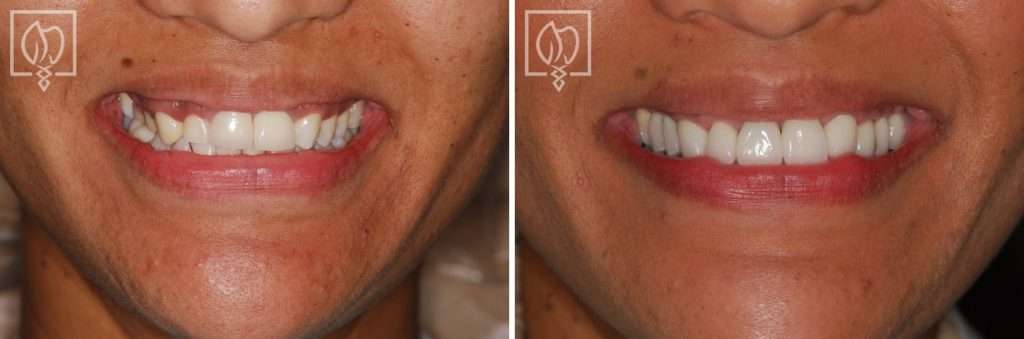
Multi-Faceted Treatment for Patient Unhappy With Her Artificial-Looking Crowns, Teeth and Gums
Many patients come to Elite Prosthetic Dentistry unhappy with the appearance of their smile. However, this particular patient presented with multiple interconnected problems that together created a smile she found deeply unsatisfying.

Treating Kevin’s Collapsed Bite with a Complete Smile Makeover with New Dentures
Dentures are sometimes not created to the ideal aesthetic and functional scheme. When improperly fabricated, dentures can make an individual appear almost a generation older than their actual age. They can have a poor fit that feels loose and unstable when eating or speaking, and they can actually accelerate bone loss over time.

Salvaging Ms. N’s Severely Broken-Down Upper and Lower Teeth from Gum and Bone Disease
Many people in the U.S. suffer from extensive periodontal disease characterized by significant bone loss and shrinkage of the gum tissue. This condition can begin at a very young age and worsen quickly due to hereditary factors and lack of early diagnosis by their dentist.
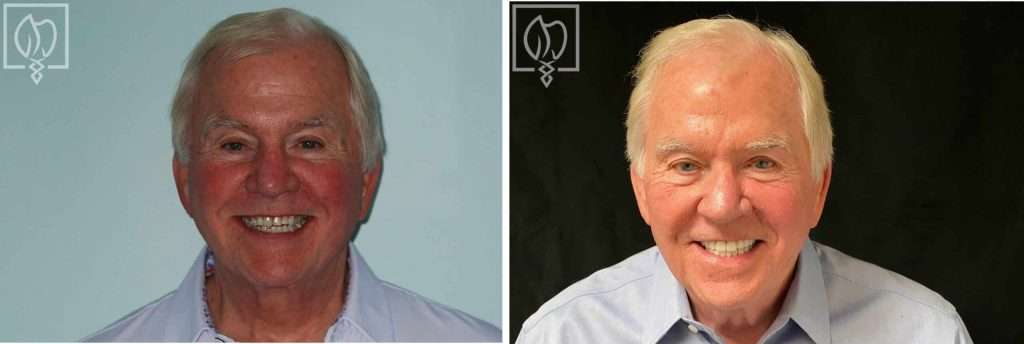
A Smile Transformation in Just Four Months: A Patient’s Dental Crown Restoration for a TV Series
A patient with dental crowns that were in poor shape was going to appear on a streaming video series on a major TV network that was scheduled to begin filming soon. Our patient, John, an author about to embark on a book tour, was anxious as his teeth were not up to his standards to appear on television.
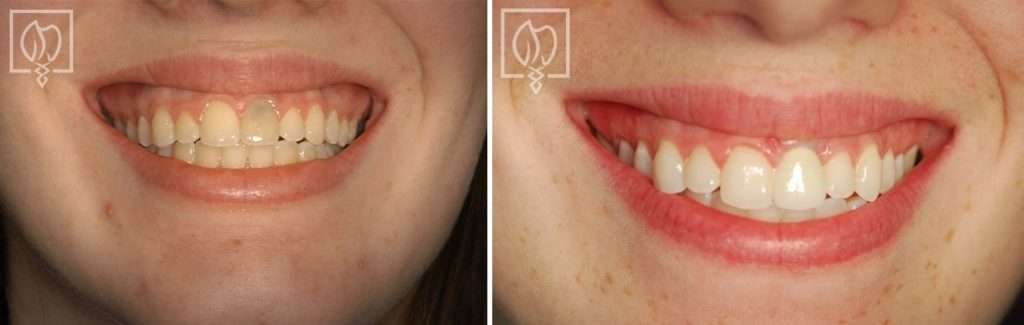
Replacing a Discolored Front Tooth with a Precision Placed Implant
Some of the most challenging restorations occur when fabricating an anterior crown to fit on an implant. Not only does one have the difficulty of matching the single front tooth to the other ones in the high visibility zone, but the dentist must also ensure the position of the underlying implant is precise through accurate preplanning and placement.
Our Services in Palisades
Beyond veneer-fell-off, Palisades patients rely on Dr. Gerald Marlin for a full range of advanced dental care.
More services available in Palisades:
veneer-fell-off Near Palisades
Dr. Gerald Marlin also provides veneer-fell-off services for patients in these neighboring communities.
Getting Here from Palisades
Elite Prosthetic Dentistry is conveniently located near Palisades, DC.
From Palisades, take MacArthur Boulevard toward the District. Our practice is conveniently located just minutes away.
Address:
4400 Jenifer Street NW, Suite 220
Washington, DC 20015
Phone: (202) 244-2101
Schedule ConsultationSchedule Your Consultation from Palisades
Palisades residents trust Dr. Gerald Marlin for precision dental care. With 3,900+ implants placed and 40+ years of experience, your smile is in expert hands.