
Crown & Bridge Problems in Cleveland Park, DC
Cleveland Park residents with failing crowns and problematic bridges receive comprehensive evaluation and specialized treatment from Dr. Marlin, a specialty-trained prosthodontist just 8 minutes away via Connecticut Avenue.
Cleveland Park’s tree-lined streets, established character, and proximity to Rock Creek Park appeal to long-term DC residents who value community and neighborhood stability. Many Cleveland Park residents have maintained their homes and their dental health for decades. Yet restorations placed years ago eventually require evaluation and often replacement as materials wear and bone structure changes.
For Cleveland Park patients with crown or bridge concerns, Dr. Marlin’s practice is conveniently located just 8 minutes away via Connecticut Avenue. Rather than traveling across the city, a quick drive provides access to prosthodontic expertise that can definitively address what’s happening with your restorations.
The Asymptomatic Crown: Why Early Detection Matters
Cleveland Park residents who’ve been careful with their teeth often assume that if a crown doesn’t hurt, it’s fine. This assumption sometimes leads to unpleasant surprises. A crown that feels perfectly normal might have marginal leakage that’s allowing decay to develop beneath the surface, undetected until the problem becomes substantial.
This is why periodic evaluation by a prosthodontist adds value, particularly as crowns age past the ten-year mark. Digital imaging reveals early problems before they become symptomatic, allowing proactive treatment that’s less invasive and less costly than waiting for a crisis.
Occult Decay and Marginal Leakage
Occult decay is decay that’s hidden beneath a crown or restoration, invisible to the naked eye until the problem is advanced. It develops when marginal adaptation fails: the crown edge is no longer sealed tightly to the tooth. Bacteria and saliva seep into the gap, and acid produced by bacteria begins dissolving the tooth structure.
The decay can progress for years before the patient notices anything wrong. By the time it becomes painful or obvious, the decay may extend beneath the crown extensively, requiring the crown to be removed and a more extensive restoration placed.
Digital X-rays reveal early occult decay. Experienced prosthodontists also notice subtle signs: slight discoloration at the crown edge, a barely perceptible margin gap, or changes in the tooth’s appearance that suggest something is wrong beneath the surface. Early detection of pain or sensitivity under crowns can prevent more extensive damage.
Bridge Functionality Over Time
Cleveland Park residents with bridges often report that the bridge continues functioning well year after year. Yet underlying changes occur that may not be obvious. Bone resorbs slowly around the abutment teeth. The periodontal support gradually weakens. The bridge, though still functional, becomes increasingly dependent on healthy supporting teeth.
Periodic evaluation by a prosthodontist assesses whether bone loss is progressing, whether the abutment teeth are developing problems, and whether the bridge can be expected to function reliably for another decade or whether replacement should be considered proactively.
Getting Here from Cleveland Park
From Cleveland Park, take Connecticut Avenue NW toward Washington D.C. The drive is approximately 8 minutes depending on traffic. Parking is available at the practice, and the location is accessible via Metro.
Bite Changes and Crown Complications
Cleveland Park patients sometimes experience changes in their bite over years. Teeth shift slightly. Existing restorations wear or move. A crown that was properly positioned initially may gradually develop an improper relationship with opposing teeth, causing excessive force concentration.
This can result in the supporting tooth becoming painful, the crown wearing prematurely, or the opposing natural tooth wearing abnormally. Addressing bite changes through adjustment or crown replacement can prevent further problems.
The Bridge Spanning a Missing Tooth: Long-term Considerations
A bridge that has replaced a missing tooth for 15 or 20 years represents a significant investment and usually functions well. However, Cleveland Park residents considering long-term planning should understand that bridges have a finite lifespan and that the abutment teeth carry an extra burden.
Dental implants, once the missing tooth is replaced with an implant, preserve the abutment teeth and often provide better long-term outcomes. If the bridge eventually needs replacement, discussing whether implant replacement might be advisable adds another dimension to the decision-making process.
Consultation and Detailed Assessment
Dr. Marlin’s evaluation includes careful examination of the crown or bridge, assessment of underlying tooth support and bone, evaluation of your bite, and digital imaging to visualize hidden problems. He discusses findings clearly and explains what your options are.
If a crown can be maintained through careful monitoring and preventive care, you’ll understand that. If early problems are found, you’ll learn about proactive treatment options. If replacement is necessary, you’ll understand why the current restoration is problematic and how the new one will be designed to avoid repeating those issues.
Protecting Your Restorations Long-term
Cleveland Park residents who maintain their homes carefully should apply the same attention to maintaining their restorations. Excellent oral hygiene, particularly careful cleaning around crown and bridge margins, prevents many problems. Avoiding hard foods, chewing on ice or non-food items, and managing grinding or clenching through a night guard all extend restoration longevity.
Material Selection for Durability and Esthetics
When replacement is necessary, Dr. Marlin discusses material options. For Cleveland Park patients valuing both appearance and durability, the choice of material significantly impacts how long the new crown will serve. Modern materials like zirconia and lithium disilicate offer advantages over porcelain-over-metal crowns in terms of fracture resistance and esthetics.
Related Resources
Learn more about crown and bridge evaluation and treatment at our Crown and Bridge Problems page. To understand Dr. Marlin’s specialty training and approach, visit Meet Dr. Gerald Marlin. Explore our dental crowns in Cleveland Park services for specialized restorative care in your area.
Cleveland Park residents deserve expert evaluation of their crown and bridge issues by someone trained to identify both obvious and subtle problems. Dr. Marlin provides that expertise just 8 minutes from your neighborhood.
Understanding Undetected Problems in Asymptomatic Crowns
For Cleveland Park residents whose crowns feel fine but have underlying problems, understanding how problems develop silently is important. Marginal adaptation failure is often silent. Bacteria infiltrate the gap. Cement breaks down. Decay develops beneath the crown margin.
The patient experiences no symptoms because the crown insulates the tooth. Only professional evaluation and radiographs reveal the problem.
For Cleveland Park patients, periodic evaluation and radiographs are essential even for crowns that feel fine.
Bone Loss Progression and Bridge Lifespan
For Cleveland Park residents with bridges, bone loss around abutment teeth is a critical concern. Bone gradually resorbs over years. This weakens the attachment of the abutment teeth.
Radiographs reveal bone loss. Comparison of radiographs taken years apart shows whether bone loss is progressing or stable.
Progressive bone loss limits bridge viability. Understanding bone loss patterns helps Cleveland Park residents project realistic bridge longevity.
Preventive Radiography and Early Detection
For Cleveland Park residents, a preventive radiography protocol catches problems early. Radiographs every 2-3 years for crowns older than 10 years allows early detection of decay, bone loss, or other problems.
Early detection when problems are small allows simpler, less expensive treatment.
Material Durability and Long-term Value
When Cleveland Park residents require crown replacement, understanding material longevity helps with economic analysis. Premium materials cost more initially but last longer.
A zirconia crown lasting 20+ years may be more economical long-term than a less expensive material requiring replacement in 10-12 years.
Addressing Systemic Dental Problems
For Cleveland Park residents experiencing multiple crown failures, addressing systemic issues is important. Are multiple crowns failing from aggressive decay? From bite problems? From grinding damage?
Identifying systemic issues allows preventive treatment that protects remaining restorations.
Bridge Viability and Progressive Bone Loss
Some Cleveland Park residents have bridges that functioned well for many years but are now showing early signs of problems. Progressive bone loss around abutment teeth is the most common issue, occurring slowly and silently.
Digital imaging reveals bone loss. A healthy bone level shows dense white bone surrounding the tooth root. Progressive bone loss appears as a gradual reduction in the white bone area, showing the black radiolucent bone loss area expanding over years.
Early detection allows discussion of bridge viability. Some bridges can continue functioning well with bone loss stabilized. Others show progressive loss suggesting replacement should be planned soon to avoid the bridge failing.
Decay at Crown Margins and Prevention
Decay at crown margins accounts for a substantial percentage of crown failures. This decay occurs when marginal adaptation fails. A gap develops between crown and tooth. Bacteria and saliva seep into the gap. Decay develops at the margin and extends along the crown edge, sometimes extending significantly beneath the crown surface.
Prevention requires maintaining excellent marginal adaptation. Careful crown preparation with well-defined margins allows the lab technician to replicate precise margins. Quality cement and technique ensure good marginal seal.
For Cleveland Park residents with excellent oral hygiene focused on crown margins, decay risk is minimized. Careful flossing removes plaque in the critical areas where decay initiates.
Professional Monitoring Protocols
For Cleveland Park residents with multiple crowns or bridges, establishing a professional monitoring protocol helps prevent problems. Regular examination every 6 months, digital imaging every 2-3 years for crowns over 10 years old, and attention to any changes helps catch problems early.
Early detection of decay, bone loss, or margin deterioration allows treatment before situations become advanced.
(202) 244-2101
Frequently Asked Questions
Why would a crown that feels fine need to be replaced?
Crowns that feel fine might have marginal leakage, early decay developing at the margin, or compromised support beneath the surface. Digital imaging and detailed examination reveal these hidden problems before they become symptomatic. Replacing a crown proactively can prevent more extensive damage and tooth loss.
Is it normal for my bite to feel different after having a crown replaced?
Some adjustment is normal as your mouth adapts to the new restoration. If the feeling persists beyond a few days or feels uncomfortable, it indicates the new crown may be contacting your opposing teeth at a different angle or height. Your dentist can adjust the bite to ensure proper contact.
Can a bridge be repaired without removing it?
Limited repairs are possible without removing the bridge, such as adjusting the pontic or abutment crowns. However, if the bridge itself is compromised or if decay has developed under the pontic or abutment teeth, removal is usually necessary to treat the underlying problem properly.
How much of my tooth needs to be removed to place a crown?
A typical crown preparation removes 1.5 to 2 millimeters of tooth structure from all sides to create space for the crown material. The amount varies based on the tooth's size, shape, and the crown material chosen. Minimally invasive techniques preserve as much tooth structure as possible.
What happens if the tooth under my crown dies?
If the pulp inside the tooth dies (becomes nonvital), the tooth cannot be saved by simply replacing the crown. Root canal therapy is necessary to remove the dead pulp tissue. After root canal therapy, a crown can be replaced on top. Without addressing the pulp, infection or abscess can develop.
Related Patient Success Stories
Explore similar patient success stories demonstrating our expertise in advanced prosthetic dentistry.
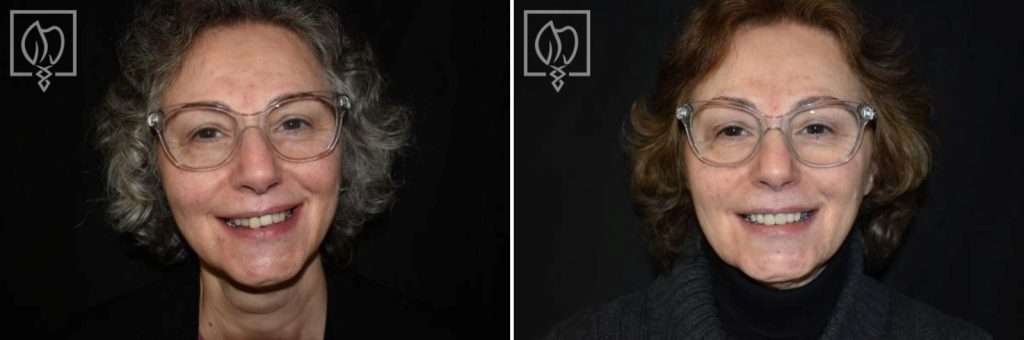
Temporary Crowns Restore Patient's Smile in Just One Day with an Immediate Smile Makeover
A patient from Potomac, Maryland, came to Elite Prosthetic Dentistry with the chief complaint of pain from a failing dental implant and its significant impact on her appearance.
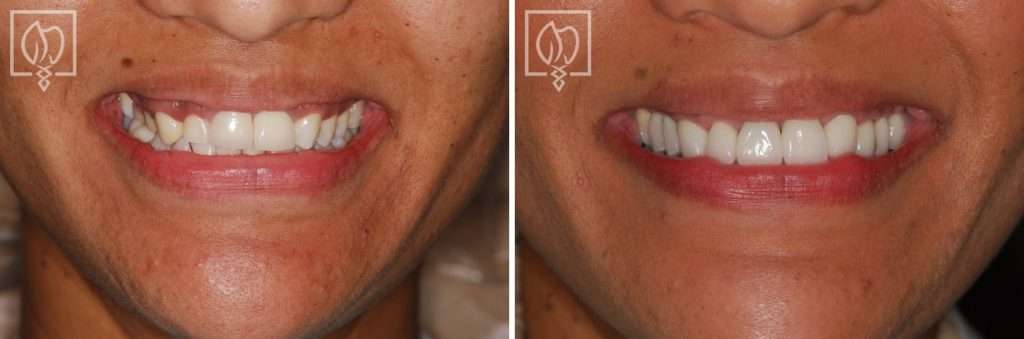
Multi-Faceted Treatment for Patient Unhappy With Her Artificial-Looking Crowns, Teeth and Gums
Many patients come to Elite Prosthetic Dentistry unhappy with the appearance of their smile. However, this particular patient presented with multiple interconnected problems that together created a smile she found deeply unsatisfying.
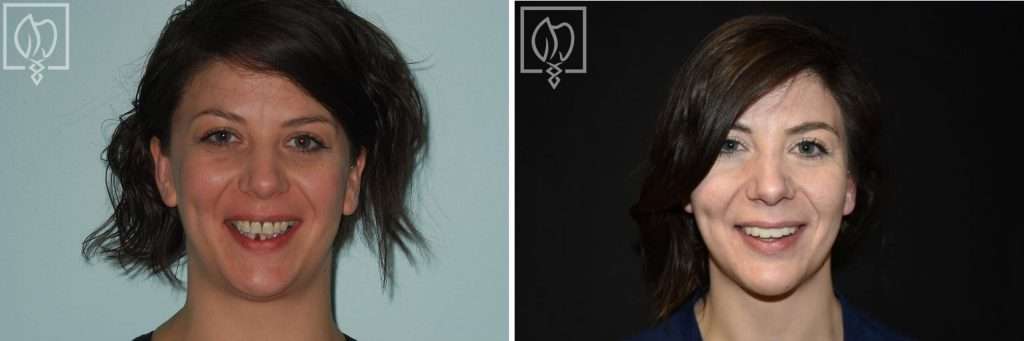
Salvaging Ms. N’s Severely Broken-Down Upper and Lower Teeth from Gum and Bone Disease
Many people in the U.S. suffer from extensive periodontal disease characterized by significant bone loss and shrinkage of the gum tissue. This condition can begin at a very young age and worsen quickly due to hereditary factors and lack of early diagnosis by their dentist.
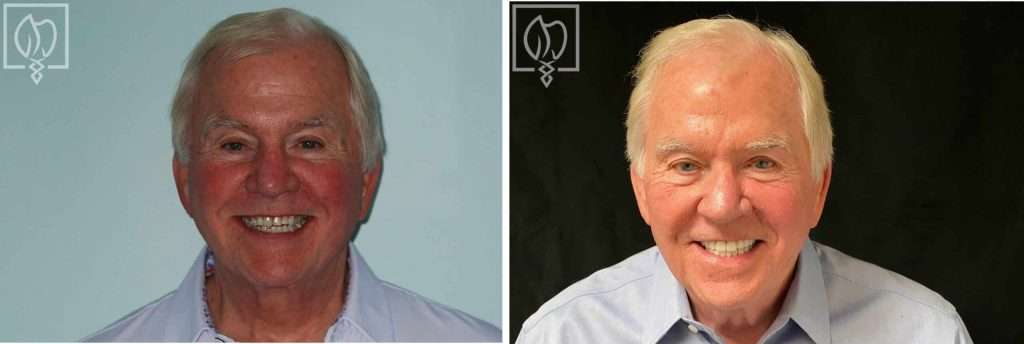
A Smile Transformation in Just Four Months: A Patient’s Dental Crown Restoration for a TV Series
A patient with dental crowns that were in poor shape was going to appear on a streaming video series on a major TV network that was scheduled to begin filming soon. Our patient, John, an author about to embark on a book tour, was anxious as his teeth were not up to his standards to appear on television.
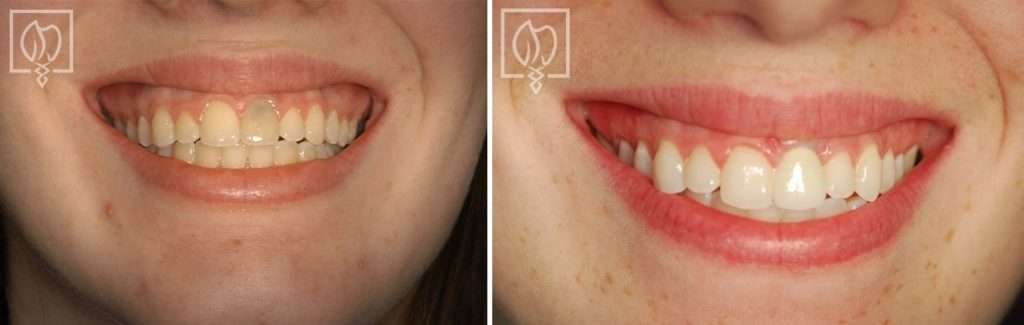
Replacing a Discolored Front Tooth with a Precision Placed Implant
Some of the most challenging restorations occur when fabricating an anterior crown to fit on an implant. Not only does one have the difficulty of matching the single front tooth to the other ones in the high visibility zone, but the dentist must also ensure the position of the underlying implant is precise through accurate preplanning and placement.
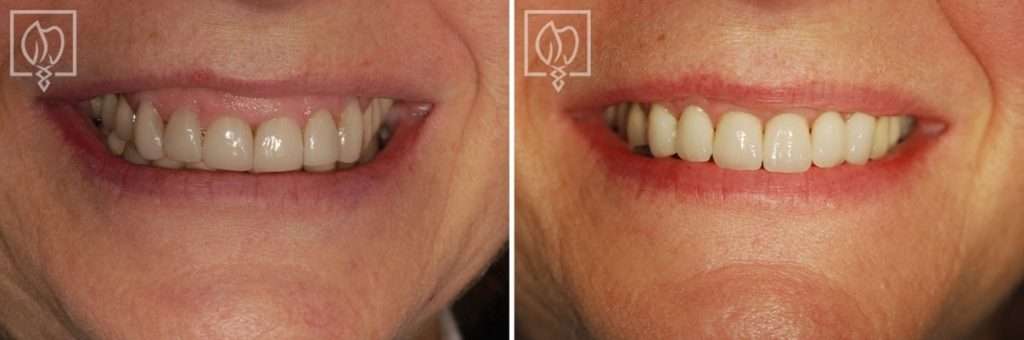
Patient Was Dissatisfied With Her 'Gummy' Smile
Excessive gingival tissue, commonly referred to as a "gummy smile," can significantly impact the appearance of a person's smile and their self-confidence. When someone smiles and a large amount of gum tissue is visible above the teeth, it can create the perception that the teeth are too small or short, even when they are actually normal size.
Our Services in Cleveland Park
Beyond crown-problems, Cleveland Park patients rely on Dr. Gerald Marlin for a full range of advanced dental care.
More services available in Cleveland Park:
crown-problems Near Cleveland Park
Dr. Gerald Marlin also provides crown-problems services for patients in these neighboring communities.
Getting Here from Cleveland Park
Elite Prosthetic Dentistry is conveniently located near Cleveland Park, DC.
Cleveland Park residents reach our office in 8 minutes via Connecticut Avenue NW
Address:
4400 Jenifer Street NW, Suite 220
Washington, DC 20015
Phone: (202) 244-2101
Schedule ConsultationSchedule Your Consultation from Cleveland Park
Cleveland Park residents trust Dr. Gerald Marlin for precision dental care. With 3,900+ implants placed and 40+ years of experience, your smile is in expert hands.