
Botched Cosmetic Dentistry: Expert Corrective Treatment
Expert correction of failed cosmetic dental work. Dr. Marlin fixes oversized veneers, wrong shade, bulky restorations. Specialist prosthodontist in DC.
Botched Cosmetic Dentistry: What Went Wrong and How We Correct It
Your smile should be one of your greatest assets. When cosmetic dental work falls short of expectations, it affects not only your appearance but also your confidence and willingness to smile openly. The good news is that botched cosmetic dentistry can be corrected, often dramatically, by a prosthodontist with expertise in aesthetic restoration and direct laboratory control.
Why Cosmetic Dentistry Fails
Cosmetic dentistry failures don’t happen by accident. They result from predictable breakdowns in treatment planning, patient communication, and execution. Understanding why your cosmetic work went wrong is the first step toward ensuring your corrective treatment succeeds.
Oversized and Over-Contoured Restorations
One of the most common failures is creating restorations that are simply too large for your face and lips. A prosthodontist analyzes dentolabial relationships, meaning the precise interaction between tooth size, tooth position, and lip support. When these relationships are ignored, you end up with restorations that dominate your facial proportions and appear bulky or artificial. The teeth may be too wide, extend too far occlusally, or lack proper emergence profiles, creating a cartoonish or unnatural appearance that no amount of shade manipulation can fix.
Over-contoured restorations also interfere with natural lip dynamics during speech and smiling. Your lip muscles expect teeth to occupy a specific spatial relationship, and when restorations alter that relationship, your smile appears strained or your lips compensate by changing their position, creating aesthetic discord.
Incorrect Shade Selection and Monochromatic Appearance
Shade selection requires far more sophistication than simply matching a shade guide to a tooth. Natural teeth are not uniformly colored throughout. They feature cervical regions that are more opaque and yellow, central portions that are more translucent, and incisal areas that are nearly transparent or slightly blue-gray. Restorations that are fabricated to a single, uniform shade throughout the visible surface appear flat, artificial, and lifeless.
Additionally, shade guides are viewed under artificial lighting and do not account for individual variations in lip color, skin tone, and the optical effects created by surrounding natural teeth. A shade that appears perfect in the operatory under bright LED light may appear completely wrong under natural daylight or normal indoor lighting. This mismatch is one reason why patients walk out of the chair feeling the shade is wrong even if the dentist was confident it was correct.
Loss of Natural Translucency and Characterization
Natural teeth transmit light in complex ways. The incisal third of your front teeth is highly translucent, allowing light to pass through and creating the subtle color variations you see at the edges of natural teeth. The middle third is more opaque but still allows light penetration. The cervical third is most opaque and more yellow. This graduated translucency is what makes natural teeth appear alive and dimensional.
Cosmetic restorations that are fabricated with uniform opacity throughout look like plastic or porcelain “bathroom tiles.” The restorations do not interact with light the way natural teeth do, creating an immediately recognizable artificial appearance. This effect is magnified when restorations are placed adjacent to natural teeth, which will inevitably be more translucent and natural-appearing than the artificial restorations.
Gingival Asymmetry and Poor Proportions
A beautiful smile requires balanced gingival architecture. The gum line across your front teeth should follow a specific pattern where the canines and central incisors are typically at similar heights, with the lateral incisors positioned slightly apical (lower) to create a natural variation. When this architecture is asymmetrical or too high, it draws attention to gum tissue rather than teeth, creating an unbalanced aesthetic.
Additionally, individual tooth proportions must align with your unique facial anatomy and smile line. The width-to-height ratio of front teeth, the presence of contact points, the shape of the incisal edge, and the emergence profile all contribute to whether restorations appear natural or artificial. When these proportions are incorrect relative to your face, no amount of shade or contour refinement will create a natural appearance.
Emergence Profile Failures
The emergence profile is how a restoration transitions from tooth to gum tissue. An improper emergence profile creates several visible problems: the restoration appears artificially flared, the restoration creates a shadow line between tooth and gum, or the restoration creates an over-contoured bulky effect that interferes with natural lip support. Correct emergence profiles require understanding periodontal anatomy and the specific relationship between tooth position, gum tissue, and the restorative material.
Why These Failures Happen
Absence of Diagnostic Wax-Up or Mock-Up
A diagnostic wax-up is a three-dimensional model of how the final restorations will appear before any tooth preparation occurs. This allows the dentist and patient to evaluate the design together, identify proportion or aesthetic issues, and make changes at no cost to the patient’s teeth. Many dentists skip this step to save time and laboratory costs, proceeding directly to tooth preparation based on vague aesthetic goals.
When a wax-up is skipped, the patient has no way to visualize the final result, and the dentist has no opportunity to discuss specific proportions, shade, contour, or positioning before teeth are irreversibly prepared. This is one of the primary reasons cosmetic failures occur: there was no agreed-upon treatment goal, and the patient’s aesthetic expectations were never actually validated.
Communication Gaps Between Dentist and Patient
Aesthetic goals are inherently subjective. What one patient considers beautiful, another considers artificial. When a dentist assumes they understand a patient’s aesthetic goals without explicit discussion and demonstration, misalignment is inevitable. Successful cosmetic dentistry requires detailed conversations about what you dislike about your current smile, what specifically you hope to improve, and what specific restorations would accomplish those goals.
Many patients never see the shade guide during the selection process or understand what the selected shade represents. Many patients are unaware that their restorations will be monochromatic unless specific design decisions are made to prevent this. The dentist may believe they have communicated the plan clearly while the patient is operating with completely different expectations.
Limitations of General Dentistry Training
General dentists receive training in cosmetic principles, but this training is fundamentally different from the advanced, specialized education that prosthodontists receive in aesthetic dentistry. A prosthodontist completes four additional years of specialized graduate training focused specifically on complex restorative and aesthetic dentistry, including courses in dental aesthetics, advanced laboratory techniques, material science, and clinical protocols for achieving predictable cosmetic results.
General dentists may have the technical skill to place restorations but lack the depth of aesthetic training to make complex design decisions that transform a smile. They may not have experience with advanced shade selection systems, digital smile design, diagnostic mock-ups, or the prosthodontic principles that create natural-looking results.
Reliance on Commercial Laboratories
When a dentist sends restoration design to a commercial laboratory, there is no direct communication between the laboratory technician and the patient. The technician interprets the prescription submitted by the dentist, and this interpretation is the foundation for what gets fabricated. If the prescription is vague about aesthetic goals, contour preferences, or translucency requirements, the laboratory defaults to standard fabrication protocols that often produce generic, artificial-looking results.
Many commercial laboratories operate on volume-based pricing models where complex aesthetic refinements would reduce profitability. A laboratory technician fabricating fifty cases per month has less time to spend on individual aesthetic refinement for each case than a prosthodontist’s laboratory technician who works on fewer cases with greater individual attention. The economic model drives toward standard, faster, less refined results.
Rushed Timelines and Inadequate Refinement
Cosmetic dentistry done right requires time. It requires comprehensive evaluation, diagnostic wax-ups, patient approval and evaluation of mock-ups, iterative refinement of the design, careful shade selection with multiple verification methods, extensive chairside refinement and adjustments, and follow-up visits to ensure the final result meets aesthetic and functional goals.
When timelines are compressed to fit patients into operatory schedules or to satisfy patient impatience, refinement steps are cut short. Adjustments are made in limited timeframes. Shade verification is skipped. The result is restorations that were fabricated by the laboratory but never properly refined or personalized for the individual patient. This is how even competent dentists produce cosmetic failures: not from lack of technical skill, but from insufficient time invested in proper refinement.
The Prosthodontist’s Correction Framework
Correcting botched cosmetic dentistry requires a systematic approach that diagnoses exactly what went wrong and establishes a clear protocol for how to make it right.
Comprehensive Diagnostic Photography and Analysis
Your evaluation begins with professional diagnostic photography that captures your smile from multiple angles under standardized lighting. These photographs reveal proportional relationships, gingival architecture, shade variations, emergence profiles, and all the subtle characteristics that determine whether your smile appears natural. This photographic record becomes the foundation for design decisions and allows us to track improvements throughout the correction process.
We also perform detailed facial analysis, measuring proportions between facial thirds, assessing your smile line, evaluating buccal corridors (the visible spaces between teeth and lips when you smile), and determining how your restorations should interact with your specific facial anatomy. Every face is unique, and restorations that would be appropriate for one patient would be inappropriate for another based on these individual characteristics.
Digital Smile Design and Virtual Planning
Using advanced digital smile design software, we map your smile architecture and create virtual designs of your corrected smile before any tooth preparation occurs. This technology allows you to see exactly what your corrected smile will look like, discuss specific design elements, and approve the aesthetic plan. The digital design becomes the blueprint that guides diagnostic wax-up fabrication and ultimately restoration design.
Digital smile design also reveals design flaws in your existing restorations that might not be immediately obvious. Asymmetries, proportion issues, shade mismatches, and contour problems that are difficult to articulate in words become visually obvious in the digital design process.
Diagnostic Mock-Up and Extended Evaluation
Before committing to tooth preparation, we fabricate a diagnostic mock-up using shade-matched composite materials on your existing teeth. This mock-up shows you exactly what your corrected smile will look like and allows you to live with that appearance for several days or weeks. You see how it looks under different lighting conditions, how it feels, how it interacts with your lips, and whether it matches your aesthetic goals.
This step is absolutely critical. It prevents corrective failures because you are making informed decisions based on visualization rather than abstract discussion. If the mock-up reveals that the shade is wrong, or the contour doesn’t match your goals, or the proportions don’t feel right, we modify the design before any permanent restorations are fabricated. This iterative refinement ensures your final restorations match your actual aesthetic preferences, not what your dentist assumed you wanted.
In-House Laboratory Precision and Aesthetic Control
Your corrected restorations are fabricated in our in-house prosthodontic laboratory, not at a commercial lab. This means Dr. Marlin works directly with our master ceramicist on every case, discussing aesthetic goals, shade refinements, translucency requirements, surface characterization, and contour refinements throughout the fabrication process.
Our laboratory technicians have the expertise and time to create restorations with proper shade layering, where different areas of the restoration feature different shades and opacities to mimic natural teeth. They can create internal characterization (subtle color variations and marking patterns within the restoration) that adds dimension and prevents the flat, artificial appearance. They can vary surface texture and translucency to create the graduated light transmission that makes natural teeth appear alive.
The in-house laboratory model eliminates the communication gap between dentist and laboratory technician. Dr. Marlin can request refinements in real time, evaluate restorations for aesthetic properties, and ensure that the final product matches the digital design and patient approval. This level of control over aesthetic refinement is impossible in a commercial laboratory relationship.
Progressive Refinement and Seating Adjustments
Even after your permanent restorations are completed, the correction process includes extensive chairside refinement. We evaluate shade under multiple lighting conditions, make micro-adjustments to contour that may be necessary to optimize emergence profiles or proportions, verify that your bite is balanced, and ensure that aesthetics and function work in harmony.
We also schedule follow-up visits at one week, one month, three months, and six months to ensure that the aesthetic result is stable and that you remain satisfied. If minor adjustments become apparent after you have worn your restorations for a period of time, we make those adjustments without additional cost. This commitment to ongoing refinement is part of the prosthodontic standard of care for complex cosmetic cases.
Why Corrective Work Is Harder Than Original Work
Correcting botched cosmetic dentistry is more complex than original cosmetic dentistry for several important reasons.
Tooth structure has already been compromised. Your teeth have already received one round of preparation and restoration. They have been filed and shaped to accommodate the original restorations. The underlying tooth structure may be thinner than ideal, or preparation may have been over-aggressive. This means your corrected restorations must work with a more limited amount of remaining natural tooth structure, potentially requiring either thicker restorations or additional preparation that further compromises the tooth.
The original preparation may have created anatomical problems. If the original preparation was over-extended, under-extended, or at incorrect angles, your corrected preparation must either work around those problems or further modify the tooth anatomy. An over-extended preparation on one tooth may be impossible to fully correct without additional bone removal. An under-extended preparation may require a second round of tooth preparation that feels aggressive to the patient.
Gingival architecture may have been altered. If your original restorations had over-extended margins or inappropriate contours, your gum tissue may have remodeled in response. Correcting the restorations may require gum recontouring surgery to restore ideal gingival architecture. This adds complexity, cost, and timeline to the correction process.
Patient expectations are now higher and skepticism is present. When a patient is undergoing cosmetic correction, they are typically frustrated or disappointed with their previous experience. They have spent significant money on cosmetic work they are unhappy with and are now facing additional cost and time to correct the problem. This creates a higher bar for success and lower tolerance for any refinement needs. The prosthodontist must deliver results that exceed expectations while managing justified patient skepticism.
Diagnosis of the original failure adds planning complexity. The prosthodontist must not only design beautiful restorations but also understand and address the specific reasons the original work failed. Was it a design problem, a shade problem, or a proportion problem? Was the original preparation inadequate? Did the laboratory fabricate poorly from the prescription? Did the original dentist fail to refine the restorations adequately? This diagnostic process adds time and complexity to the correction planning.
What to Expect During Your Correction Treatment
Cosmetic dentistry correction is an investment of time, resources, and patience, but the result is a smile that you will be proud to display for the next 10 to 15 years.
Comprehensive Evaluation: 1 to 2 Hours
Your initial evaluation includes detailed photography, facial analysis, bite evaluation, assessment of your existing restorations, and comprehensive discussion of what you dislike about your current smile and what you hope to achieve. We discuss aesthetic goals, timeline, financial investment, and the specific protocol we will follow to ensure success. This evaluation establishes the foundation for all subsequent treatment.
Diagnostic Phase: 1 to 3 Weeks
Based on your comprehensive evaluation, we develop a digital smile design that you approve. We then fabricate a diagnostic mock-up that you wear and evaluate for extended periods. During this phase, you have the opportunity to provide feedback and request modifications before any permanent work is fabricated. This is when aesthetic refinement happens at minimal cost.
Tooth Preparation and Temporary Restoration: 1 to 2 Visits
Once you approve the diagnostic design, we prepare your teeth to the specifications established by the digital design. We then place temporary restorations that closely match the approved design, allowing you to wear these temporaries for two to four weeks while your permanent restorations are being fabricated. This extended period in temporary restorations helps you adapt to the new aesthetic and verify that the design is correct.
Permanent Restoration Fabrication: 2 to 4 Weeks
Your permanent restorations are custom-fabricated in our laboratory with attention to every aesthetic detail: shade layering, internal characterization, surface texture, translucency variation, and contour refinement. This fabrication process is more time-intensive than standard laboratory work because each restoration receives individual attention rather than being fabricated according to standard protocols.
Seating and Chairside Refinement: 1 to 2 Hours
When your permanent restorations are complete, we spend extensive time evaluating them against the digital design, your approved mock-up, and your specific aesthetic goals. We assess shade under multiple lighting conditions, refine contours, verify that your bite is balanced, and make any micro-adjustments necessary to achieve the intended result. This chairside refinement ensures that the final restoration matches the plan precisely.
Follow-Up Visits: 6 Months
We schedule follow-up visits at one week, one month, three months, and six months to verify that your aesthetic result is stable, that you remain satisfied, and that the restorations are functioning properly. If any adjustments become necessary, we make those adjustments without additional cost as part of our commitment to your long-term satisfaction.
Your Next Step
If you are unhappy with cosmetic dental work, you deserve a comprehensive evaluation by a prosthodontist who can diagnose exactly what went wrong and present realistic options for correction. Contact our office to schedule a detailed consultation. We will evaluate your existing restorations, discuss your aesthetic goals, and develop a specific protocol that delivers the natural-looking, beautiful smile you should have had from the beginning.
Your smile is one of the first things people notice about you. When it is not what you want it to be, every social interaction is affected. Corrective cosmetic dentistry with a specialist prosthodontist gives you the opportunity to finally achieve the beautiful, confident smile that reflects how you want to present yourself to the world.
Your Best Smile Is Within Reach
Schedule a consultation with Dr. Gerald Marlin to discuss your treatment options and take the first step toward a healthier, more confident smile.
Frequently Asked Questions
What are the most common cosmetic dentistry failures?
The most frequent failures include oversized restorations that dominate facial proportions, incorrect shade selection resulting in artificial appearance, loss of natural translucency and incisal characteristics, bulky or overly contoured restorations, asymmetrical gum lines, and poor emergence profiles that appear flat and opaque. These failures stem from inadequate diagnostic planning, insufficient patient communication about aesthetic goals, and limitations in treatment execution rather than material selection alone.
Why is correcting botched cosmetic dentistry harder than the original work?
Corrective treatment requires removal of existing restorations that may be well-integrated with tooth structure and surrounding tissues, necessitating preparation of already-compromised teeth that have received significant material removal. The prosthodontist must also diagnose and correct the design flaws from the original work while managing patient frustration and skepticism, establish completely new treatment goals, and potentially address preparatory errors or material incompatibility issues. The underlying tooth structure may have been over-prepared or damaged, requiring additional restoration material and more complex planning.
How does digital smile design prevent cosmetic failures?
Digital smile design uses facial photography, lip dynamics analysis, and precise tooth proportion mapping to establish aesthetic guidelines before any tooth preparation occurs. This technology allows us to preview the final result with the patient, identify potential proportion or shade issues, and create a diagnostic wax-up or mock-up that the patient can evaluate for extended periods. The design process incorporates dentolabial relationships, buccal corridors, midline alignment, and individual patient goals that might be missed in traditional planning approaches.
Will my corrected smile look completely natural this time?
Yes, with proper prosthodontist-directed treatment and in-house laboratory fabrication, corrected cosmetic work can achieve natural aesthetics that your original restorations lacked. Natural-looking teeth require proper shade layering, internal characterization, surface texture variation, translucency gradients, and appropriate contours that reflect how natural teeth actually appear. The combination of specialist prosthodontic training and direct control over laboratory fabrication ensures that aesthetic principles are executed precisely rather than interpreted through a commercial lab intermediary.
How long does the correction process typically take?
Complete cosmetic dentistry correction ranges from three to six months depending on the complexity of the original failure, number of teeth involved, and whether additional procedures like gum reshaping are necessary. The timeline includes comprehensive evaluation and diagnostic work, temporary restoration phases, permanent restoration fabrication with multiple refinement cycles, final seating and adjustments, and follow-up visits to ensure stability and patient satisfaction. Rushing this timeline is one reason original cosmetic work failed, so we prioritize thorough planning over speed.
Can you fix my smile without removing all my old cosmetic work?
In some limited cases where the underlying restoration is sound and only the external shape, shade, or contour requires modification, selective refinement might be possible. However, most botched cosmetic work requires complete removal and replacement because the internal structure of the restoration contributes to the aesthetic failure. Trying to repair over failed work typically compounds the problems and extends the correction timeline, so complete replacement with properly designed, fabricated restorations yields superior results and better long-term predictability.
What should I do if I am unhappy with cosmetic dental work right now?
Document your specific concerns with photographs and written notes about what appears unnatural or incorrect to you. Request your complete dental records and radiographs from your original dentist. Schedule a comprehensive evaluation with a specialist prosthodontist who can assess the work objectively, explain what went wrong, discuss your aesthetic goals, and present realistic correction options with timelines and costs. This specialist evaluation provides the foundation for making informed decisions about whether to pursue correction and what approach will deliver the result you deserve.
Related Patient Success Stories
Explore similar patient success stories demonstrating our expertise in advanced prosthetic dentistry.
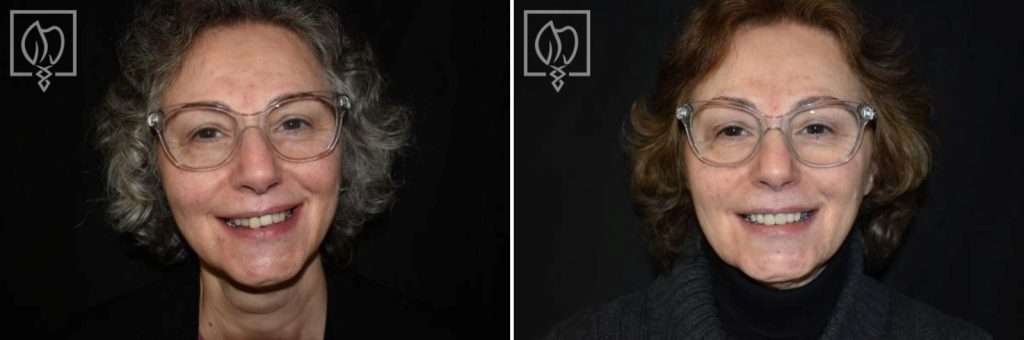
Temporary Crowns Restore Patient's Smile in Just One Day with an Immediate Smile Makeover
A patient from Potomac, Maryland, came to Elite Prosthetic Dentistry with the chief complaint of pain from a failing dental implant and its significant impact on her appearance.
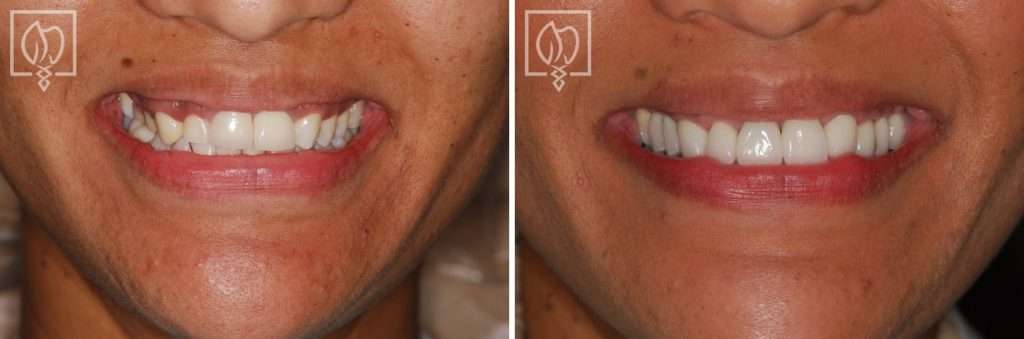
Multi-Faceted Treatment for Patient Unhappy With Her Artificial-Looking Crowns, Teeth and Gums
Many patients come to Elite Prosthetic Dentistry unhappy with the appearance of their smile. However, this particular patient presented with multiple interconnected problems that together created a smile she found deeply unsatisfying.
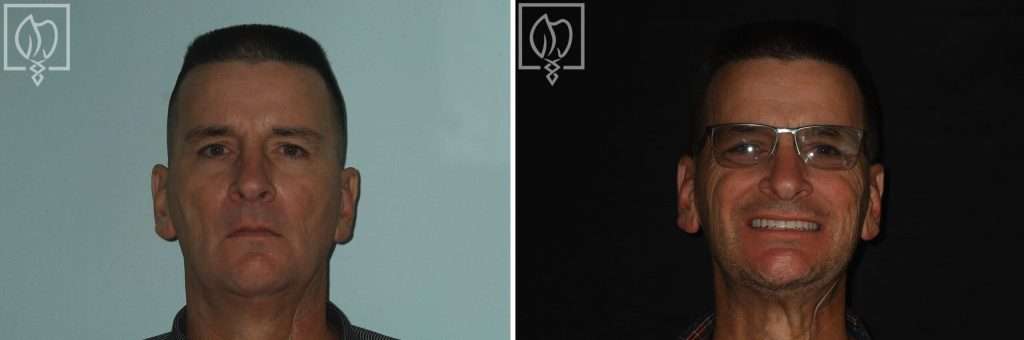
Treating Kevin’s Collapsed Bite with a Complete Smile Makeover with New Dentures
Dentures are sometimes not created to the ideal aesthetic and functional scheme. When improperly fabricated, dentures can make an individual appear almost a generation older than their actual age. They can have a poor fit that feels loose and unstable when eating or speaking, and they can actually accelerate bone loss over time.
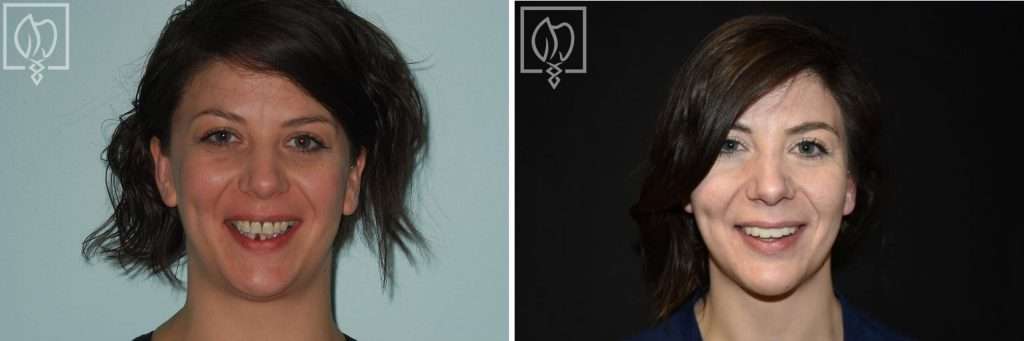
Salvaging Ms. N’s Severely Broken-Down Upper and Lower Teeth from Gum and Bone Disease
Many people in the U.S. suffer from extensive periodontal disease characterized by significant bone loss and shrinkage of the gum tissue. This condition can begin at a very young age and worsen quickly due to hereditary factors and lack of early diagnosis by their dentist.
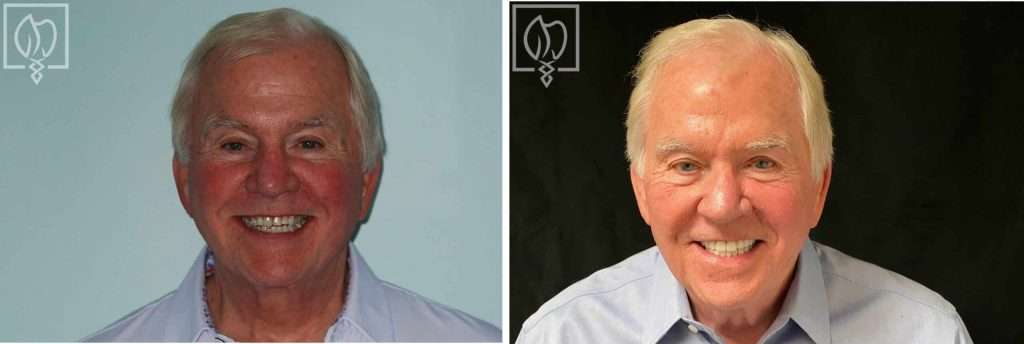
A Smile Transformation in Just Four Months: A Patient’s Dental Crown Restoration for a TV Series
A patient with dental crowns that were in poor shape was going to appear on a streaming video series on a major TV network that was scheduled to begin filming soon. Our patient, John, an author about to embark on a book tour, was anxious as his teeth were not up to his standards to appear on television.
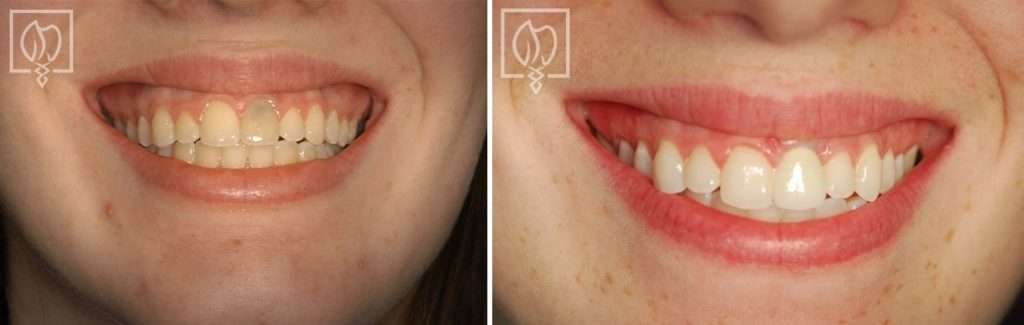
Replacing a Discolored Front Tooth with a Precision Placed Implant
Some of the most challenging restorations occur when fabricating an anterior crown to fit on an implant. Not only does one have the difficulty of matching the single front tooth to the other ones in the high visibility zone, but the dentist must also ensure the position of the underlying implant is precise through accurate preplanning and placement.
Related Articles
Deepen your knowledge with additional insights on this topic.
 Cosmetic Dentistry
 Can my tetracycline stained teeth be made to look pretty?
Tetracycline and other deep, intrinsic stains are best masked with custom crowns - veneers won’t suffice. Elite Prosthetic Dentistry in Washington, DC.
 Cosmetic Dentistry
 How is the Gummy Smile Fixed?
Dr. Marlin reshapes gum tissue and fabricates custom crowns to correct gummy smiles, creating a balanced and confident smile in Washington, DC.
Discovering Cosmetic Dentistry Beyond Aesthetics
Explore how cosmetic dentistry goes beyond aesthetics to improve oral health, self-confidence, and overall well-being with modern treatments and technology.
 Cosmetic Dentistry
 Benefits of a Cosmetic Smile Makeover With Dental Sedation
A cosmetic smile makeover can transform your appearance and give you the beautiful smile you have always wanted. Elite Prosthetic Dentistry in Washington, DC.
 Cosmetic Dentistry
 Does Treating or Rehabilitating a Gummy Smile Require Surgery?
Gummy smile correction may involve crown lengthening surgery or porcelain restorations depending on severity. Washington, DC prosthodontist explains.
 Cosmetic Dentistry
 Treatable Common Dental Conditions Which Cause Patients to Be Self-Conscious About Their Smile
Common dental conditions like gaps, chips, and discoloration can be treated with cosmetic dentistry at Elite Prosthetic Dentistry in Washington, DC.
Botched Cosmetic Dentistry: Expert Corrective Treatment Near You
Dr. Gerald Marlin provides botched cosmetic dentistry: expert corrective treatment services to patients throughout the Washington, DC metropolitan area. Select your community to learn more.
Ready to Transform Your Smile?
With 40+ years of experience and 3,900+ dental implants placed, Dr. Gerald Marlin delivers results that last. Schedule your consultation today.