

Crown and Bridge Problems: Diagnosis and Expert Repair
Expert diagnosis and repair of failing crowns and bridges. Dr. Marlin identifies why restorations fail and provides lasting solutions.
Crown and Bridge Problems: Why Restorations Fail and How We Fix Them
Dental crowns and bridges are among the most common restorations in dentistry, but they’re far from immune to failure. When a crown comes loose, a bridge develops an odd odor, or pain emerges from under a restoration you thought would last forever, the experience is frustrating. What makes it more frustrating is discovering that the problem might have been preventable, or that the “fix” your original dentist proposes is really just prolonging the inevitable.
At Elite Prosthetic Dentistry, we evaluate failing crowns and bridges daily. We see restorations that were placed without adequate preparation, crowns fabricated by commercial labs using high-volume production methods, bridges that were never designed to handle the bite forces they face, and restorations where the underlying tooth has decayed because margins weren’t sealed properly. Each failure tells a story. Understanding that story is the first step toward a solution that actually lasts.
Why Crown and Bridge Restorations Fail
Crown and bridge failure is rarely sudden. It’s almost always the result of compounding problems that began the moment the restoration was placed. Understanding these failure modes helps you recognize which problems can be managed temporarily and which require a complete remake.
Inadequate Preparation Design
A crown requires proper preparation geometry to stay in place and function correctly. The tooth must be reduced by specific amounts, the walls must diverge at the right angle, and the margins must be placed where they can be sealed and cleaned. Many dentists reduce teeth too aggressively or not aggressively enough. Too little reduction means bulk becomes excessive and the restoration looks fake. Too much reduction weakens the tooth and provides insufficient retention.
The preparation walls must also diverge at approximately 6 degrees to allow the crown to seat fully. Walls that are too parallel trap cement and make the crown difficult to remove. Walls that diverge too much reduce retention, causing the crown to move or come loose. This isn’t an obvious problem until months or years later when looseness develops.
Prosthodontic training emphasizes preparation geometry because we understand how it affects longevity. A tooth prepared correctly can hold a crown passively for decades. A tooth prepared with errors creates a restoration that will fail within years, no matter how beautiful it looks initially.
Impression and Lab Errors
Even with a perfectly prepared tooth, the restoration fails if the impression is inadequate or the lab cuts corners. Impressions must capture precise detail at the margins. If gingival retraction was insufficient, if the impression material had bubbles, or if the impression was simply rushed, the resulting crown will have a poor fit. A crown that doesn’t seat fully at the margin allows cement to wash out and bacteria to infiltrate, causing decay under the restoration.
Commercial labs optimize for volume. They use standardized blocking-out techniques, pre-made post-and-core systems, and rapid turnaround protocols. This works fine for straightforward cases, but for any restoration requiring precision and customization, volume-optimized labs produce restorations that are “good enough” rather than exceptional.
Cement Failure and Margin Breakdown
Even an excellent crown with a perfect preparation will fail if cement doesn’t seal properly or if the margin breaks down over time. Cement fails for several reasons: improper margin location, inadequate moisture control during cementation, cement void at the margin, or simply the inevitable degradation that occurs over 10, 15, or 20 years of chewing forces and thermal cycling.
Margin breakdown occurs when the junction between the crown and tooth widens enough that bacteria colonize the gap. This allows decay to develop under the crown without any obvious external sign. By the time pain develops or the crown loosens, the decay is already advanced.
Bite Force and Occlusal Imbalance
Your bite applies tremendous force to your teeth. When a crown or bridge is placed without careful attention to bite mechanics, it becomes the first tooth to contact when you chew or clench. This creates excessive stress concentration at that one point. Over time, this unbalanced loading can cause:
- Loosening of the restoration
- Fracture of the restoration material
- Pain or sensitivity in the supporting tooth
- Damage to opposing natural teeth
- Shifting of adjacent teeth
A prosthodontist evaluates your bite using articulating paper, checks force distribution, and sometimes uses sophisticated bite analysis to ensure the restoration is balanced with the rest of your dentition. This prevents problems that would otherwise emerge within months.
Bridge-Specific Failures
Bridges present additional challenges because they span from one or more supporting teeth across a gap to another supporting tooth. The pontic (the false tooth) distributes forces to both abutment teeth in complex ways. Common bridge failures include:
- Decay on abutment teeth because margins weren’t sealed properly
- Fracture of the framework due to unbalanced forces
- Pontic tissue breakdown or separation
- Food trapping under the pontic creating odor and tissue inflammation
- Loosening of one or both abutment crowns
Bridges also fail when the abutment teeth aren’t strong enough to support both the bridge and the bite forces applied to it. This is why dentists sometimes recommend implants instead of bridges for larger spans. The implant carries its own portion of the load rather than adding to an abutment tooth’s burden.
Material Fatigue and Aging
The crown material itself contributes to longevity. Porcelain fused to metal (PFM) crowns are durable but can fracture if a bite force exceeds the material’s tolerance. All-ceramic crowns are more esthetic but sometimes more fragile. Full gold crowns are highly durable and kind to opposing teeth, but few patients accept gold in their smile zone.
Over many years, even the best materials accumulate microscopic wear. The glaze on porcelain roughens. The bond between porcelain and metal subtly weakens. Zirconia crowns can accumulate small cracks. These changes don’t cause sudden failure, but they do increase failure risk as years accumulate.
How Prosthodontic Evaluation Differs
When you present a failing crown or bridge to a general dentist, the default response is often to re-cement it or extract it and place a new one using the same method that failed before. A prosthodontist takes a different approach.
Detailed Diagnosis
We examine the restoration in context: How is the underlying tooth? Is there decay? What is the preparation like? Has it shifted since placement? What does the bite look like? Is there a fundamental design flaw, or is this a simple cement failure? We use radiographs, clinical examination, sometimes CBCT imaging, and functional testing to understand the full picture.
Evaluation of Root Cause
Is the failure due to decay, cement washout, inadequate preparation, poor lab work, bite problems, or a combination? This matters enormously. A crown re-cemented without addressing the underlying cause will fail again. A preparation with fundamental flaws requires complete remake with better technique. Bite imbalance requires occlusal equilibration before replacement.
Material and Technique Selection
Based on the diagnosis, we select the appropriate material and technique for lasting results. For a tooth with insufficient retention form, we might recommend a post-and-core to provide additional retention. For a bridge with excessive span, we might recommend implants instead. For esthetic concerns, we ensure the lab has the specifications needed for a natural-looking result. These decisions prevent problems before they happen.
In-House Fabrication Advantage
With our in-house lab, we maintain direct control over restoration quality. The prosthodontist examines the prepared tooth and works directly with our ceramist to establish the shade, contour, and bite before the restoration is finished. Try-ins allow real-time refinement. If something isn’t quite right, we adjust it immediately. This prevents the “looks good on the model but doesn’t fit right in the mouth” problem that sometimes happens with outside labs.
Treatment Approaches for Failing Restorations
The solution depends on the underlying problem. Not every failing crown requires replacement, but most do.
Temporary Solutions
Re-cementing can temporarily stabilize a loose crown if the restoration itself is intact and the preparation is adequate. However, this is a holding action, not a permanent fix. It works best when the crown is relatively new, the preparation is good, and you’re simply waiting for time or resources to do a complete remake.
Bite adjustment can address some sensitivity and looseness issues. If the crown or bridge is hitting too hard during chewing, equalizing the bite forces relieves stress and sometimes resolves symptoms. This can extend restoration life while you plan for a remake.
Margin repair using composite resin can sometimes seal a small area of margin breakdown temporarily. Again, this is a short-term measure. A properly re-cemented crown with sealed margins will typically last longer than one with patched margins.
Complete Restoration Remake
Most failing crowns and bridges benefit from complete removal, re-evaluation, and remake with improved technique and materials. This involves:
- Careful removal of the failed restoration without damaging the underlying tooth
- Thorough examination and cleaning of the prepared tooth
- Evaluation of remaining tooth structure and decay management
- Re-preparation if necessary to correct previous errors
- Detailed impression and shade communication with the lab
- Careful try-in and adjustment before final cementation
- Systematic bite verification and adjustment
This process takes more time than simply slapping a new crown on an old preparation. It costs more. But it produces a restoration that functions properly and lasts 15, 20, or 25 years instead of 5 years.
When Implants Are the Better Answer
For patients with a failing bridge and sufficient bone, one or more dental implants may be the better long-term solution. An implant-supported crown doesn’t require a traditionally prepared tooth. An implant doesn’t decay. An implant doesn’t require the complex force distribution that makes bridges tricky.
For patients with failing multiple restorations, or with multiple missing teeth, we sometimes recommend a comprehensive plan that includes implants, custom restorations, and bite rebalancing rather than attempting to salvage failing dentistry. This approach produces more predictable outcomes and better long-term stability.
Why Materials Matter
The choice of crown material affects both longevity and esthetics. Understanding the tradeoffs helps you make an informed decision.
Porcelain Fused to Metal (PFM)
PFM crowns have a metal substructure with porcelain fused to the surface. They’re strong, durable, and esthetically acceptable in most locations. However, the metal sometimes shows at the gumline, and if the porcelain chips, the underlying metal becomes visible. PFM crowns can fracture if excessive bite force is applied.
All-Ceramic and Zirconia
All-ceramic crowns (including zirconia) offer superior esthetics because there’s no metal substructure. They can be highly translucent and match natural teeth beautifully. Zirconia is extremely strong and resists chipping. However, zirconia’s strength comes from opacity, which can look artificial in the esthetic zone. Lithium disilicate ceramics offer better esthetics but are somewhat less durable than zirconia.
The right material depends on the tooth location, your bite strength, your esthetic expectations, and your existing restorations. A back molar can tolerate more aggressive force than a front tooth. A tooth adjacent to other ceramic restorations benefits from material matching for esthetic consistency.
Gold
Full gold crowns are rarely placed today for esthetic reasons, but for back teeth with extreme bite force, gold is unsurpassed. It’s durable, kind to opposing teeth, and exceptionally easy for the dentist and lab to work with. If you’re willing to accept the color and cost, gold is an excellent choice for posterior teeth that take severe forces.
The Role of the In-House Lab
Dr. Marlin’s in-house lab isn’t simply a convenience. It’s a competitive advantage that directly affects crown and bridge quality and longevity.
Real-Time Communication
When the ceramist is in the office, communication is immediate and detailed. The dentist can show the ceramist exactly what shade is needed, what contour will look natural, how the restoration should feel on the prepared tooth. There’s no translation through written instructions or emails. This directness prevents misunderstandings and produces better results.
Quality Control
Every restoration is examined at multiple stages: the blocked-out model, the try-in stage, and after finishing. If something isn’t right, it’s fixed before the crown or bridge is cemented. There’s no need to send a finished crown back to a lab, wait days for modifications, and then have a second try-in. Refinement happens immediately.
Material Selection
The in-house lab allows customization of material selection based on the specific case. For a particularly difficult match in the esthetic zone, we might use a higher-grade ceramic. For a patient with extreme bite force, we might choose zirconia. For a patient who wants the absolute best longevity, we might select full gold. These decisions are made with the full clinical picture in mind, not constrained by the lab’s standard operating procedures.
Shade and Translucency
Getting the shade right is far harder than most patients realize. A crown that’s even slightly too white, too opaque, or the wrong undertone looks fake. With the in-house lab, we can do multiple shade refinements, test layering techniques, and verify the final shade under different lighting before cementation. This attention to detail is what separates a crown that draws comments from one that disappears into your smile.
Long-Term Management of Crowns and Bridges
Once a crown or bridge is properly placed, maintenance matters enormously. Regular professional cleanings and examinations catch problems early, before they become expensive repairs or replacements.
Professional Examination Every Six Months
During routine prophylaxis visits, we examine crown and bridge margins for breakdown, assess bite balance, check for cement washout, and look for any signs of decay or looseness. Early detection of marginal breakdown or cement failure allows us to address the problem before it advances. A small re-cementation at the six-month mark prevents a complete remake at the two-year mark.
Daily Home Care
Crowns and bridges are cleaned just like natural teeth, but require slightly different technique around the margins. Floss threaded under a bridge requires a specific technique to avoid catching. Waterpik devices can be effective for under-bridge cleaning. For crowns with composite margins, aggressive flossing can fray the material, so gentle technique matters.
Bite Assessment
Over time, bite relationships can shift. Adjacent teeth can move. Wear on opposing natural teeth can change bite contact points. We monitor these changes during your visits and adjust the crown or bridge if necessary to maintain balanced forces. This proactive approach prevents accelerated wear and loosening.
Common Patient Concerns
Many patients with failing crowns and bridges worry about the cost of replacement, the time involved, or whether they’ll need multiple visits. Here’s what to realistically expect.
Treatment Timeline
A simple crown remake typically requires two visits: one for preparation and impression, one for try-in and cementation. The lab needs 7-10 days, so the total timeline is usually 10-14 days. A more complex case involving multiple teeth or bite adjustment might require more time.
Cost Considerations
A crown remake costs more than the original crown (often $400-800 more for a single crown) because of the additional clinical time required for proper evaluation and removal of the failed restoration. However, a properly made crown lasts 15-20 years, while a poorly made crown fails in 5 years. Over a patient’s lifetime, the “expensive” crown is actually more economical.
Insurance sometimes covers crown replacement if adequate time has passed since the original placement. If a crown fails within two years, most insurance considers it a dentist-responsibility redo. If it fails after five or more years, insurance typically covers it as a new restoration. We’ll verify your coverage before proceeding.
Implant Versus Bridge Versus Replacement Crown
For patients missing a single tooth, implants offer the best long-term outcome because the implant doesn’t depend on adjacent teeth, doesn’t cause bone loss under a pontic, and doesn’t decay. For patients with failing bridges, replacing the bridge with implants might cost more initially but eliminates the need for periodic re-cementation and removes the risk of abutment tooth decay.
For patients who simply want their existing crown remade properly, a well-executed remake often lasts 20+ years, making it a reasonable choice if the underlying tooth is still healthy and adequate.
Next Steps
If you have a crown or bridge you’re concerned about, or if you’re frustrated with a restoration that keeps having problems, schedule a detailed evaluation. We’ll examine the restoration carefully, take appropriate radiographs, and give you an honest assessment of whether it can be temporarily managed, whether it needs remake, or whether a different treatment approach might serve you better.
Our goal is to place restorations that function correctly and last for decades. If your current restoration isn’t meeting that standard, we can fix it properly.
Request a Second Opinion View Our Crown and Bridge Cases Contact Our Team
Your Best Smile Is Within Reach
Schedule a consultation with Dr. Gerald Marlin to discuss your treatment options and take the first step toward a healthier, more confident smile.
Frequently Asked Questions
Why do some crowns and bridges fail while others last 20+ years?
Crown and bridge longevity depends on preparation quality, impression accuracy, lab precision, material selection, bite force management, and ongoing maintenance. A crown placed on inadequate preparation, with a poor impression, or from a lab using shortcuts will fail far earlier than one crafted with prosthetic precision. Commercial labs optimized for volume often sacrifice the detail work that prevents early failure. Your original dentist's technique, the lab they used, and how well your bite was managed all determine whether a restoration lasts 5 years or 25 years.
Can a crown or bridge be repaired, or does it always need to be replaced?
Some problems can be addressed through adjustments or re-cementing, but most failures require replacement. If the underlying tooth is decayed, the preparation is insufficient, or the fit is fundamentally flawed, repair is temporary at best. A proper restoration requires removing the failed crown or bridge, treating any decay, evaluating the tooth structure, and fabricating a new restoration with correct preparation and lab work. This sounds expensive, but attempting a temporary fix on a structurally compromised restoration typically costs more in the long run.
What's the difference between a prosthodontist and a general dentist for crown and bridge problems?
A prosthodontist completes three additional years of specialty training focused on complex restorations, material science, bite mechanics, and esthetic dentistry. This means we evaluate not just whether a crown fits, but whether the preparation was done correctly, whether the lab technique was optimal, whether the bite is balanced, and whether the restoration functions harmoniously with your entire dentition. We can diagnose problems others miss and redesign cases that have failed.
Should I go back to the dentist who placed the original restoration?
If the original work was done properly and the problem is a cement failure or minor adjustment issue, yes. However, if the restoration failed due to technique, material, or design problems, the same dentist using the same methods will likely produce the same result. A second opinion from a prosthodontist helps identify whether this is a fixable adjustment or a fundamental design flaw requiring replacement. Many patients return to their original dentist after our evaluation and our recommendations, which is perfectly reasonable.
Will an in-house lab make a difference in how long my new crown or bridge lasts?
Yes, significantly. Commercial labs operate on high volume with standard protocols. An in-house lab allows real-time quality control, direct communication with the dentist, material selection optimization, and the ability to refine details through try-ins before final cementation. When a shade doesn't match or a contact point isn't quite right, adjustments happen immediately, not through a back-and-forth with a distant lab. This attention to detail translates directly into better fit, fewer adjustments, and longer restoration life.
How will I know if my crown or bridge problem is from decay or from the restoration itself?
Periapical X-rays reveal decay under crowns and bridges, but a detailed clinical examination is equally important. We look for marginal breakdown (where the crown edge has separated from the tooth), cement washout, discoloration beneath the margin, and the quality of the preparation underneath. CBCT imaging provides a three-dimensional view when needed. Pain under a crown often signals decay. Looseness suggests cement failure or insufficient retention form in the original preparation. These are different problems requiring different solutions.
How often should crowns and bridges be checked once they're placed?
Ideally, every six months during routine prophylaxis appointments. Early signs of failure are far easier to manage than late-stage problems. During these visits, we assess margins for breakdown, check for cement washout, verify that the restoration hasn't shifted, and evaluate bite forces. Patients who maintain regular checkups often catch small problems before they become expensive replacements. This is especially important for bridges, which span across multiple teeth and distribute forces in complex ways.
Related Patient Success Stories
Explore similar patient success stories demonstrating our expertise in advanced prosthetic dentistry.

Temporary Crowns Restore Patient's Smile in Just One Day with an Immediate Smile Makeover
A patient from Potomac, Maryland, came to Elite Prosthetic Dentistry with the chief complaint of pain from a failing dental implant and its significant impact on her appearance.
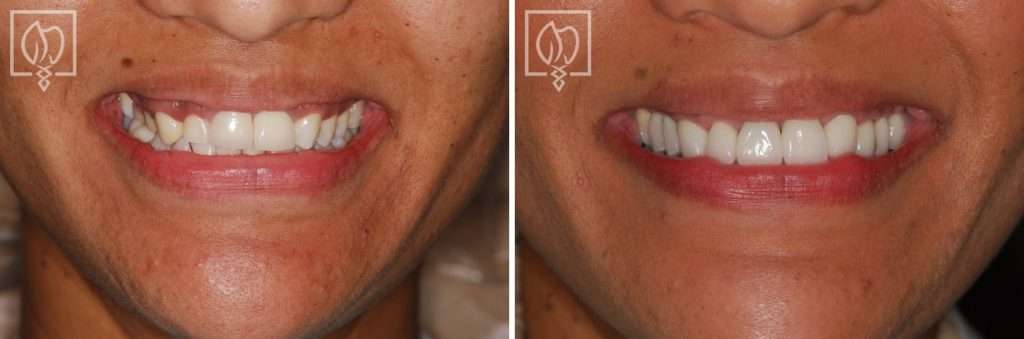
Multi-Faceted Treatment for Patient Unhappy With Her Artificial-Looking Crowns, Teeth and Gums
Many patients come to Elite Prosthetic Dentistry unhappy with the appearance of their smile. However, this particular patient presented with multiple interconnected problems that together created a smile she found deeply unsatisfying.

Salvaging Ms. N’s Severely Broken-Down Upper and Lower Teeth from Gum and Bone Disease
Many people in the U.S. suffer from extensive periodontal disease characterized by significant bone loss and shrinkage of the gum tissue. This condition can begin at a very young age and worsen quickly due to hereditary factors and lack of early diagnosis by their dentist.
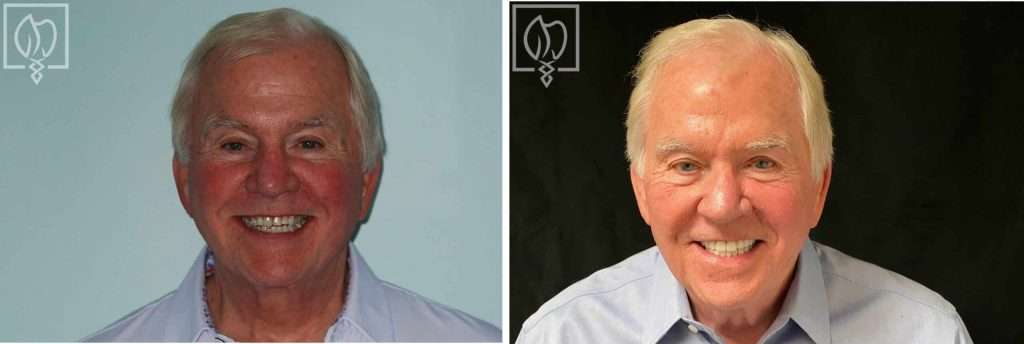
A Smile Transformation in Just Four Months: A Patient’s Dental Crown Restoration for a TV Series
A patient with dental crowns that were in poor shape was going to appear on a streaming video series on a major TV network that was scheduled to begin filming soon. Our patient, John, an author about to embark on a book tour, was anxious as his teeth were not up to his standards to appear on television.
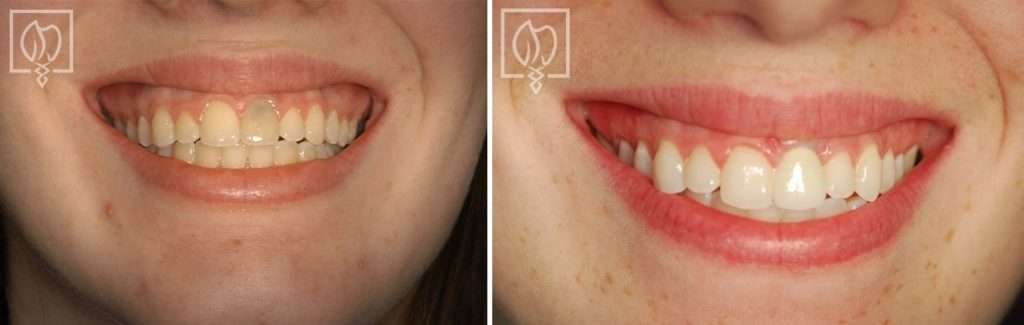
Replacing a Discolored Front Tooth with a Precision Placed Implant
Some of the most challenging restorations occur when fabricating an anterior crown to fit on an implant. Not only does one have the difficulty of matching the single front tooth to the other ones in the high visibility zone, but the dentist must also ensure the position of the underlying implant is precise through accurate preplanning and placement.
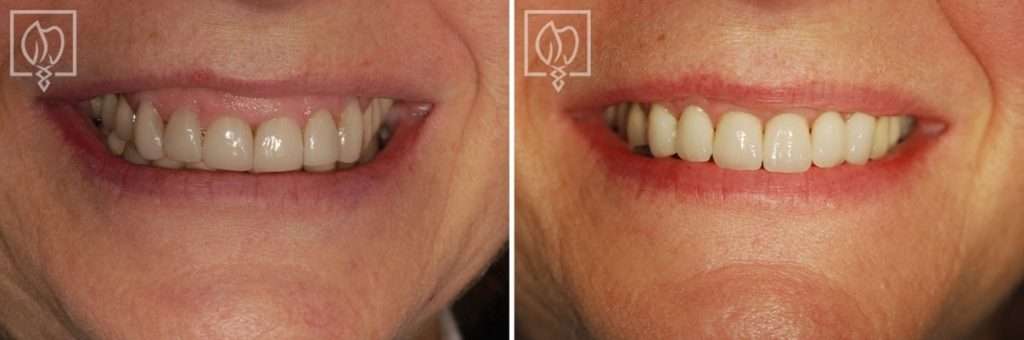
Patient Was Dissatisfied With Her 'Gummy' Smile
Excessive gingival tissue, commonly referred to as a "gummy smile," can significantly impact the appearance of a person's smile and their self-confidence. When someone smiles and a large amount of gum tissue is visible above the teeth, it can create the perception that the teeth are too small or short, even when they are actually normal size.
Crown and Bridge Problems: Diagnosis and Expert Repair Near You
Dr. Gerald Marlin provides crown and bridge problems: diagnosis and expert repair services to patients throughout the Washington, DC metropolitan area. Select your community to learn more.
Ready to Transform Your Smile?
With 40+ years of experience and 3,900+ dental implants placed, Dr. Gerald Marlin delivers results that last. Schedule your consultation today.