
Veneer Problems
A prosthodontist's evaluation of your failing veneers goes deeper than surface inspection. We examine preparation design, bonding integrity, porcelain composition, margin sealing, and underlying tooth health under magnification. We diagnose why your veneers failed, not just what is wrong. That clarity guides the right solution forward.
Patients from Bethesda, Potomac, Chevy Chase, McLean, Arlington, Fairfax, and surrounding communities often come to our Washington, DC office for veneer second-opinion evaluations.
Elite Prosthetic Dentistry
Specialist Prosthodontic Practice · 40+ Experience
A specialist evaluation identifies the cause, determines what can be preserved, and outlines the most effective path forward for your smile.
Signs Your Veneers Need a Specialist Evaluation
If you notice any of these issues, a prosthodontist evaluation is warranted. Early intervention prevents further damage and expands your treatment options.
Debonding or Falling Off
One or more veneers have separated from the tooth or completely detached. This is a sign of bonding protocol failure or preparation inadequacy.
Chipping or Cracking
The veneer has chipped, cracked, or fractured. While porcelain is strong, cracks compromise integrity and are visible to the eye.
Color Changes or Staining
The veneer has become discolored, yellowed, or stained. This indicates margin breakdown or underlying material degradation.
Gaps Appearing at Margins
You notice visible spaces where the veneer meets the natural tooth. This opens the door to decay and staining.
Gum Recession Exposing Edges
Gum recession has exposed the margin line or the underlying tooth. This is cosmetically unacceptable and requires professional evaluation.
Overall Aesthetic Dissatisfaction
Your veneers do not look natural, do not match your other teeth, or simply do not feel right. You deserve to be satisfied with your smile.
What a Prosthodontist Evaluates About Your Veneers
Bonding Integrity Under Magnification
We use a microscope to examine how well the veneer is bonded to the underlying tooth. We look for gaps, voids, or areas of separation. We test the integrity by gentle pressure to see if there is any flexing or movement. A proper bond creates a monolithic unit where the veneer and tooth move as one. A compromised bond is the fastest path to failure.
Preparation Design Quality
We evaluate how the underlying tooth was prepared. A poor preparation is too deep, too shallow, has sharp angles instead of rounded line angles, or removes tooth structure asymmetrically. The preparation depth should be 0.5 mm to 1 mm, with proper contours that support the veneer. Over-preparation removes too much tooth; under-preparation creates a thick, unnatural veneer.
Porcelain Thickness and Material Type
We assess whether the veneer is the correct thickness, typically 0.7 mm to 1 mm. We examine the porcelain composition and quality. High-quality feldspathic or lithium disilicate porcelain is more durable and more natural-looking than lower-grade ceramics. Some veneers are too thick, creating a bulky, artificial appearance. Others are too thin and prone to chipping.
Occlusal Interference and Bite Mechanics
We examine how your bite contacts the veneer. If the bite lands on the veneer edge rather than distributing force across the tooth, the veneer will chip or debond. We assess whether you grind or clench your teeth at night (parafunction), which creates shear forces that exceed the bond strength. If parafunction is present, nightguard use is mandatory for longevity.
Margin Seal and Leakage
We examine the margin, which is the edge where the veneer meets the natural tooth. This is where 90% of veneer failures begin. A poor margin allows bacteria and oral fluids to infiltrate, causing decay in the underlying tooth, discoloration, and eventual debonding. A proper margin should be subgingival (just below the gum line), smooth, and perfectly sealed.
Underlying Tooth Health
We examine the tooth beneath the veneer using radiographs and clinical examination. Is there decay? Is the tooth healthy or compromised? Has the veneer been on so long that the underlying tooth has darkened? We assess whether the tooth structure is sound enough to support a new veneer, or whether more invasive treatment (like a crown) is needed.
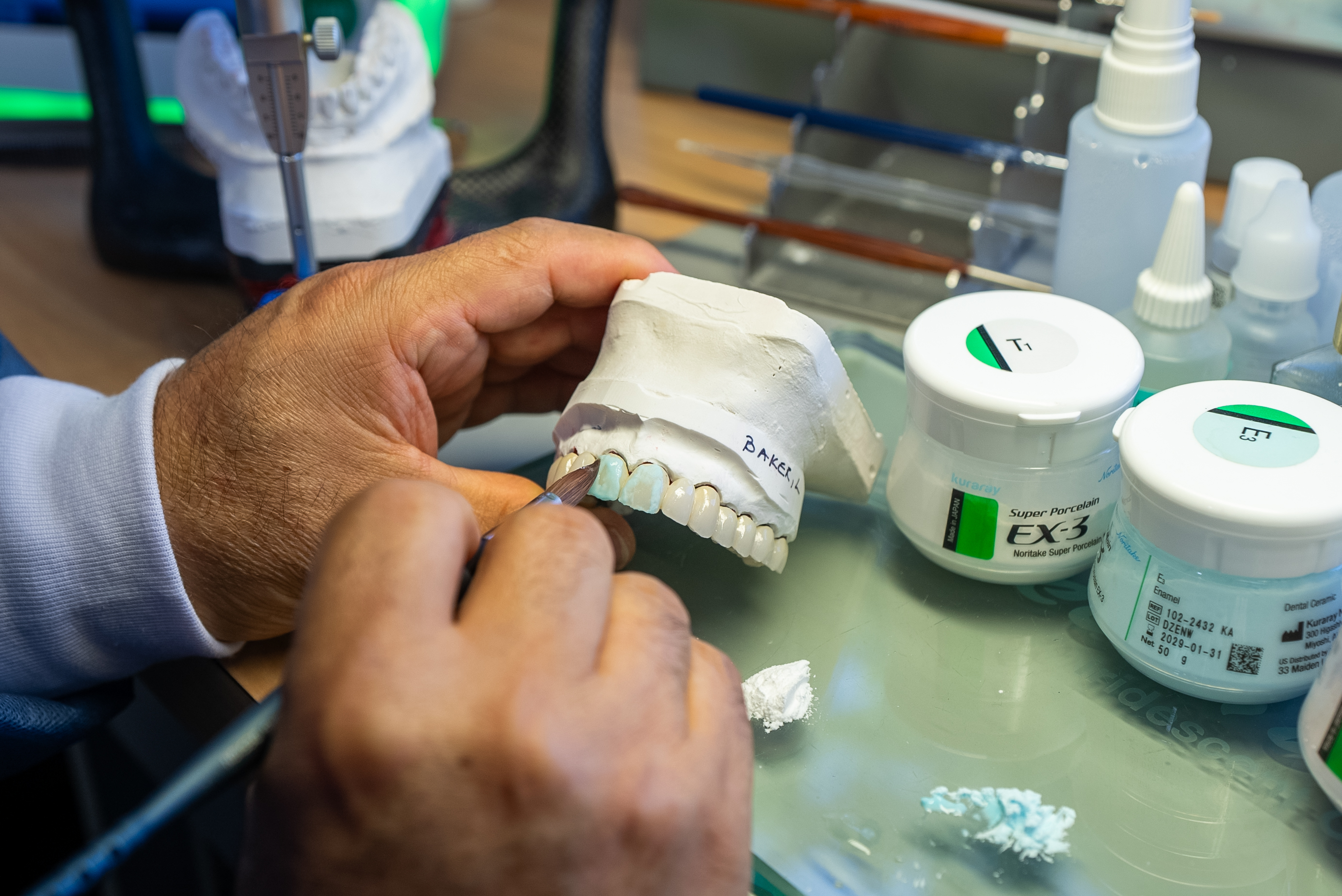
Expert Hands, Premium Standards
Dr. Gerald Marlin personally oversees every veneer case from diagnosis through delivery. Our in-house lab allows us to maintain complete control over preparation, fabrication, margin finishing, and bonding. When you have veneers replaced or repaired, you benefit from direct prosthodontist oversight and customized laboratory work tailored to your specific case.
Each veneer is custom-built with precision margins, optimal thickness, and porcelain composition selected for your bite and esthetics. If adjustments are needed after try-in, we remake it same-day. This level of control is why our veneer replacement cases resolve long-standing problems.
Common Veneer Problems
Veneer Fell Off
Your veneer has completely debonded or separated from the tooth. Learn why this happens and your repair options.
View Solutions →Chipped or Cracked Veneers
A visible chip or crack in your veneer. Find out if repair is possible or replacement is necessary.
View Solutions →Veneer Discoloration
Your veneer has yellowed, stained, or changed color. Understand the causes and your replacement options.
View Solutions →Gaps and Gum Recession
Visible gaps or dark lines at the veneer margins and receding gums exposing edges. Explore your options.
View Solutions →Looking for comprehensive veneer information and care?
Visit our Porcelain Veneers Service Page →Why Veneers Fail: The Technical Reasons
Veneer failure is almost never random. Every failure has a root cause, and understanding it prevents repeat failure. The reasons break down into predictable categories: material selection, preparation technique, bonding protocol, bite mechanics, and lab quality. When any of these is compromised, the clock starts ticking toward failure.
Porcelain vs. Composite and Material Degradation
High-quality feldspathic or lithium disilicate porcelain veneers can last 10 to 15 years or longer. Composite resin veneers applied directly to the tooth typically last only 3 to 5 years before they stain, chip, or wear. Material quality plays a significant role in veneer longevity and appearance. Higher-grade ceramics and modern materials tend to produce more durable and natural-looking results. If your veneers failed sooner than expected, the material selection may be worth evaluating.
Preparation Depth and Design Errors
Over-preparation removes too much healthy tooth and compromises structural integrity. The result is a thick, bulky veneer that looks unnatural and does not bond well. Under-preparation creates a thin preparation that cannot support a veneer, leading to fracture under bite forces. Poor preparation angles (sharp corners instead of rounded line angles) create stress concentration points where failure initiates. Asymmetrical preparation that removes more tooth on one side creates uneven stress distribution and failure on the over-prepared side.
Bonding Protocol Errors
A proper veneer bond requires meticulous attention to moisture control, surface preparation, and adhesive selection. Moisture contamination during cementation is the most common cause of early debonding. If saliva or blood contacts the prepared tooth surface after etching, the bond is compromised before the veneer is even seated. Poor etching technique, inadequate etchant time, or rinsing with contaminated water all weaken the bond. A modern bonding system combined with careful moisture isolation produces bonds designed to last. When bonding protocols are not fully optimized, veneer retention can be affected over time.
Occlusal Forces and Parafunctional Habits
Veneers are not designed to absorb heavy bite forces. If your bite is heavy, or if you grind your teeth at night (bruxism) or clench during the day, the shear forces exceed the veneer's bond strength. Many veneer failures are caused by undiagnosed grinding. Protective nightguards are mandatory for patients with parafunctional habits. Without one, even perfectly placed veneers will fail. If you are a grinder or clencher and your previous veneers failed, this was likely the cause.
Lab Quality and Fabrication Standards
Laboratory quality and standards vary across the industry. Our in-house lab maintains strict quality controls to ensure precise margins, correct thickness, flawless porcelain, and excellent esthetics. We evaluate every veneer under magnification, adjust it if needed, and ensure it meets our standards before cementation.
In-House Lab Precision for Veneer Work
Custom Shade Layering
Our lab technicians custom-build each veneer with multiple layers of porcelain, each tinted to the exact shade you need. This creates depth, translucency, and a natural appearance that off-the-shelf veneers do not typically achieve.
Try-In Appointments
Before cementing your veneers, we fit them to your teeth and let you see them in your mouth. You can request adjustments to shade, shape, or translucency. Once you are satisfied, we cement them permanently.
Same-Day Adjustments
If a veneer needs adjustment after cementation, our lab is in-house. We can modify, polish, or adjust your veneer the same day. No waiting for a lab turnaround. Your satisfaction comes first.
Why Our In-House Lab Matters for Veneer Replacement
- + We control preparation-to-delivery timeline. No delays waiting for an outside lab.
- + We maintain consistent quality standards across every veneer we place.
- + We can remake a veneer same-day if the shade or fit is not perfect on try-in.
- + We build every veneer to our exacting specifications, not a lab technician's standard.
- + We use premium porcelain and materials, not commodity ceramics.



Frequently Asked Questions
Why do my veneers keep falling off?
Can chipped veneers be repaired or do they need replacement?
How long should porcelain veneers last?
Why have my veneers changed color?
Is it normal to see a dark line at the edge of my veneer?
Can you replace veneers placed by another dentist?
What is the difference between porcelain and composite veneers?
Get Clarity on Your Veneer Situation
A specialist's comprehensive evaluation provides clarity about what happened with your veneers, answers your questions, and outlines a clear path forward. Whether your veneers have failed, chipped, or changed color, or if they simply do not feel right, our evaluation can help you understand your options.
No pressure. Clear answers. A defined plan.
Interested in sedation dentistry? Learn about our sedation options.