
Second Opinion on Botched or Unsatisfactory Cosmetic Dentistry
Your instinct that something is wrong with your smile is valid. Whether your cosmetic dentistry looks fake, the color does not match, or the proportions feel off, a specialist prosthodontist's evaluation can identify what went wrong and show you how to correct it.
Elite Prosthetic Dentistry
Specialist Prosthodontic Practice · 40+ Experience · In-House Lab Since 1985
97%
Cosmetic Success Rate
35+ years
Crown Longevity
1000+
Smile Makeovers
39+
Years Cosmetic Focus
Signs Your Cosmetic Dentistry Needs Evaluation
These symptoms indicate that your cosmetic work may not have achieved the result you expected. Do not dismiss these concerns.
Teeth Look Fake or Bulky
Your new restorations appear oversized, unnatural, or too thick. The contours lack the subtle variation of natural teeth. People may comment that your teeth look "fake" or "too bright."
Shade Does Not Match
Your new crowns or veneers are noticeably whiter, yellower, or a different tone than your natural teeth. The shade looks flat and lifeless rather than having the depth and translucency of natural tooth structure.
Asymmetric Gum Line
The gum line around your new teeth is uneven or one tooth sits higher or lower than it should relative to the adjacent teeth. When you smile, the gum architecture looks unnatural.
Smile Does Not Match Your Face
Your new smile does not complement your facial proportions, lip shape, or skin tone. The teeth seem to exist in isolation from the rest of your face rather than harmonizing with your overall appearance.
Restorations Feel Heavy or Uncomfortable
Your new teeth feel thick in your mouth. You are hyperaware of them when eating or speaking. The thickness affects your comfort or changes how you speak.
General Dissatisfaction
You avoid smiling in photos, cover your mouth when laughing, or feel regret about the cosmetic work you had done. You expected to feel confident but instead feel disappointed.
Why Cosmetic Dentistry Goes Wrong
Cosmetic dentistry failures are rarely due to malice. They result from inadequate planning, technical limitations, or provider expertise gaps. Understanding the root cause is essential to preventing the same mistake again.
Diagnostic Wax-Up Skipped
Many cosmetic cases proceed directly to tooth preparation and crown fabrication without first prototyping the result on a model. This means the patient never approved the planned shape, shade, and contour before treatment. The restoration arrives as a surprise. If the surprise is unwelcome, extensive redoing may be necessary. Proper cosmetic dentistry always includes a diagnostic wax-up that the patient sees and approves in advance.
Patient Communication Failure
The dentist did not thoroughly discuss what the final result would look like, or did not listen to what the patient actually wanted. Cosmetic expectations are deeply personal. A patient may say "whiter teeth" and expect a specific shade that the dentist misinterprets. Without clear visual communication, both parties can end up disappointed with the result.
General Dentist Limitations
Cosmetic dentistry requires specific training in shade, form, proportion, lip dynamics, and smile design. These topics receive minimal emphasis in general dental school. A general dentist may have made crowns thousands of times but without specific cosmetic training, may not understand subtle principles that separate a natural-looking restoration from one that looks fabricated.
Commercial Lab vs. In-House Expertise
Large commercial laboratories produce hundreds of crowns per week. Ceramicists have limited time to customize each restoration. They cannot easily adjust contour or shade after try-in because the crown must be shipped back and forth. Our in-house laboratory allows direct collaboration between Dr. Marlin and our ceramicist. We adjust restorations on the spot during try-in and delivery.
Bite Mechanics Not Considered
Cosmetic restorations must function properly in the patient's bite. If the new crowns are positioned too far forward, too thick, or in an incorrect occlusal plane, they feel wrong in the mouth and may contribute to discomfort or accelerated wear. Cosmetic and functional considerations must align.
Insufficient Tooth Preparation Planning
The amount of tooth structure that must be removed to place a crown is determined during treatment planning. If the dentist removes too much tooth to create a substructure that is too thick, the resulting crown will look bulky. If not enough is removed, the restoration will be undersized. Proper preparation requires careful planning and execution to allow the lab to fabricate a natural-looking restoration.
These failures are not inevitable. Proper planning, patient communication, specialist expertise, custom laboratory work, and attention to both aesthetics and function prevent cosmetic disappointment. That is exactly how we approach cosmetic dentistry at Elite.
Our Framework for Cosmetic Evaluation
A prosthodontist evaluates cosmetic dentistry using specific clinical criteria. We do not guess. We measure and analyze.
Shade Analysis
We evaluate your tooth shade under natural light, office light, and with standard shade tabs. We compare the shade of your restoration to your natural adjacent teeth and measure whether the restoration matches or stands out. We assess whether the shade is too bright, too dull, too yellow, or too gray. We consider how shade appears in different lighting conditions. A natural-looking restoration should be indistinguishable from natural tooth color in all lighting.
Proportion and Dimension Analysis
We measure the width and length of your teeth relative to each other and to your face. We evaluate whether individual tooth dimensions are appropriate for your face size, gender, and age. We assess incisor edge position and contact points. Natural teeth have proportions that follow mathematical relationships. Restorations that deviate significantly appear artificial. We use visual assessment, reference guides, and digital analysis to evaluate these relationships.
Symmetry and Alignment Assessment
We evaluate whether your teeth are aligned with the midline of your face. We assess the parallelism of the incisal plane to your interpupillary line. We examine whether the gum line is level and whether gum height is symmetric from tooth to tooth. We evaluate the symmetry of your smile arc (how the curvature of your teeth relates to your lower lip). Asymmetry creates visual discord even if each tooth is technically correct in isolation.
Gingival Architecture Evaluation
We examine the shape and contour of the gingival tissues around your restorations. We look for abnormal papilla height, scalloping that is too pronounced or too flat, or contour that does not follow the shape of the underlying teeth. We assess whether the gum margin is positioned correctly relative to the restoration. Poor gingival architecture makes even well-proportioned teeth look unnatural because the support tissue is wrong.
Lip Dynamics and Smile Analysis
We evaluate how your teeth relate to your lips at rest and during smiling. We assess the buccal corridors (the spaces between your teeth and lips when you smile), the smile arc (the relationship between your upper teeth and lower lip curve), and the display of your teeth in different expressions. Restorations that are positioned too far forward, too bulky, or in the wrong vertical position disrupt natural lip dynamics and feel uncomfortable.
Surface Texture and Translucency Assessment
We examine the surface texture and light reflection properties of your restorations. Natural teeth have subtle surface texture and translucency, particularly at the incisal edge. Restorations that are too smooth, too glossy, or uniformly opaque lack the light-reflecting properties of natural teeth and appear fabricated. We evaluate whether the restoration captures the subtle translucency that gives natural teeth their depth and vitality.
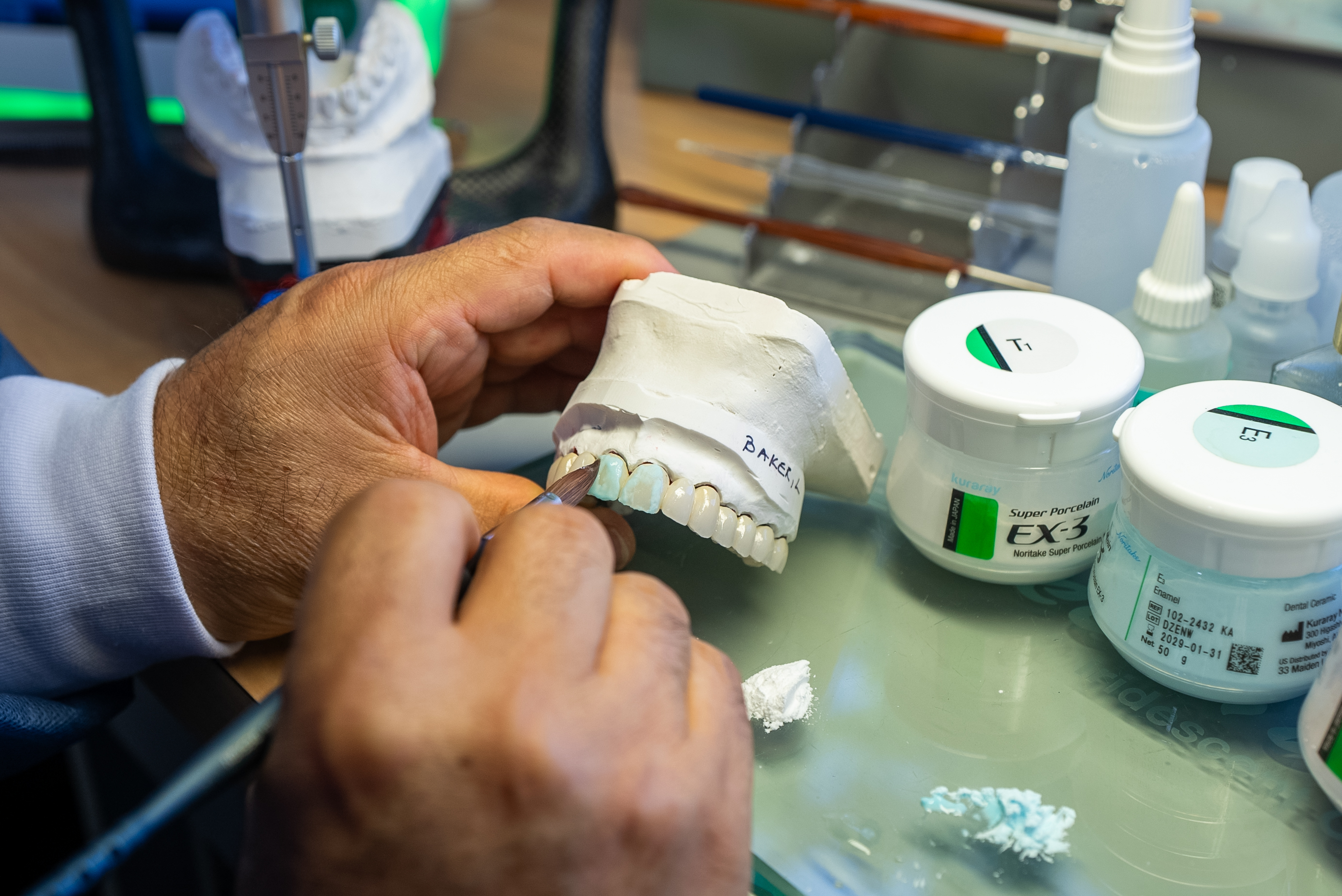
Laboratory Excellence Drives Cosmetic Success
The quality of your cosmetic dentistry depends entirely on the laboratory that fabricates it. Elite Prosthetic Dentistry has maintained an in-house laboratory since 1985, allowing Dr. Marlin to work directly with our ceramicists on every case.
Unlike commercial laboratories that process hundreds of crowns per week, our in-house team customizes every restoration. We adjust shade, contour, and texture until the result is indistinguishable from natural teeth. If your current cosmetic dentistry disappoints you, it likely came from a commercial lab. When you choose Elite for corrective work, you gain direct laboratory oversight and the ability to refine every detail.
Learn about our laboratory advantage →Smile Transformations by Elite Prosthetic Dentistry
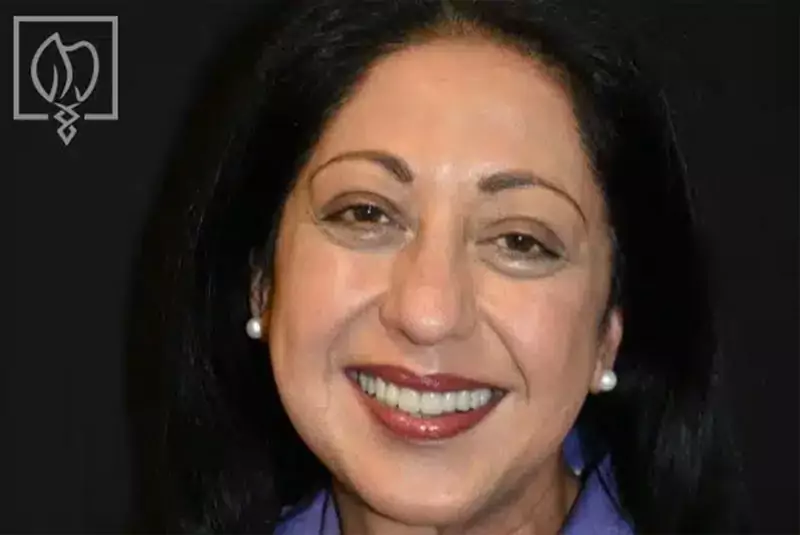
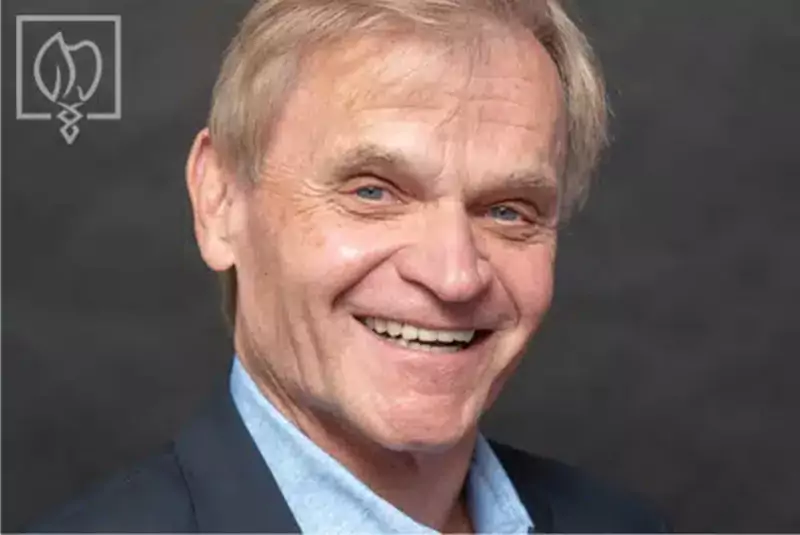
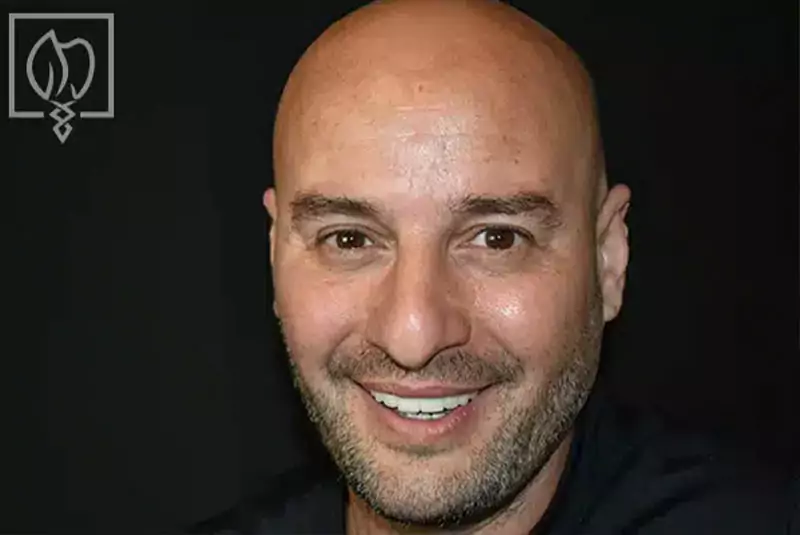
When cosmetic dentistry is done right, the result is a natural, confident smile that transforms how you feel about yourself. These cases show what proper planning, specialist expertise, and quality laboratory work achieve.
Related Second Opinion Services
Cosmetic dentistry failures often connect to larger restorative issues. Explore related evaluations that may apply to your situation.
Failed Smile Makeover
Comprehensive cosmetic rehabilitation that did not achieve the intended result. We evaluate what went wrong with the overall smile design.
Get a second opinion →Fake Looking Teeth
Restorations that do not look natural. We provide detailed feedback on what makes them appear artificial and how to correct it.
Get a second opinion →Unhappy With Dental Work
General dissatisfaction with restorative or cosmetic dentistry. We help identify the specific issues driving your dissatisfaction.
Get a second opinion →Ultimate Smile Makeover
If your cosmetic dentistry needs correction, see how a properly planned smile makeover transforms your appearance.
Learn more →Porcelain Veneers DC
Properly designed and fabricated veneers are a powerful tool for cosmetic transformation. Explore proper veneer placement.
Learn more →In-House Laboratory Advantage
Discover how our in-house laboratory since 1985 ensures superior cosmetic results and quality control for every restoration.
Learn more →Our In-House Laboratory Difference
The quality of your cosmetic dentistry depends directly on the laboratory that fabricates it. Elite Prosthetic Dentistry has maintained an in-house dental laboratory since 1985. This is not a manufacturing choice made for profit margin. It is a commitment to quality control that external laboratories cannot match.
Direct Communication
Dr. Marlin works directly with our ceramicists. We discuss each case, review tooth shade under the same lighting, and make real-time decisions about contour and finish. This level of collaboration is impossible with remote commercial labs.
Custom Shade Modification
If a restoration does not match perfectly on try-in, we adjust the shade in-house. We do not ship it back and forth. We do not settle for close enough. Our ceramicist refines the shade until it is indistinguishable from natural teeth.
Contour and Surface Customization
After try-in, if the contour or surface texture needs adjustment, we make those changes immediately. We adjust incisal edges, surface texture, and marginal fit. Commercial labs cannot offer this level of post-fabrication customization.
Quality Control
Our ceramicists are not processing hundreds of crowns per week. They focus on excellence. Every restoration is reviewed for margin fit, contact point position, occlusal anatomy, and aesthetic naturalness before delivery.
Material Knowledge
Our lab team understands the properties of every ceramic material we use. They know how to achieve optimal translucency, how different materials respond to light, and how to layer materials for the most natural appearance.
Urgency and Turnaround
In-house fabrication means faster turnaround. If adjustments are needed, we do not wait for shipping. We do not take time off for external lab schedules. Your restorations are completed efficiently without sacrificing quality.
If your current cosmetic dentistry disappointed you, it may have been fabricated in a commercial laboratory. When you choose Elite for corrective work, you gain the advantage of direct laboratory oversight and the ability to refine every detail until it is exactly right. That commitment to customization and quality is why our cosmetic restorations look natural and last longer.
Frequently Asked Questions About Cosmetic Dentistry Evaluation
How do I know if my cosmetic dentistry is actually botched, or if I'm just being too critical?
What makes teeth look fake rather than natural?
Can botched cosmetic dentistry be fixed, or do I need to start over?
What is a diagnostic wax-up, and why does it matter for cosmetic dentistry?
How important is the laboratory in producing natural-looking cosmetic dentistry?
What should I expect during a cosmetic dentistry second opinion evaluation?
Can the shade of my cosmetic dentistry be fixed if it is too white or does not match?
Your Smile Deserves to Look Natural
If your cosmetic dentistry disappointed you, that result is not permanent. A prosthodontist evaluation can identify exactly what went wrong and show you how to correct it. Most cosmetic failures can be addressed with proper planning, specialist expertise, and quality laboratory work. Do not settle for teeth that look fake or feel wrong.
Call or schedule online. Let us know you need a cosmetic dentistry second opinion, and we will arrange a comprehensive consultation.
We Are Your Source of Information for Every Area of Implant, Cosmetic, and Restorative Dentistry
Anxious about your visit? Learn about our sedation and comfort options.